Exam-Style Problems
⬅ Back to SubchapterNov 2004 p3 q9
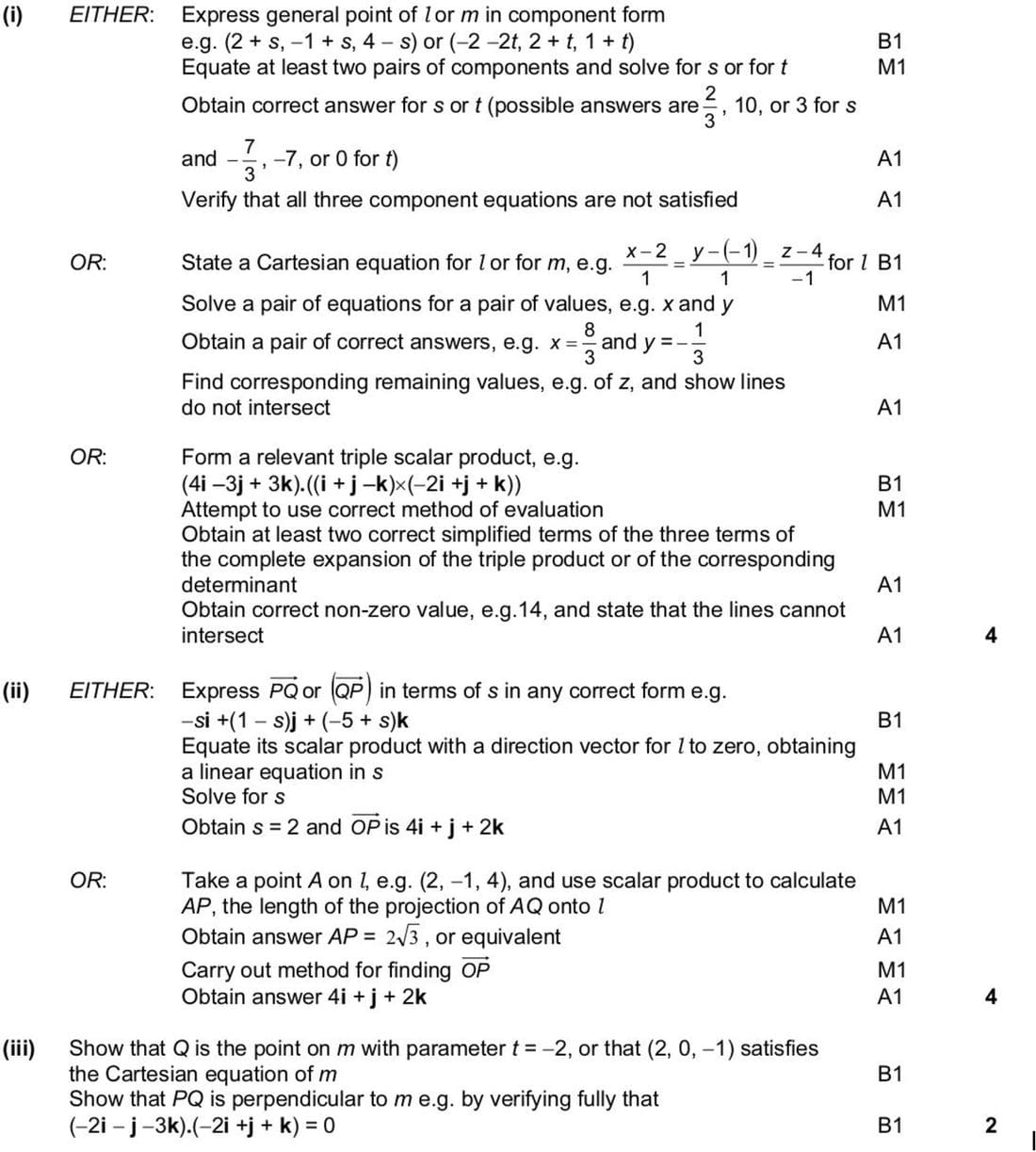
The lines l and m have vector equations
\(\mathbf{r} = 2\mathbf{i} - \mathbf{j} + 4\mathbf{k} + s(\mathbf{i} + \mathbf{j} - \mathbf{k})\)
and
\(\mathbf{r} = -2\mathbf{i} + 2\mathbf{j} + \mathbf{k} + t(-2\mathbf{i} + \mathbf{j} + \mathbf{k})\)
respectively.
- Show that l and m do not intersect.
- The point P lies on l and the point Q has position vector \(2\mathbf{i} - \mathbf{k}\). Given that the line PQ is perpendicular to l, find the position vector of P.
- Verify that Q lies on m and that PQ is perpendicular to m.
Problem 2172
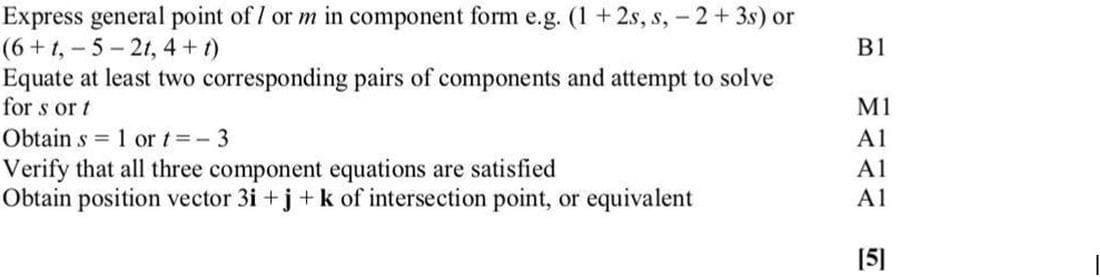
The lines l and m have vector equations
\(\mathbf{r} = \mathbf{i} - 2\mathbf{k} + s(2\mathbf{i} + \mathbf{j} + 3\mathbf{k})\)
and
\(\mathbf{r} = 6\mathbf{i} - 5\mathbf{j} + 4\mathbf{k} + t(\mathbf{i} - 2\mathbf{j} + \mathbf{k})\)
respectively.
Show that l and m intersect, and find the position vector of their point of intersection.
Nov 2002 p3 q10
With respect to the origin O, the points A, B, C, D have position vectors given by
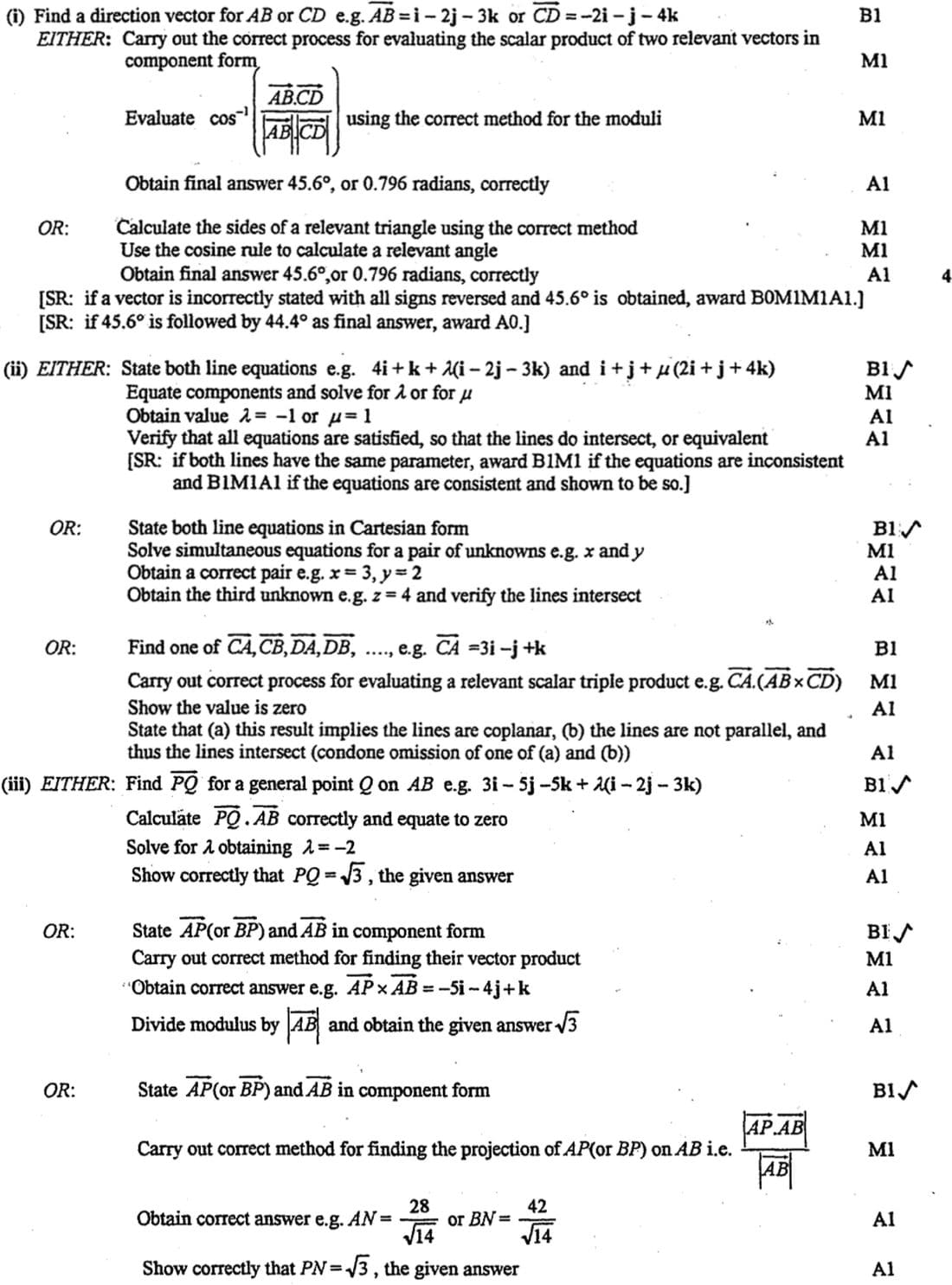
\(\overrightarrow{OA} = 4\mathbf{i} + \mathbf{k}, \quad \overrightarrow{OB} = 5\mathbf{i} - 2\mathbf{j} - 2\mathbf{k}, \quad \overrightarrow{OC} = \mathbf{i} + \mathbf{j}, \quad \overrightarrow{OD} = -\mathbf{i} - 4\mathbf{k}\)
- Calculate the acute angle between the lines AB and CD.
- Prove that the lines AB and CD intersect.
- The point P has position vector \(\mathbf{i} + 5\mathbf{j} + 6\mathbf{k}\). Show that the perpendicular distance from P to the line AB is equal to \(\sqrt{3}\).
Nov 2022 p33 q9
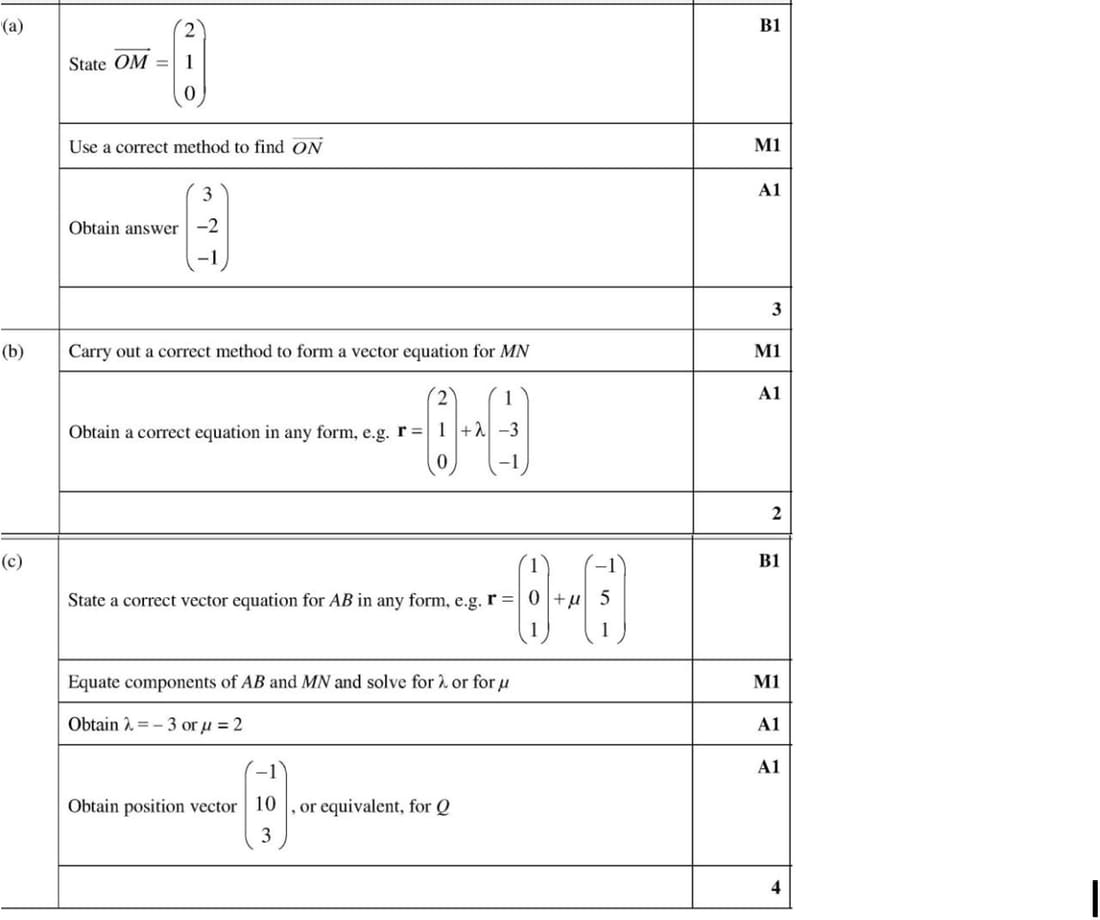
With respect to the origin O, the position vectors of the points A, B and C are given by
\(\overrightarrow{OA} = \begin{pmatrix} 0 \\ 5 \\ 2 \end{pmatrix}, \quad \overrightarrow{OB} = \begin{pmatrix} 1 \\ 0 \\ 1 \end{pmatrix} \quad \text{and} \quad \overrightarrow{OC} = \begin{pmatrix} 4 \\ -3 \\ -2 \end{pmatrix}.\)
The midpoint of AC is M and the point N lies on BC, between B and C, and is such that BN = 2NC.
(a) Find the position vectors of M and N.
(b) Find a vector equation for the line through M and N.
(c) Find the position vector of the point Q where the line through M and N intersects the line through A and B.
June 2022 p33 q9
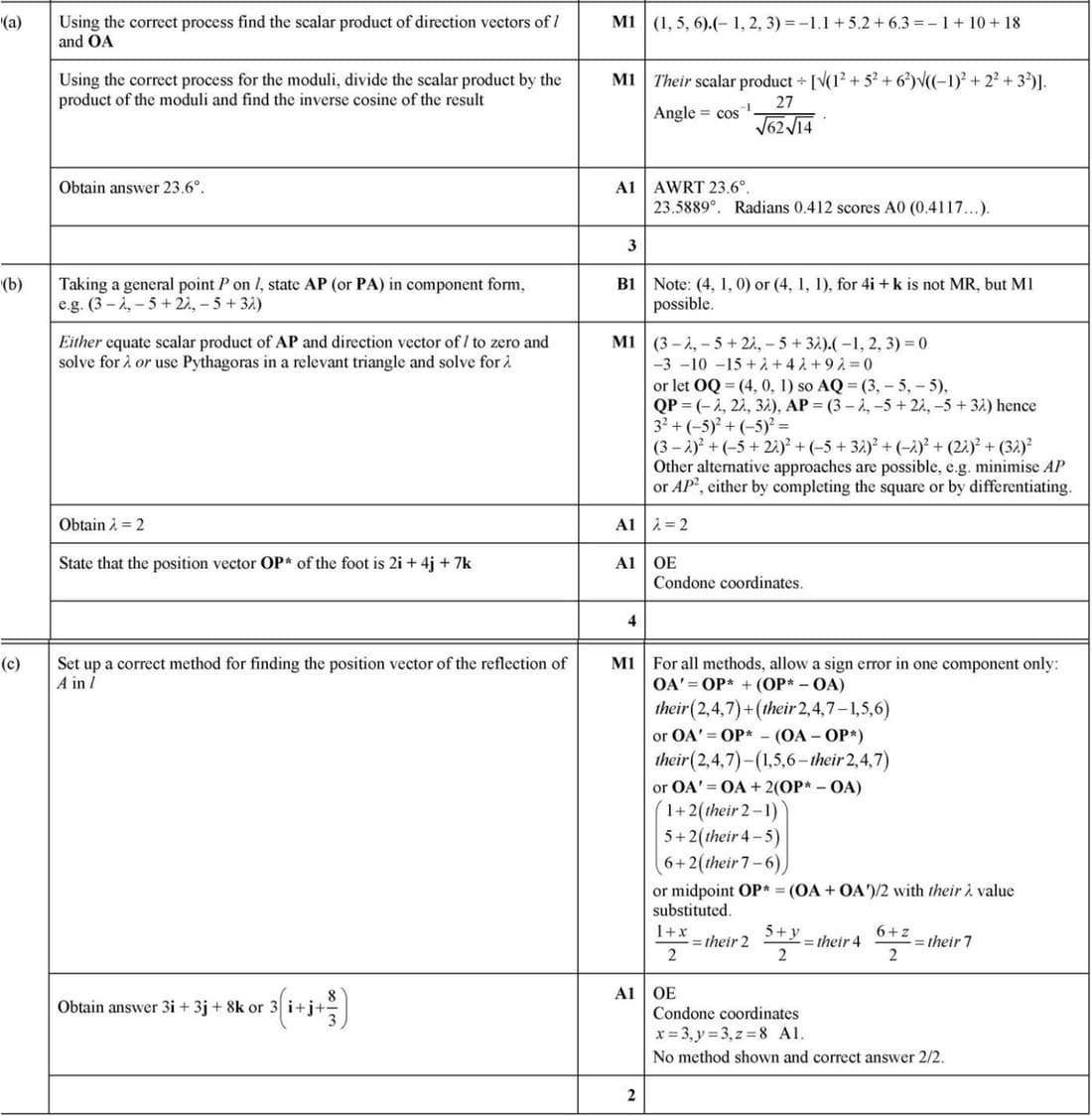
With respect to the origin \(O\), the point \(A\) has position vector given by \(\overrightarrow{OA} = \mathbf{i} + 5\mathbf{j} + 6\mathbf{k}\). The line \(l\) has vector equation \(\mathbf{r} = 4\mathbf{i} + \mathbf{k} + \lambda (-\mathbf{i} + 2\mathbf{j} + 3\mathbf{k})\).
(a) Find in degrees the acute angle between the directions of \(OA\) and \(l\).
(b) Find the position vector of the foot of the perpendicular from \(A\) to \(l\).
(c) Hence find the position vector of the reflection of \(A\) in \(l\).