Exam-Style Problems
⬅ Back to SubchapterNov 2019 p33 q10
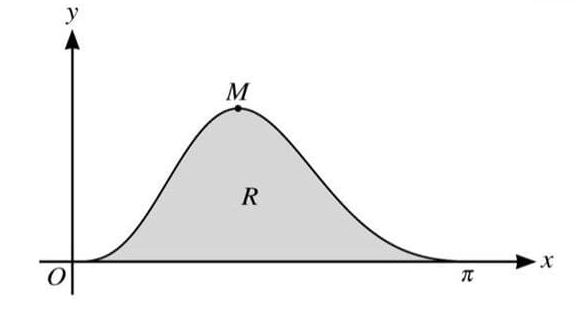
The diagram shows the graph of \(y = e^{\cos x} \sin^3 x\) for \(0 \leq x \leq \pi\), and its maximum point \(M\). The shaded region \(R\) is bounded by the curve and the \(x\)-axis.
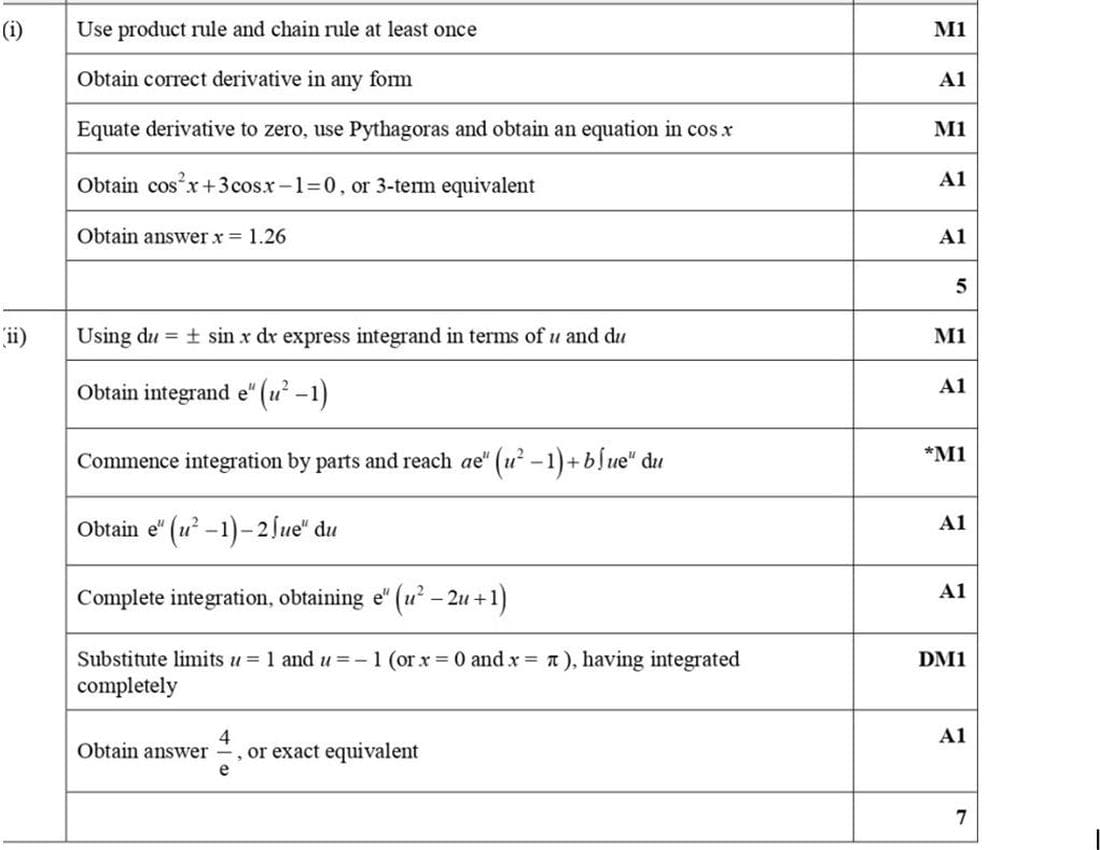
- Find the \(x\)-coordinate of \(M\). Show all necessary working and give your answer correct to 2 decimal places.
- By first using the substitution \(u = \cos x\), find the exact value of the area of \(R\).
June 2011 p31 q7
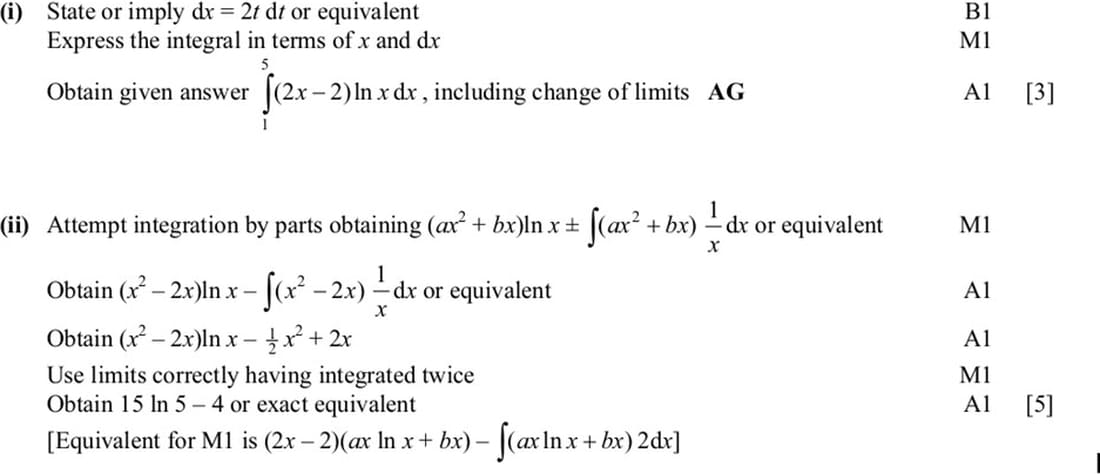
The integral \(I\) is defined by \(I = \int_0^2 4t^3 \ln(t^2 + 1) \, dt\).
(i) Use the substitution \(x = t^2 + 1\) to show that \(I = \int_1^5 (2x - 2) \ln x \, dx\).
(ii) Hence find the exact value of \(I\).
June 2002 p3 q10
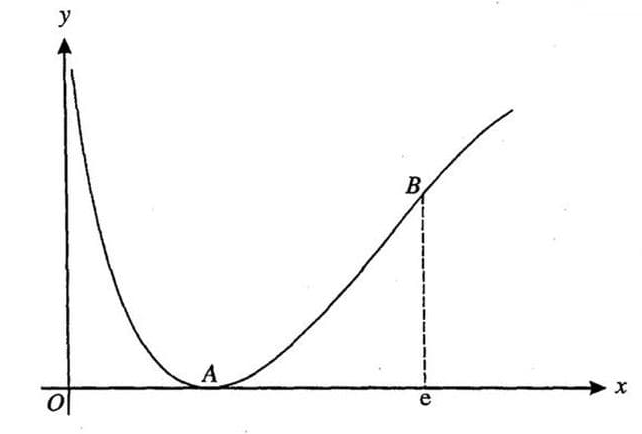
The function \(f\) is defined by \(f(x) = (\ln x)^2\) for \(x > 0\). The diagram shows a sketch of the graph of \(y = f(x)\). The minimum point of the graph is \(A\). The point \(B\) has \(x\)-coordinate \(e\).
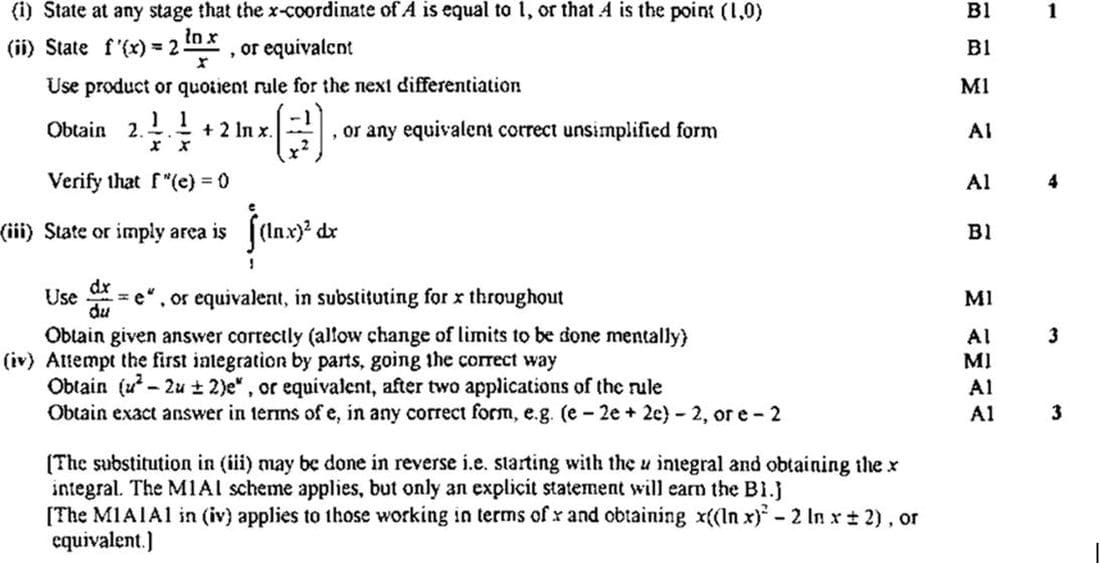
(i) State the \(x\)-coordinate of \(A\).
(ii) Show that \(f''(x) = 0\) at \(B\).
(iii) Use the substitution \(x = e^u\) to show that the area of the region bounded by the \(x\)-axis, the line \(x = e\), and the part of the curve between \(A\) and \(B\) is given by \(\int_0^1 u^2 e^u \, du\).
(iv) Hence, or otherwise, find the exact value of this area.