Exam-Style Problems
⬅ Back to Subchapter
Browsing as Guest. Progress, bookmarks and attempts are disabled.
Log in to track your work.
June 2019 p13 q8
1409
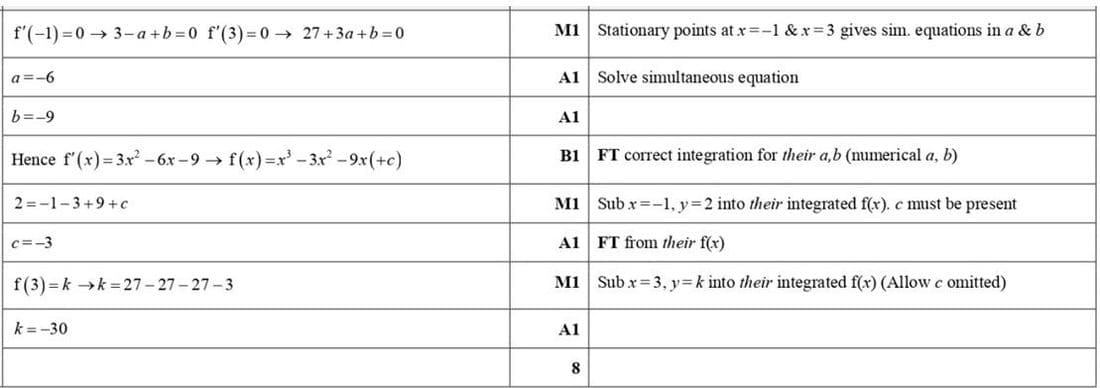
A curve is such that \(\frac{dy}{dx} = 3x^2 + ax + b\). The curve has stationary points at \((-1, 2)\) and \((3, k)\). Find the values of the constants \(a, b\) and \(k\).
Log in to record attempts.
June 2019 p11 q10
1410
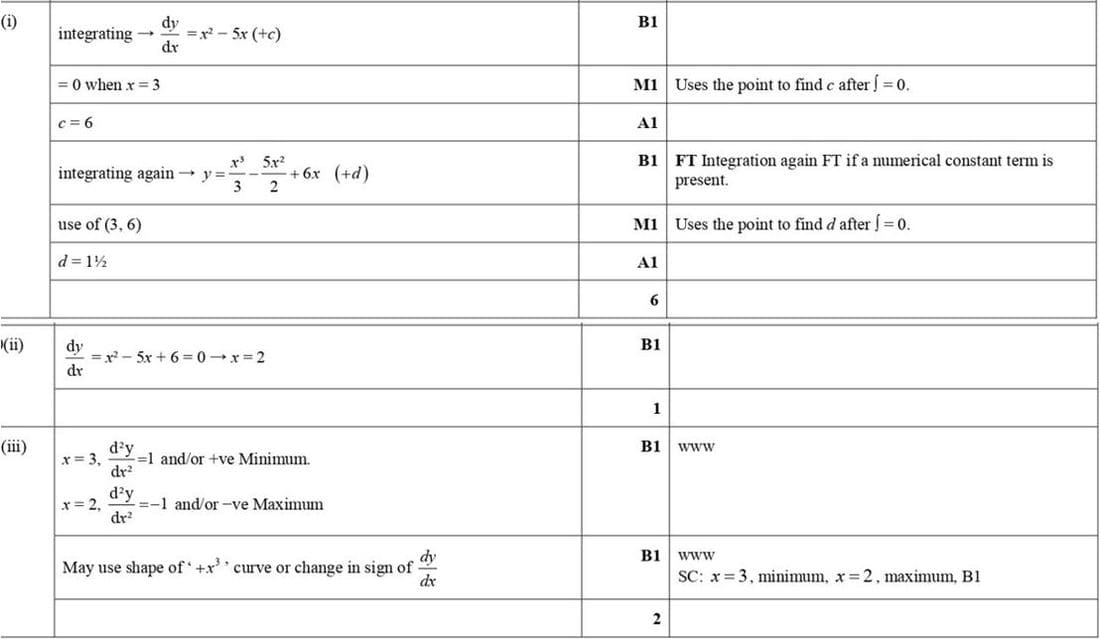
A curve for which \(\frac{d^2y}{dx^2} = 2x - 5\) has a stationary point at (3, 6).
- Find the equation of the curve.
- Find the x-coordinate of the other stationary point on the curve.
- Determine the nature of each of the stationary points.
Log in to record attempts.
Feb/Mar 2019 p12 q2
1411
A curve with equation \(y = f(x)\) passes through the points \((0, 2)\) and \((3, -1)\). It is given that \(f'(x) = kx^2 - 2x\), where \(k\) is a constant. Find the value of \(k\).

Log in to record attempts.