Exam-Style Problems
⬅ Back to SubchapterJune 2012 p12 q9
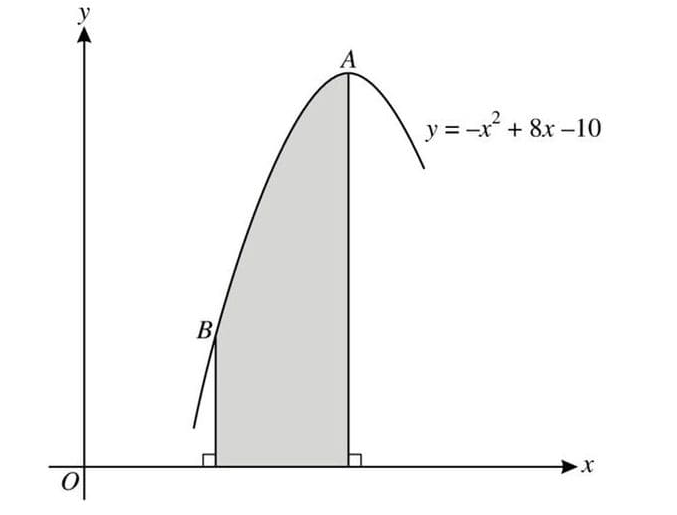
The diagram shows part of the curve \(y = -x^2 + 8x - 10\) which passes through the points \(A\) and \(B\). The curve has a maximum point at \(A\) and the gradient of the line \(BA\) is 2.
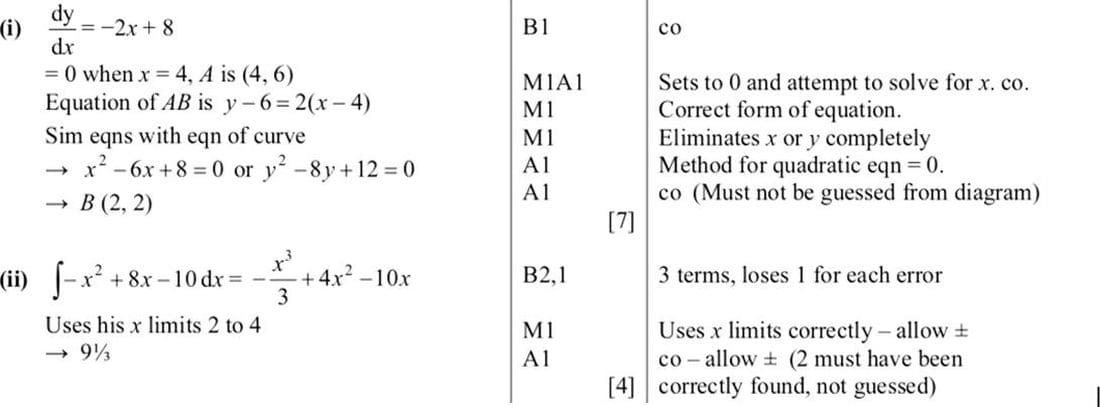
(i) Find the coordinates of \(A\) and \(B\).
(ii) Find \(\int y \, dx\) and hence evaluate the area of the shaded region.
Nov 2010 p13 q11
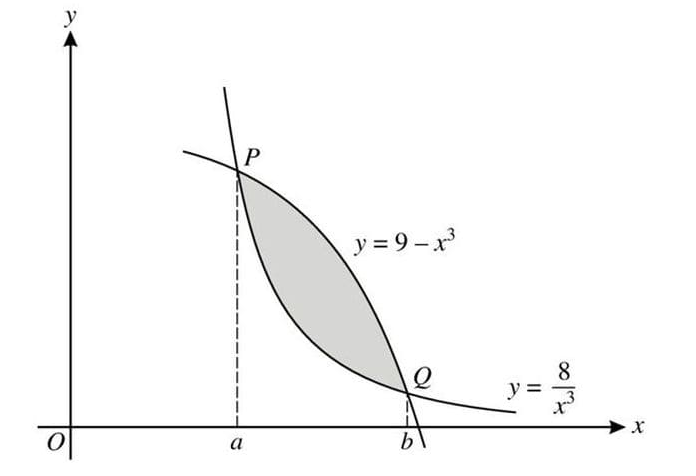
The diagram shows parts of the curves \(y = 9 - x^3\) and \(y = \frac{8}{x^3}\) and their points of intersection \(P\) and \(Q\). The \(x\)-coordinates of \(P\) and \(Q\) are \(a\) and \(b\) respectively.
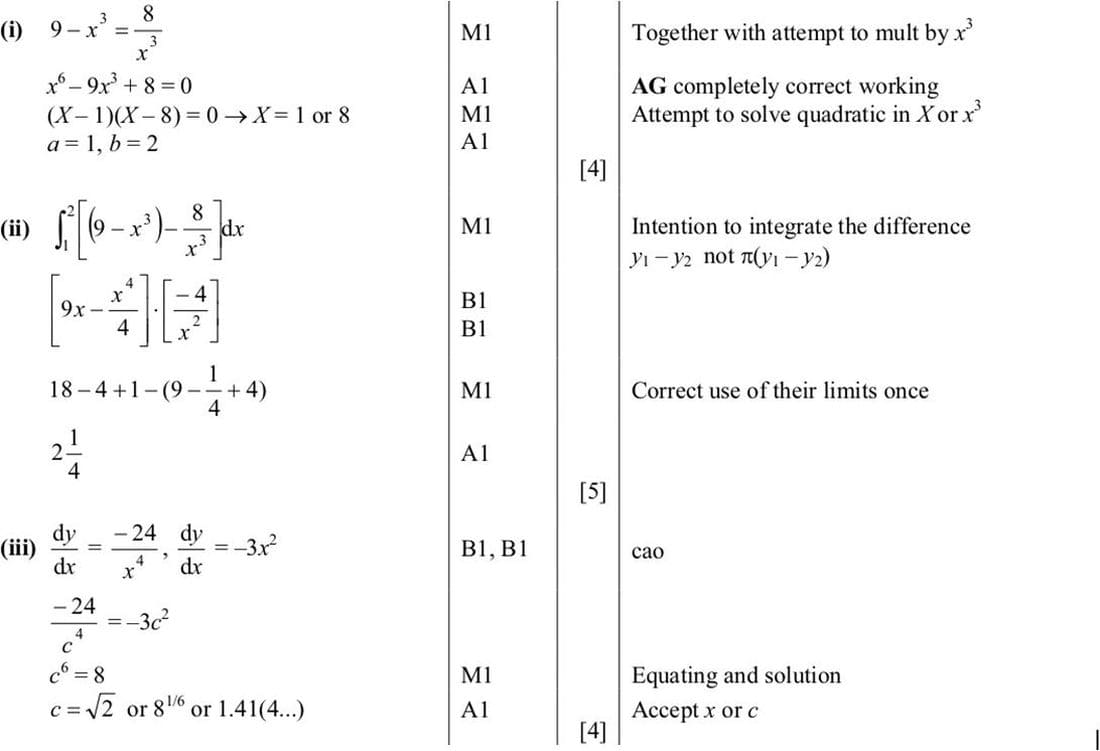
(i) Show that \(x = a\) and \(x = b\) are roots of the equation \(x^6 - 9x^3 + 8 = 0\). Solve this equation and hence state the value of \(a\) and the value of \(b\).
(ii) Find the area of the shaded region between the two curves.
(iii) The tangents to the two curves at \(x = c\) (where \(a < c < b\)) are parallel to each other. Find the value of \(c\).
June 2010 p12 q9
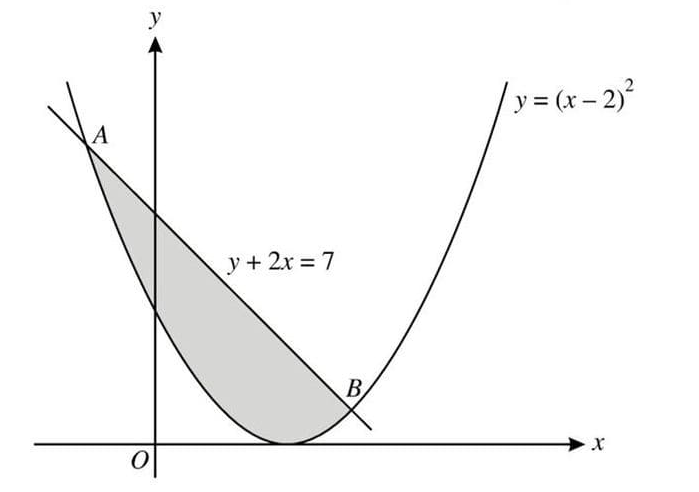
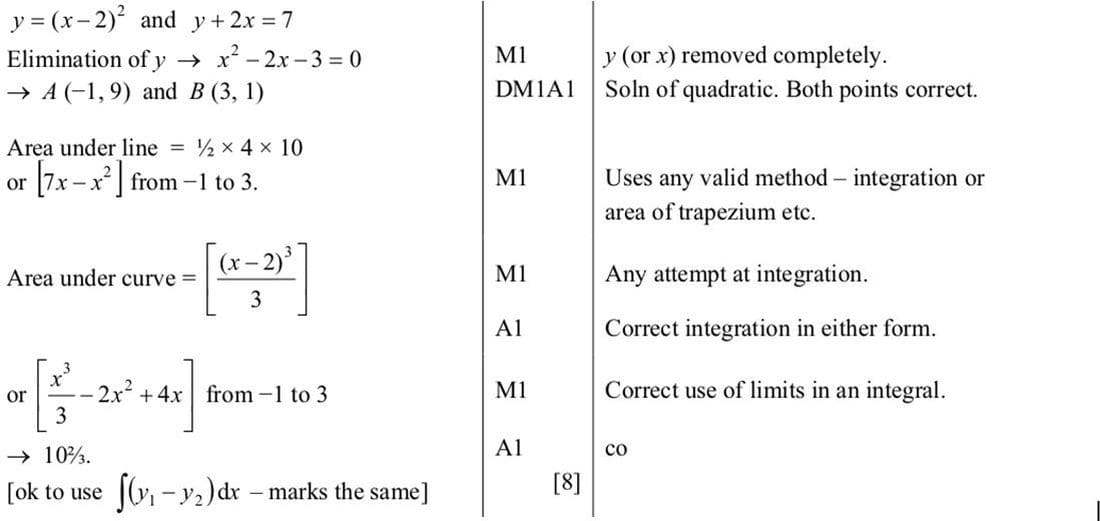
The diagram shows the curve \(y = (x-2)^2\) and the line \(y + 2x = 7\), which intersect at points \(A\) and \(B\). Find the area of the shaded region.
June 2010 p11 q4
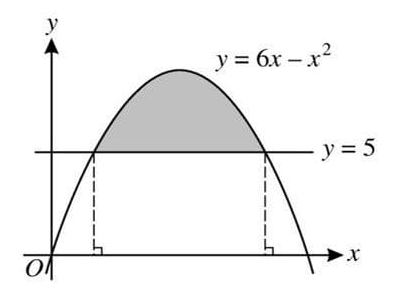
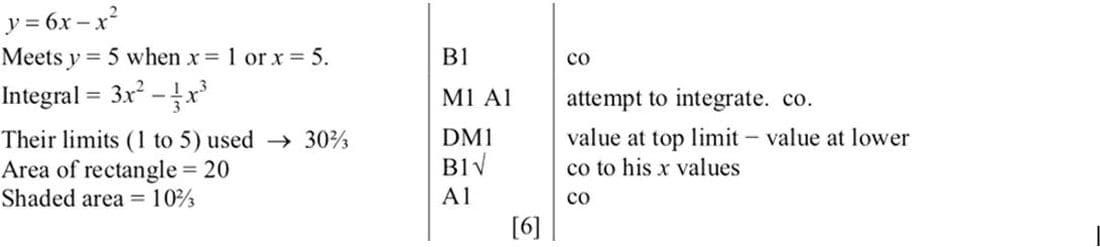
The diagram shows the curve \(y = 6x - x^2\) and the line \(y = 5\). Find the area of the shaded region.
June 2023 p12 q5
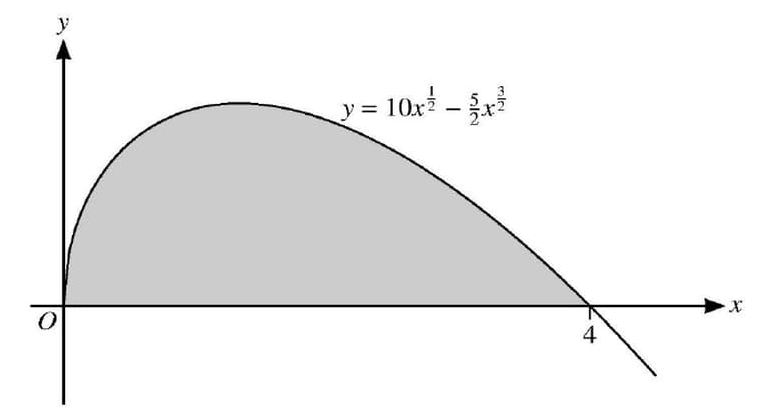
The diagram shows the curve with equation \(y = 10x^{\frac{1}{2}} - \frac{5}{2}x^{\frac{3}{2}}\) for \(x > 0\). The curve meets the x-axis at the points \((0, 0)\) and \((4, 0)\).
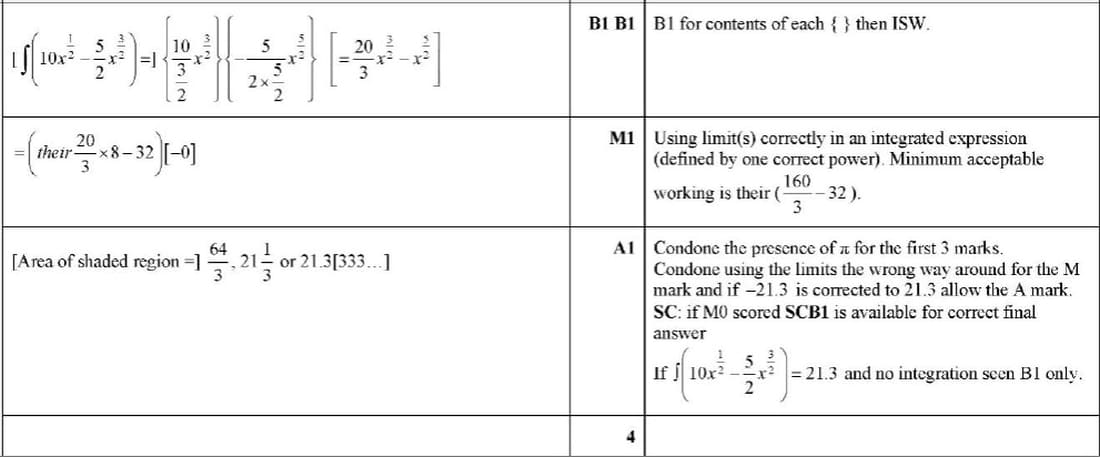
Find the area of the shaded region.