Exam-Style Problems
⬅ Back to SubchapterNov 2010 p13 q9
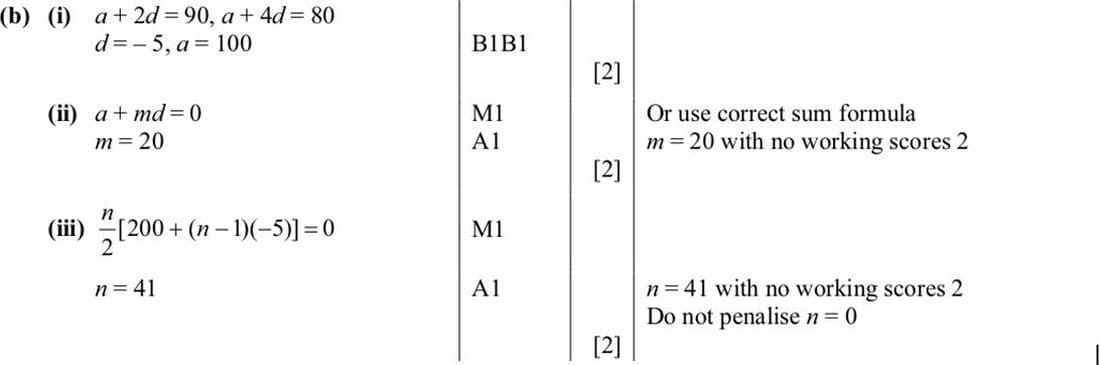
An arithmetic progression has third term 90 and fifth term 80.
(i) Find the first term and the common difference.
(ii) Find the value of \(m\) given that the sum of the first \(m\) terms is equal to the sum of the first \((m + 1)\) terms.
(iii) Find the value of \(n\) given that the sum of the first \(n\) terms is zero.
Nov 2010 p12 q5
The first and second terms of an arithmetic progression are 161 and 154 respectively. The sum of the first m terms is zero. Find the value of m.

Nov 2010 p11 q6
The fifth term of an arithmetic progression is 18 and the sum of the first 5 terms is 75. Find the first term and the common difference.

June 2010 p12 q7
Find the sum of all the multiples of 5 between 100 and 300 inclusive.

June 2022 p12 q4
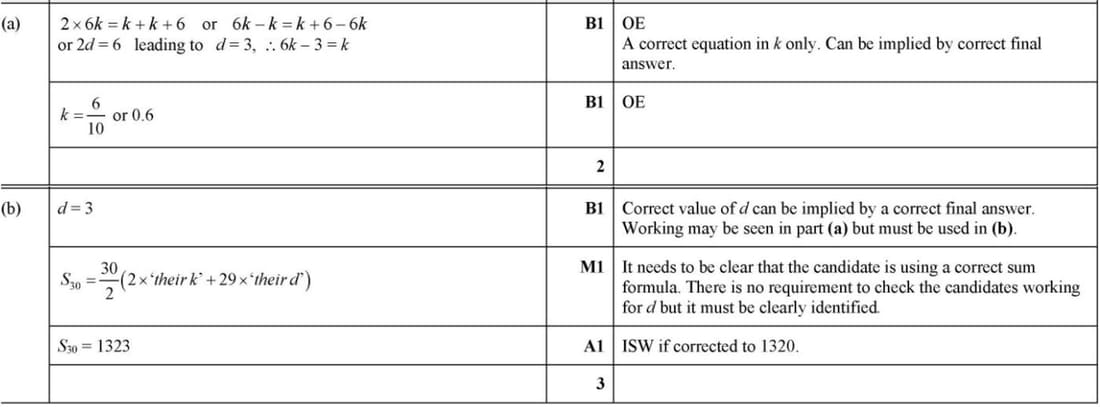
The first, second and third terms of an arithmetic progression are \(k\), \(6k\) and \(k + 6\) respectively.
(a) Find the value of the constant \(k\).
(b) Find the sum of the first 30 terms of the progression.