Exam-Style Problems
⬅ Back to SubchapterProblem 707
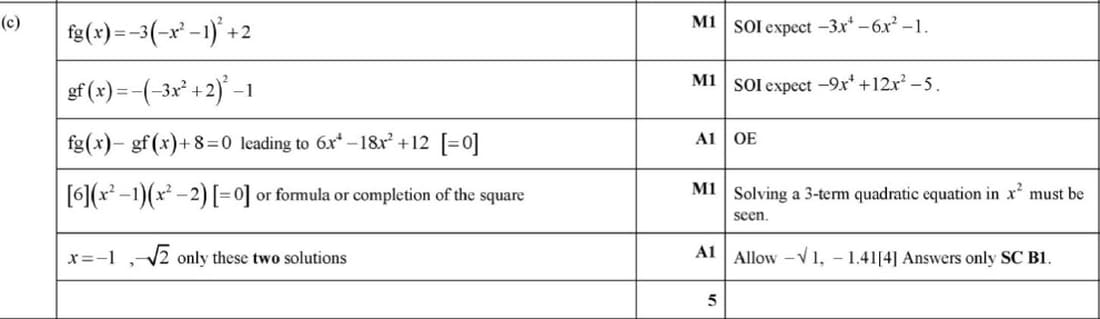
\(The function f is defined by f(x) = -3x2 + 2 for x ≤ -1.\)
\(The function g is defined by g(x) = -x2 - 1 for x ≤ -1.\)
\(Solve the equation fg(x) - gf(x) + 8 = 0.\)
Nov 2022 p12 q9
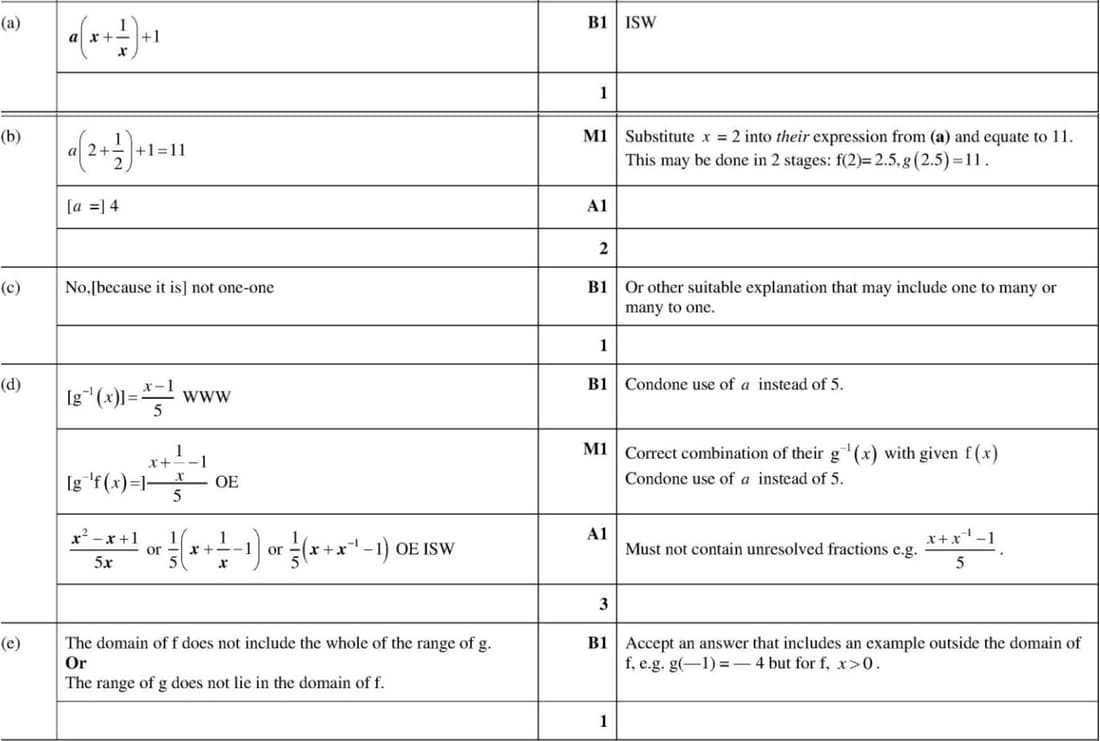
Functions f and g are defined by
\(f(x) = x + \frac{1}{x}\) for \(x > 0\),
\(g(x) = ax + 1\) for \(x \in \mathbb{R}\),
where \(a\) is a constant.
(a) Find an expression for \(gf(x)\).
(b) Given that \(gf(2) = 11\), find the value of \(a\).
(c) Given that the graph of \(y = f(x)\) has a minimum point when \(x = 1\), explain whether or not \(f\) has an inverse.
It is given instead that \(a = 5\).
(d) Find and simplify an expression for \(g^{-1}f(x)\).
(e) Explain why the composite function \(fg\) cannot be formed.
June 2022 p13 q6
The function f is defined by \(f(x) = 2x^2 - 16x + 23\) for \(x < 3\).
The function g is defined by \(g(x) = 2x + 4\) for \(x < -1\).
Find and simplify an expression for \(fg(x)\).

June 2022 p12 q10
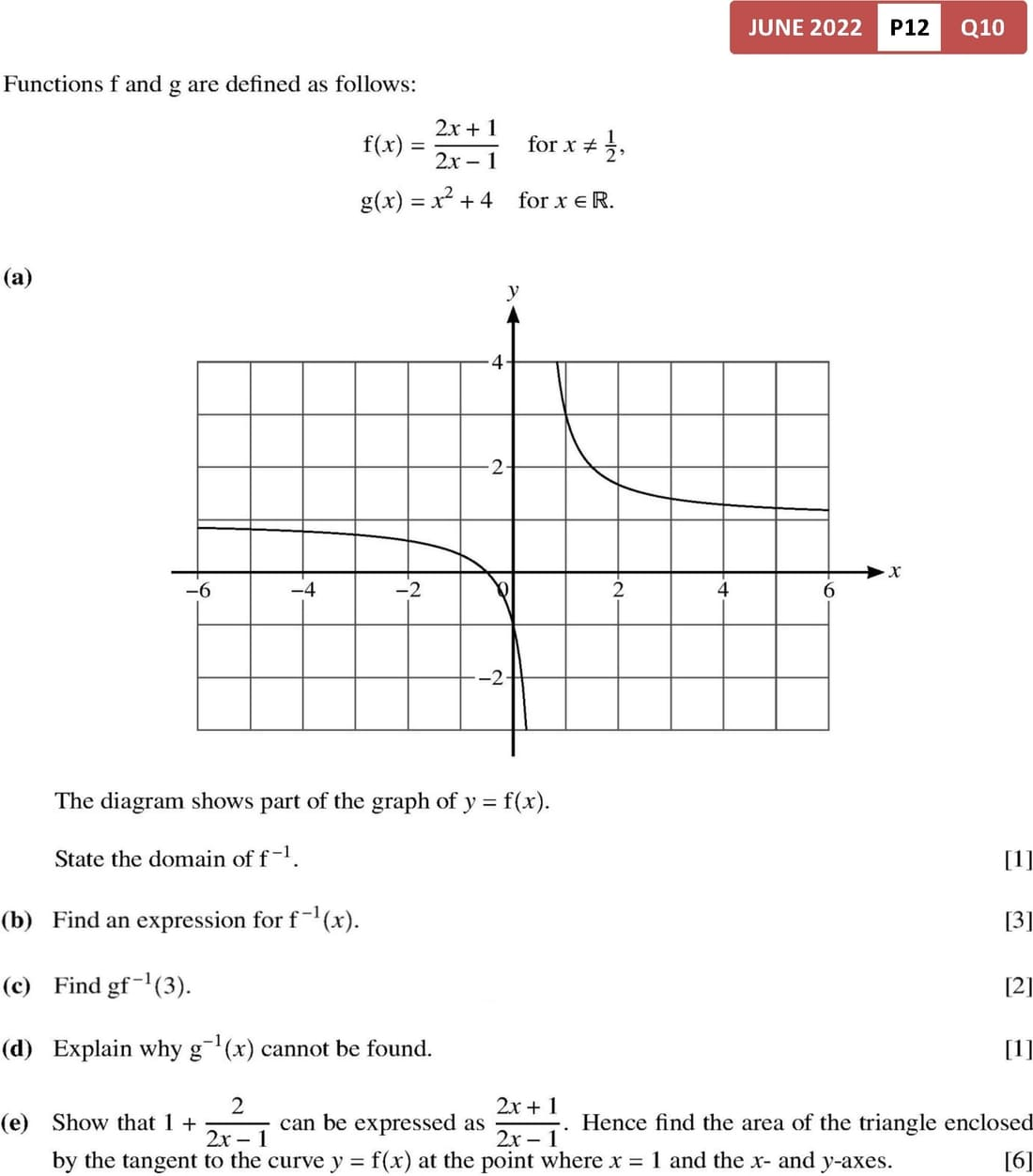
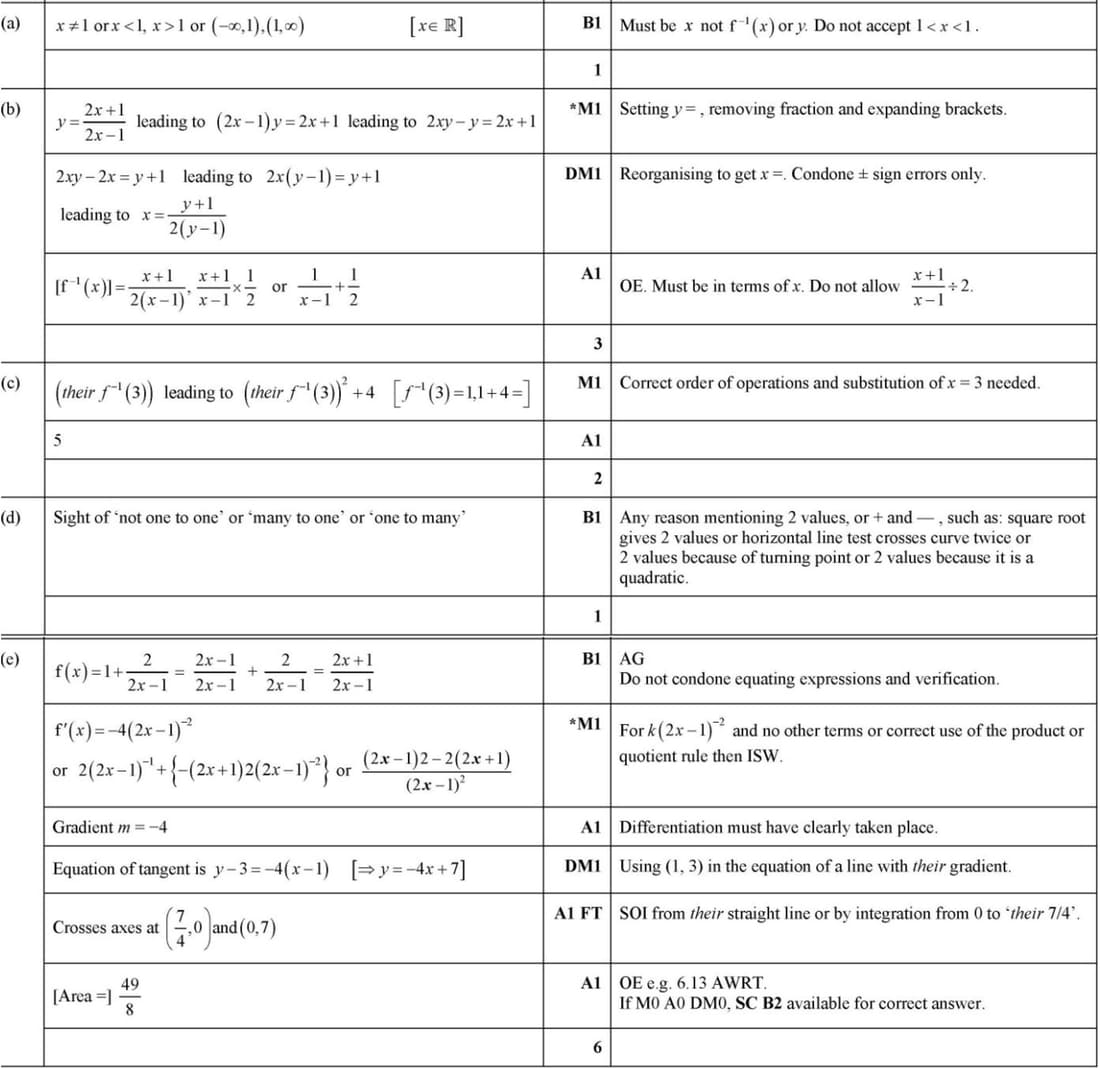
Functions f and g are defined as follows:
\(f(x) = \frac{2x+1}{2x-1}\) for \(x \neq \frac{1}{2}\),
\(g(x) = x^2 + 4\) for \(x \in \mathbb{R}\).
(a) The diagram shows part of the graph of \(y = f(x)\). State the domain of \(f^{-1}\).
(b) Find an expression for \(f^{-1}(x)\).
(c) Find \(gf^{-1}(3)\).
(d) Explain why \(g^{-1}(x)\) cannot be found.
(e) Show that \(1 + \frac{2}{2x-1}\) can be expressed as \(\frac{2x+1}{2x-1}\). Hence find the area of the triangle enclosed by the tangent to the curve \(y = f(x)\) at the point where \(x = 1\) and the x- and y-axes.