Exam-Style Problems
⬅ Back to SubchapterFM Nov 2024 p12 q06
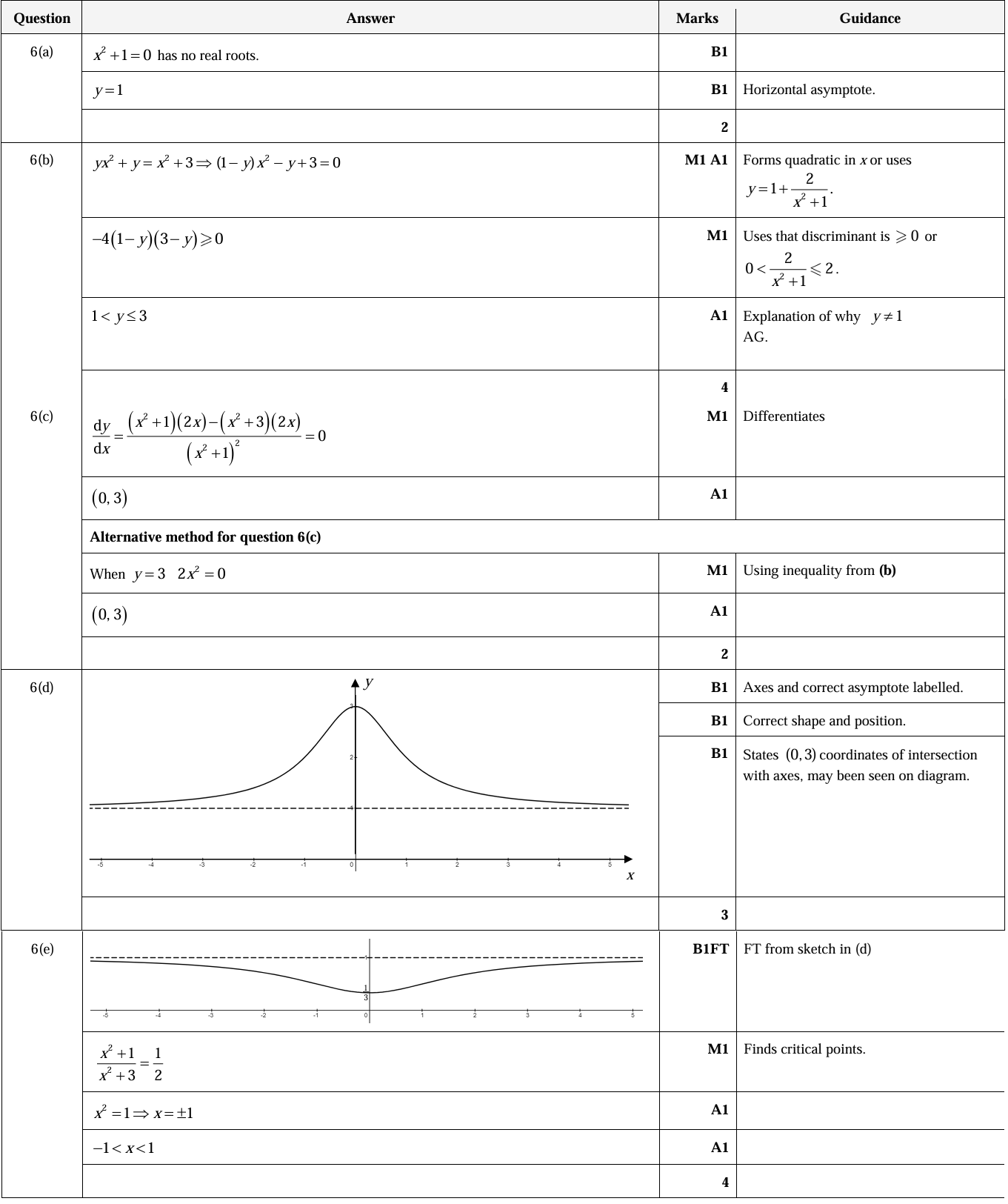
The curve C has equation \(y = \frac{x^2 + 3}{x^2 + 1}\).
- Show that C has no vertical asymptotes and state the equation of the horizontal asymptote. [2]
- Show that \(1 < y \leq 3\) for all real values of \(x\). [4]
- Find the coordinates of any stationary points on C. [2]
- Sketch C, stating the coordinates of any intersections with the axes and labelling the asymptote.
- Sketch the curve with equation \(y = \frac{x^2 + 1}{x^2 + 3}\) and find the set of values of \(x\) for which \(\frac{x^2 + 1}{x^2 + 3} < \frac{1}{2}\). [4]
FM Nov 2024 p12 q07
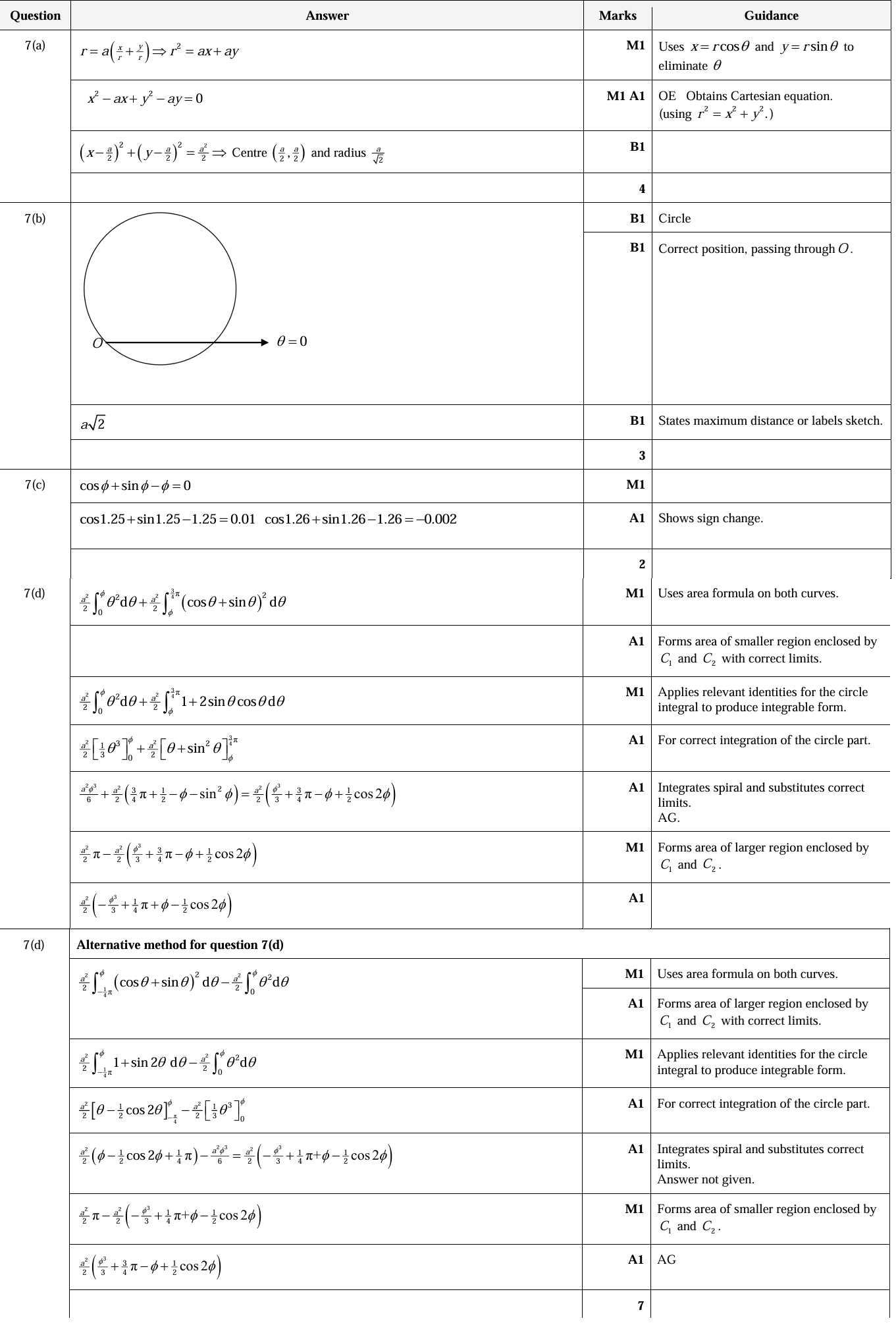
The curve \(C_1\) has polar equation \(r = a(\cos \theta + \sin \theta)\) for \(-\frac{1}{4}\pi \leq \theta \leq \frac{3}{4}\pi\), where \(a\) is a positive constant.
- Find a Cartesian equation for \(C_1\) and show that it represents a circle, stating its radius and the Cartesian coordinates of its centre.
- Sketch \(C_1\) and state the greatest distance of a point on \(C_1\) from the pole.
The curve \(C_2\) with polar equation \(r = a\theta\) intersects \(C_1\) at the pole and the point with polar coordinates \((a\phi, \phi)\).
- Verify that \(1.25 < \phi < 1.26\).
- Show that the area of the smaller region enclosed by \(C_1\) and \(C_2\) is equal to
\(\frac{1}{2}a^2 \left( \frac{3}{4}\pi + \frac{1}{3}\phi^3 - \phi + \frac{1}{2}\cos 2\phi \right)\)
and deduce, in terms of \(a\) and \(\phi\), the area of the larger region enclosed by \(C_1\) and \(C_2\).
FM Nov 2024 p13 q01
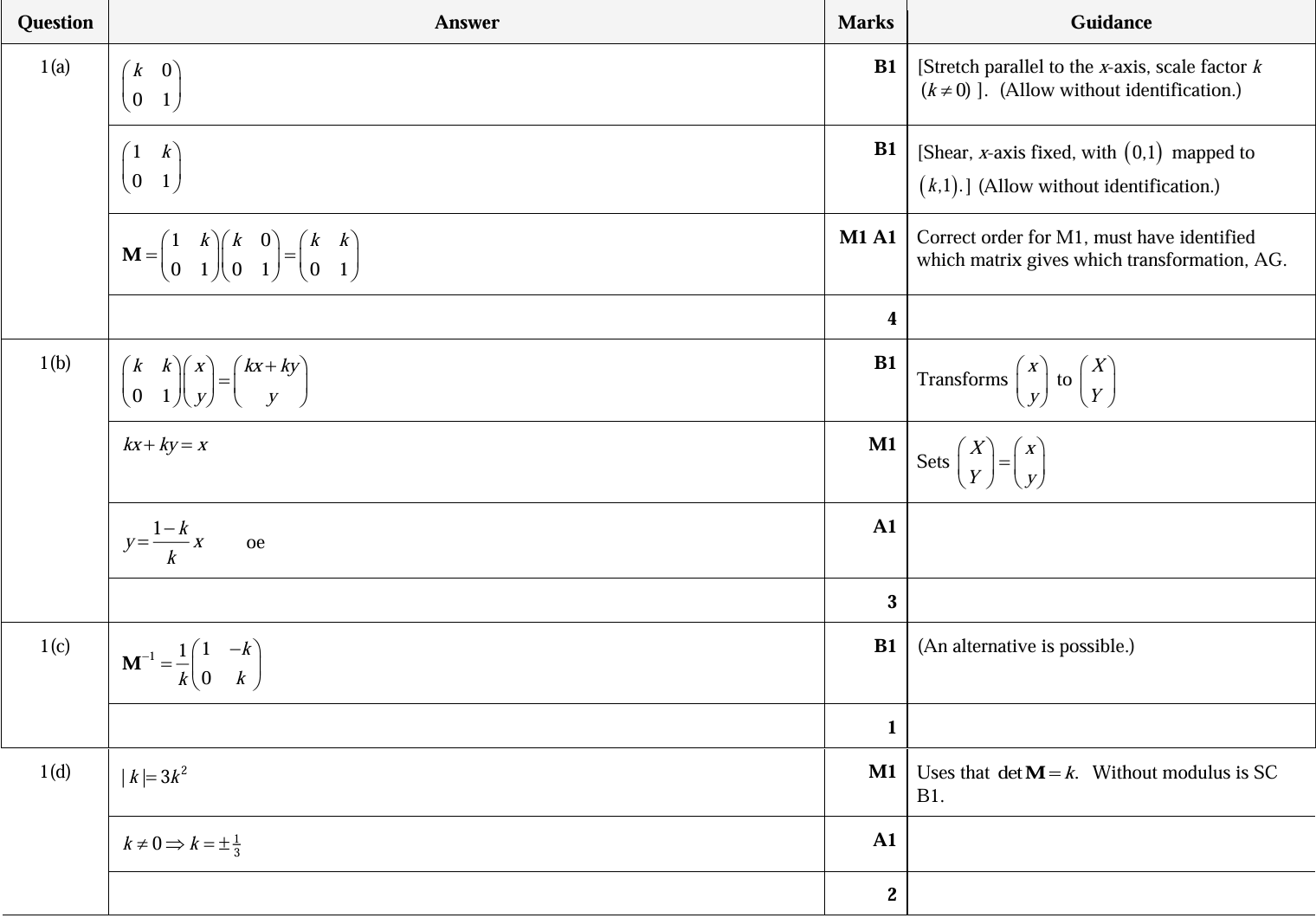
The matrix M represents the sequence of two transformations in the x-y plane given by a stretch parallel to the x-axis, scale factor k (k \neq 0), followed by a shear, x-axis fixed, with (0, 1) mapped to (k, 1).
(a) Show that M = \(\begin{pmatrix} k & k \\ 0 & 1 \end{pmatrix}\).
\((b) The transformation represented by M has a line of invariant points. Find, in terms of k, the equation of this line.\)
The unit square S in the x-y plane is transformed by M onto the parallelogram P.
(c) Find, in terms of k, a matrix which transforms P onto S.
(d) Given that the area of P is \(3k^2\) units\(^2\), find the possible values of k.
FM Nov 2024 p13 q02
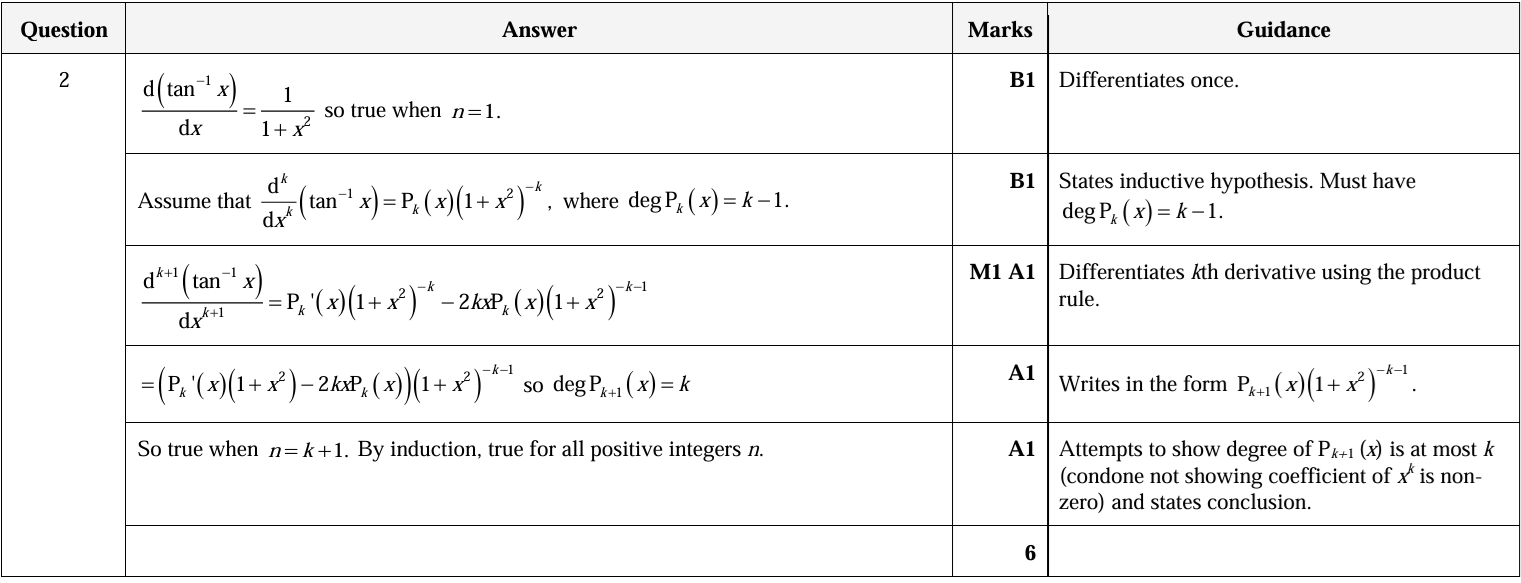
Prove by mathematical induction that, for all positive integers n,
\(\frac{d^n}{dx^n} \left( \arctan x \right) = P_n(x) (1 + x^2)^{-n},\)
where \(P_n(x)\) is a polynomial of degree \(n - 1\).
FM Nov 2024 p13 q03
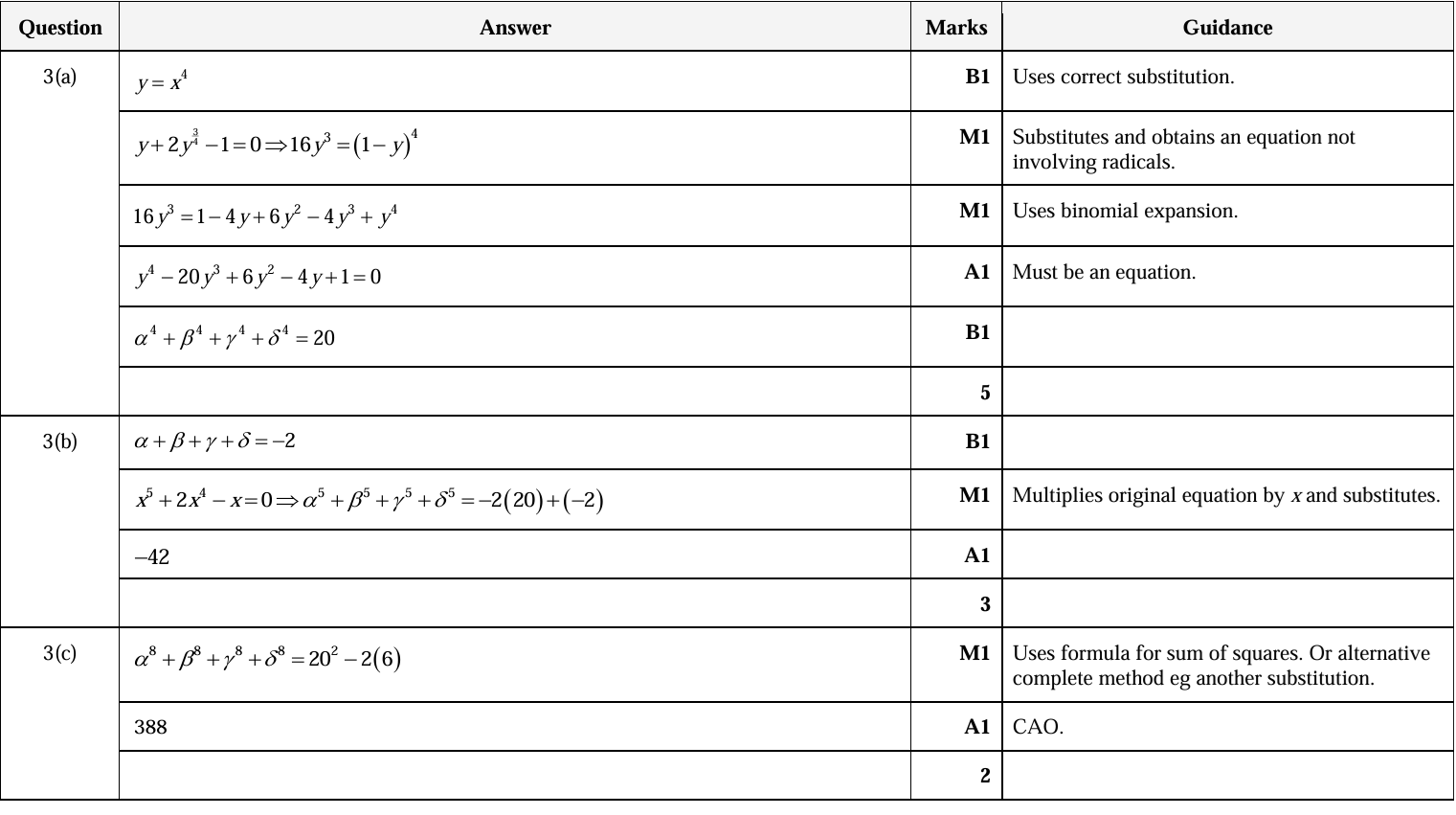
The quartic equation \(x^4 + 2x^3 - 1 = 0\) has roots \(\alpha, \beta, \gamma, \delta\).
(a) Find a quartic equation whose roots are \(\alpha^4, \beta^4, \gamma^4, \delta^4\) and state the value of \(\alpha^4 + \beta^4 + \gamma^4 + \delta^4\).
(b) Find the value of \(\alpha^5 + \beta^5 + \gamma^5 + \delta^5\).
(c) Find the value of \(\alpha^8 + \beta^8 + \gamma^8 + \delta^8\).