Exam-Style Problems
⬅ Back to SubchapterNov 2015 p41 q3
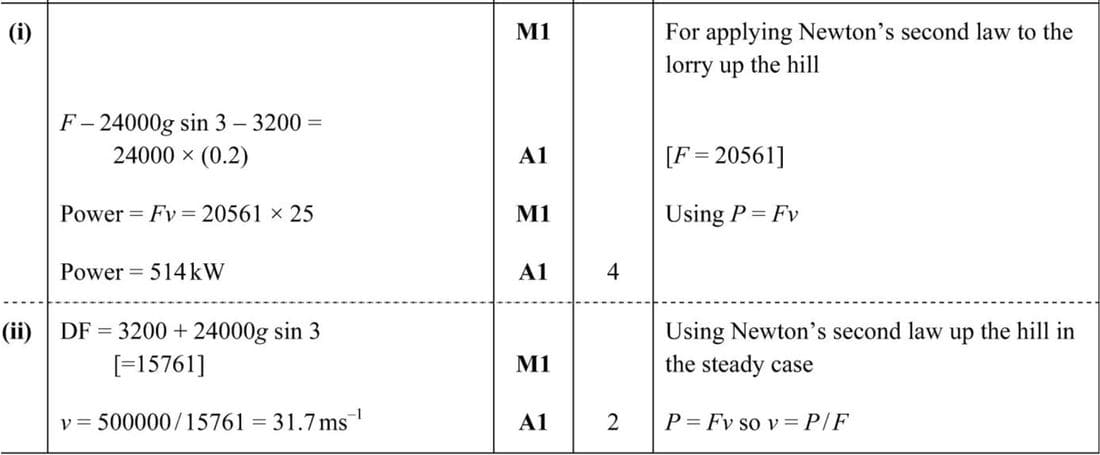
A lorry of mass 24,000 kg is travelling up a hill which is inclined at 3° to the horizontal. The power developed by the lorry’s engine is constant, and there is a constant resistance to motion of 3200 N.
- When the speed of the lorry is 25 m s-1, its acceleration is 0.2 m s-2. Find the power developed by the lorry’s engine.
- Find the steady speed at which the lorry moves up the hill if the power is 500 kW and the resistance remains 3200 N.
Nov 2015 p41 q1
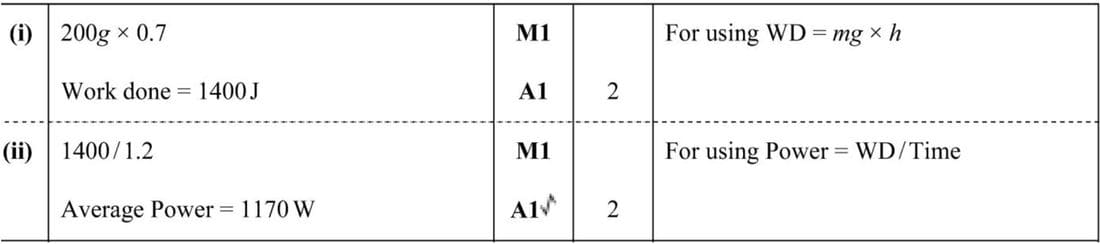
A weightlifter performs an exercise in which he raises a mass of 200 kg from rest vertically through a distance of 0.7 m and holds it at that height.
(i) Find the work done by the weightlifter.
(ii) Given that the time taken to raise the mass is 1.2 s, find the average power developed by the weightlifter.
June 2015 p43 q3
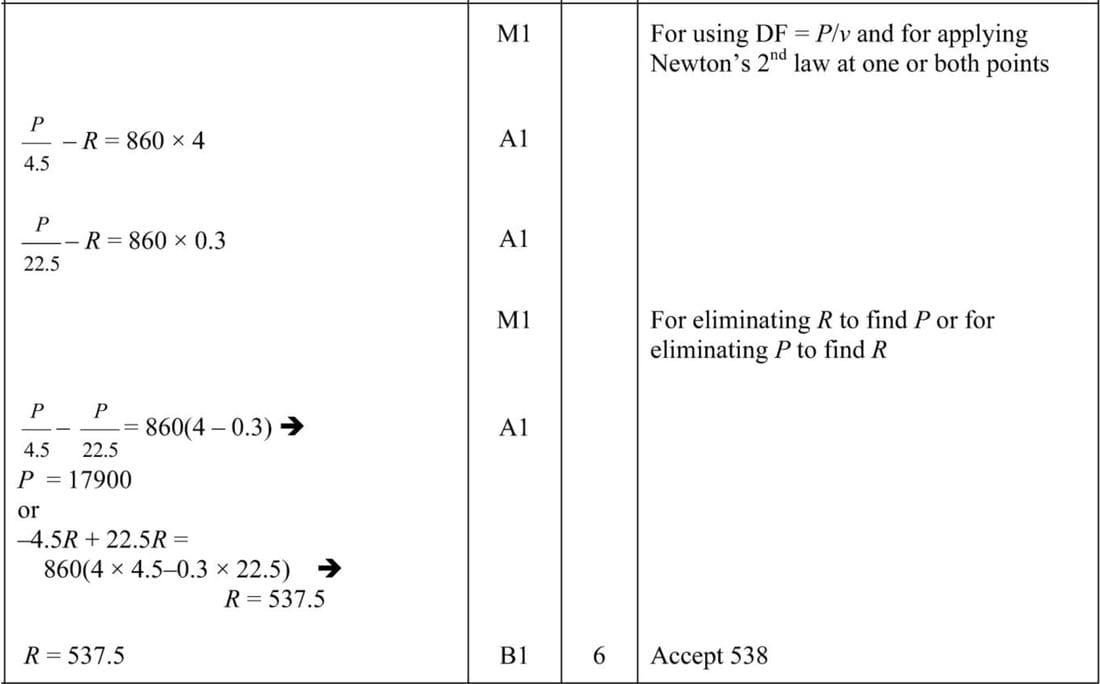
A car of mass 860 kg travels along a straight horizontal road. The power provided by the car’s engine is \(P\) W and the resistance to the car’s motion is \(R\) N. The car passes through one point with speed 4.5 m s\(^{-1}\) and acceleration 4 m s\(^{-2}\). The car passes through another point with speed 22.5 m s\(^{-1}\) and acceleration 0.3 m s\(^{-2}\). Find the values of \(P\) and \(R\).
June 2015 p43 q1
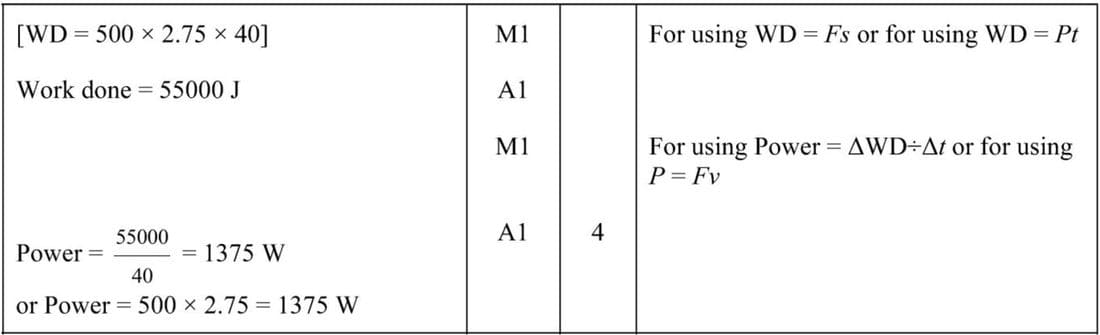
A block is pulled along a horizontal floor by a horizontal rope. The tension in the rope is 500 N and the block moves at a constant speed of 2.75 m s-1. Find the work done by the tension in 40 s and find the power applied by the tension.
Feb/Mar 2023 p42 q1
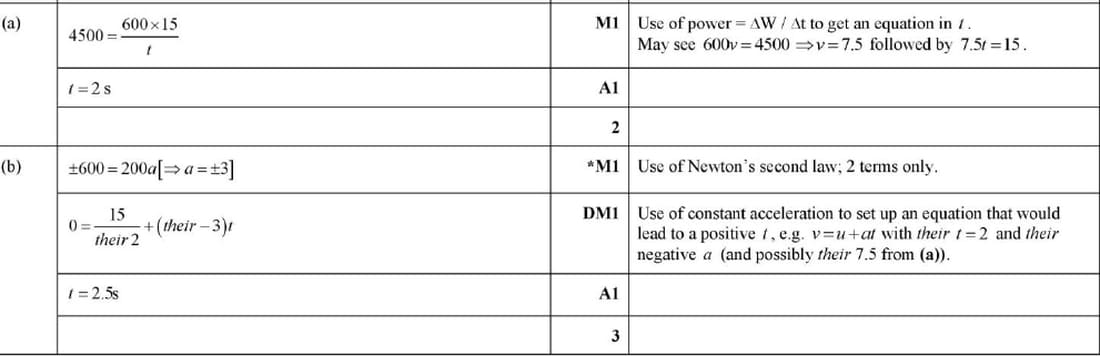
A crate of mass 200 kg is being pulled at constant speed along horizontal ground by a horizontal rope attached to a winch. The winch is working at a constant rate of 4.5 kW and there is a constant resistance to the motion of the crate of magnitude 600 N.
(a) Find the time that it takes for the crate to move a distance of 15 m.
The rope breaks after the crate has moved 15 m.
(b) Find the time taken, after the rope breaks, for the crate to come to rest.