Exam-Style Problems
⬅ Back to SubchapterNov 2021 p41 q7
3924
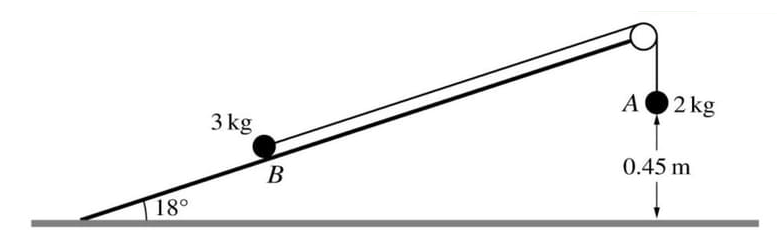
Two particles A and B of masses 2 kg and 3 kg respectively are connected by a light inextensible string. Particle B is on a smooth fixed plane which is at an angle of 18° to horizontal ground. The string passes over a fixed smooth pulley at the top of the plane. Particle A hangs vertically below the pulley and is 0.45 m above the ground (see diagram). The system is released from rest with the string taut. When A reaches the ground, the string breaks.
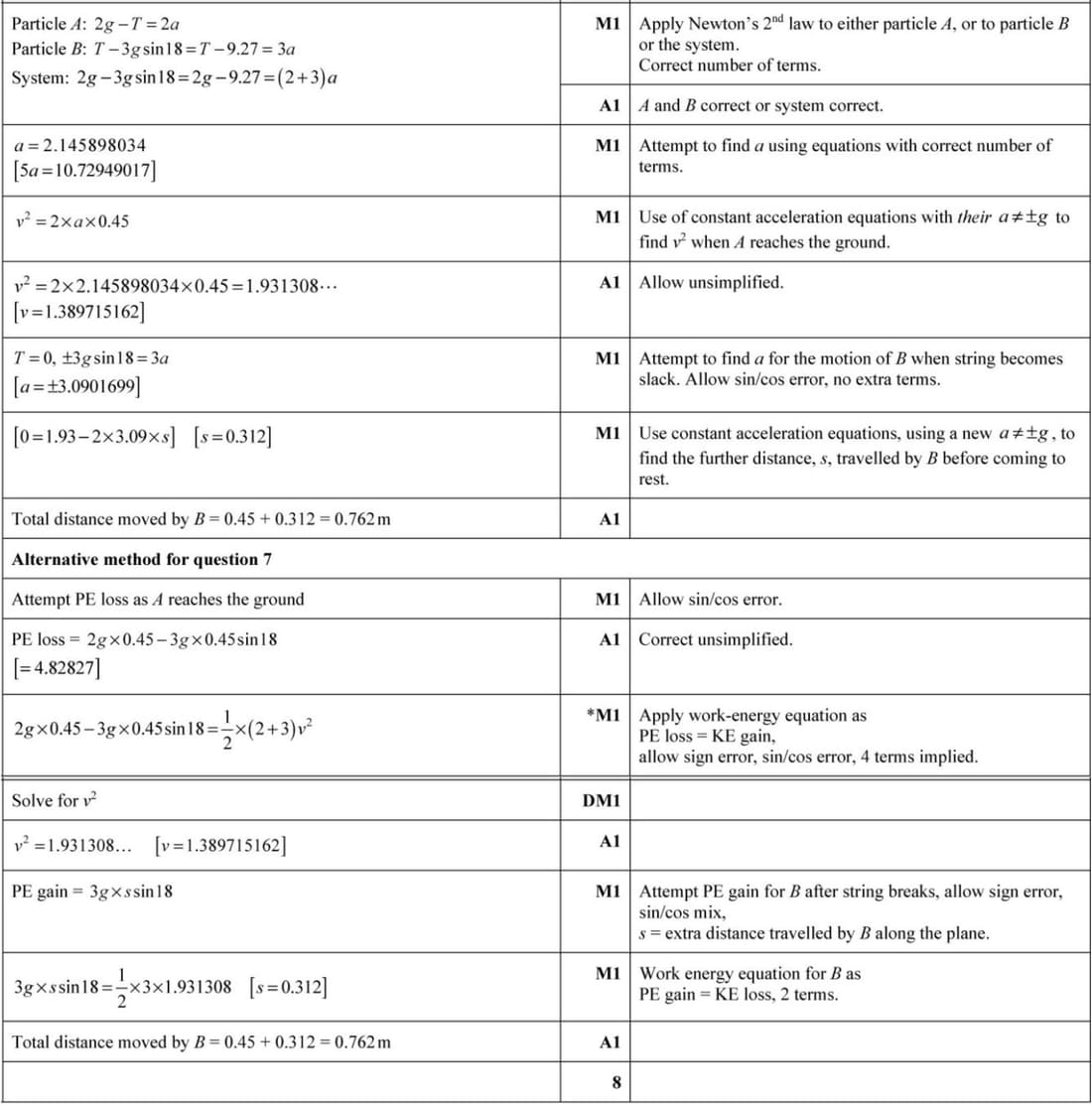
Find the total distance travelled by B before coming to instantaneous rest. You may assume that B does not reach the pulley.
June 2020 p43 q7
3925
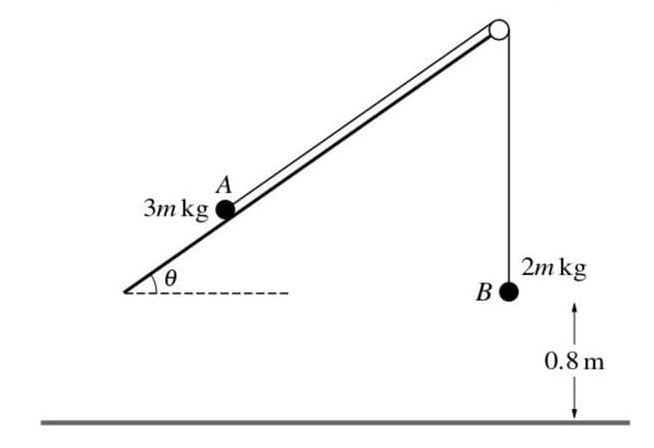
Two particles A and B, of masses 3m kg and 2m kg respectively, are attached to the ends of a light inextensible string. The string passes over a fixed smooth pulley which is attached to the edge of a plane. The plane is inclined at an angle θ to the horizontal. A lies on the plane and B hangs vertically, 0.8 m above the floor, which is horizontal. The string between A and the pulley is parallel to a line of greatest slope of the plane (see diagram). Initially A and B are at rest.
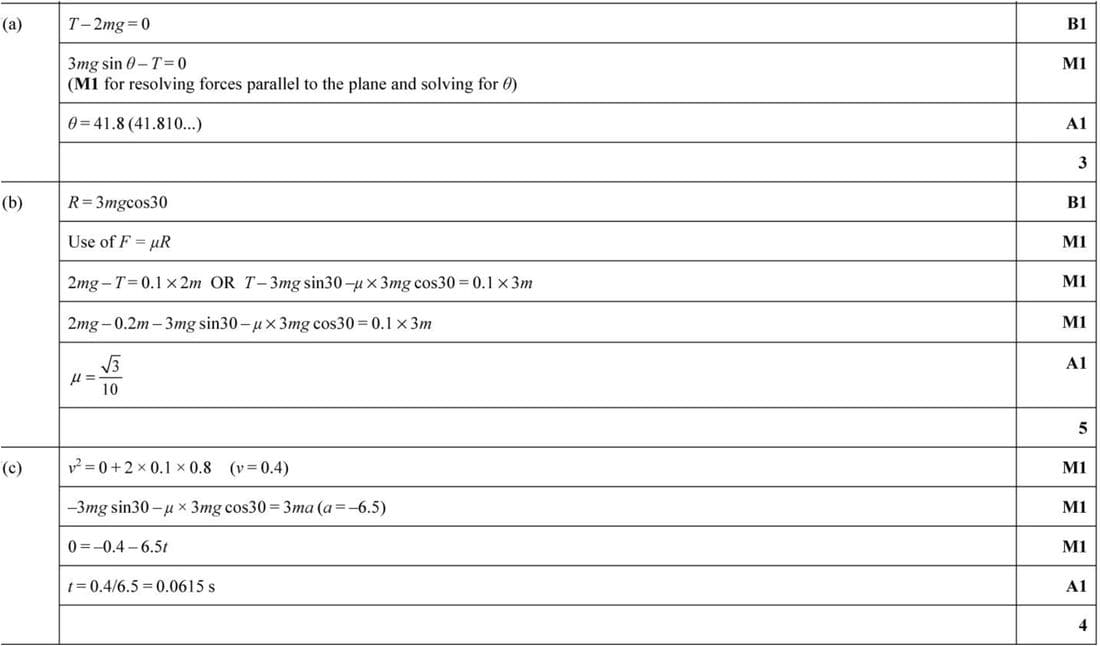
- Given that the plane is smooth, find the value of θ for which A remains at rest. [3]
- It is given instead that the plane is rough, θ = 30° and the acceleration of A up the plane is 0.1 m s-2.
- Show that the coefficient of friction between A and the plane is \(\frac{1}{10}\sqrt{3}\). [5]
- When B reaches the floor it comes to rest.
- Find the length of time after B reaches the floor for which A is moving up the plane. [You may assume that A does not reach the pulley.] [4]
Nov 2019 p42 q7
3926
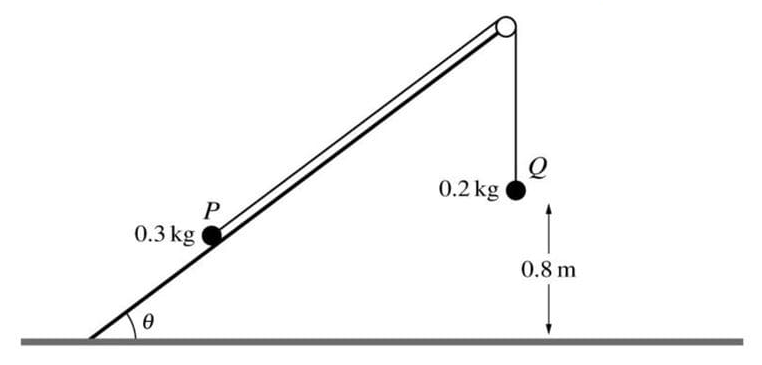
Two particles P and Q, of masses 0.3 kg and 0.2 kg respectively, are attached to the ends of a light inextensible string. The string passes over a fixed smooth pulley which is attached to the edge of a smooth plane. The plane is inclined at an angle \(\theta\) to the horizontal, where \(\sin \theta = \frac{3}{5}\). P lies on the plane and Q hangs vertically below the pulley at a height of 0.8 m above the floor (see diagram). The string between P and the pulley is parallel to a line of greatest slope of the plane. P is released from rest and Q moves vertically downwards.
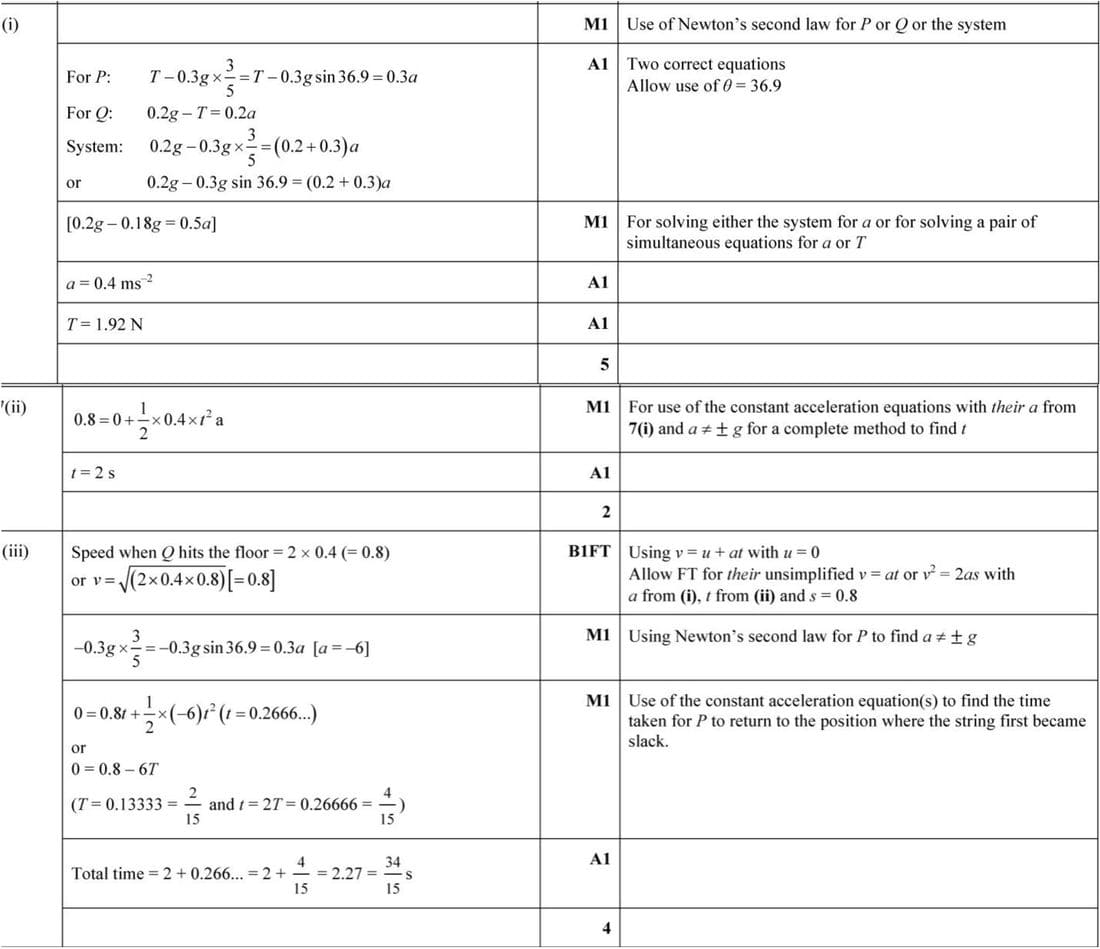
- Find the tension in the string and the magnitude of the acceleration of the particles. [5]
- Q hits the floor and does not bounce. It is given that P does not reach the pulley in the subsequent motion.
- Find the time, from the instant at which P is released, for Q to reach the floor. [2]
- When Q hits the floor the string becomes slack. Find the time, from the instant at which P is released, for the string to become taut again. [4]
Nov 2018 p42 q4
3927
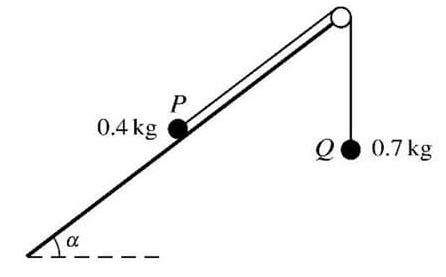
Two particles P and Q, of masses 0.4 kg and 0.7 kg respectively, are attached to the ends of a light inextensible string. The string passes over a fixed smooth pulley which is attached to the edge of a rough plane. The coefficient of friction between P and the plane is 0.5. The plane is inclined at an angle \(\alpha\) to the horizontal, where \(\tan \alpha = \frac{3}{4}\). Particle P lies on the plane and particle Q hangs vertically. The string between P and the pulley is parallel to a line of greatest slope of the plane (see diagram). A force of magnitude \(X\) N, acting directly down the plane, is applied to P.
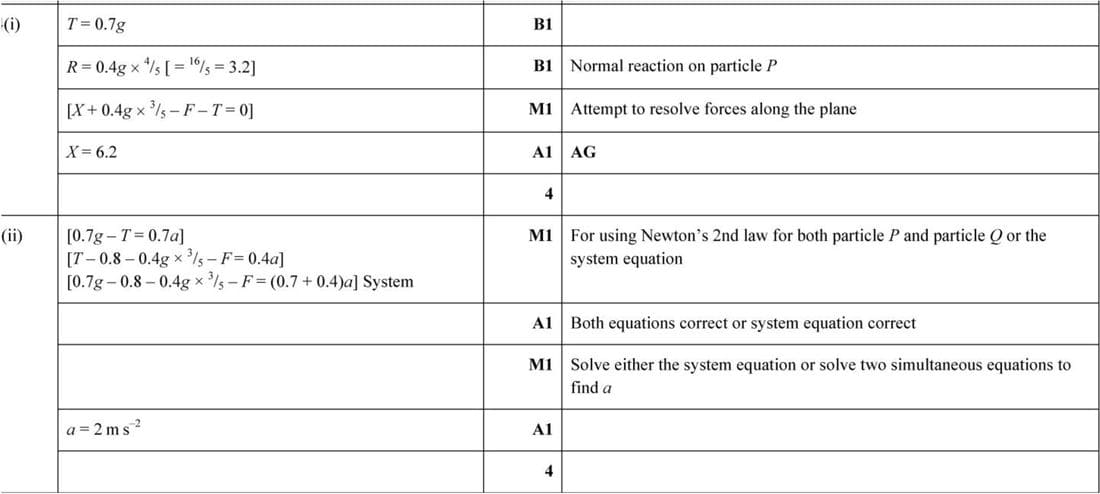
(i) Show that the greatest value of \(X\) for which P remains stationary is 6.2.
(ii) Given instead that \(X = 0.8\), find the acceleration of P.
Nov 2017 p42 q6
3928
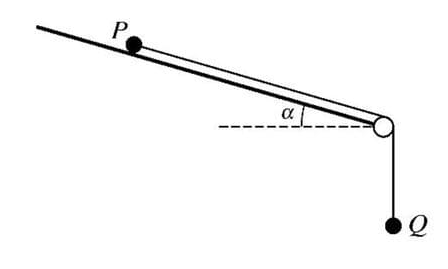
Two particles P and Q, each of mass m kg, are attached to the ends of a light inextensible string. The string passes over a fixed smooth pulley which is attached to the edge of a rough plane. The plane is inclined at an angle α to the horizontal, where \(\tan \alpha = \frac{7}{24}\). Particle P rests on the plane and particle Q hangs vertically, as shown in the diagram. The string between P and the pulley is parallel to a line of greatest slope of the plane. The system is in limiting equilibrium.
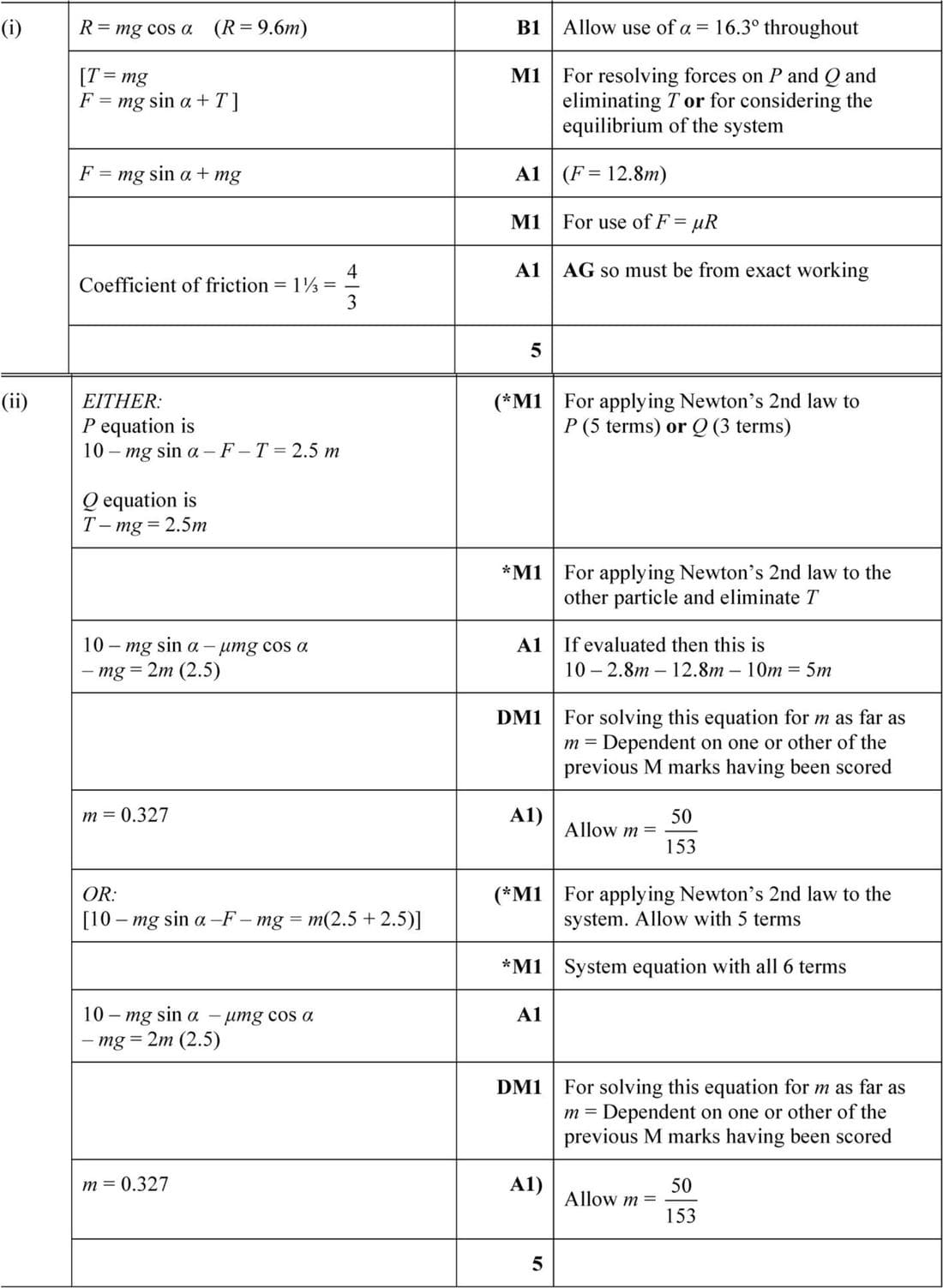
- Show that the coefficient of friction between P and the plane is \(\frac{4}{3}\).
- A force of magnitude 10N is applied to P, acting up a line of greatest slope of the plane, and P accelerates at \(2.5 \, \text{m/s}^2\). Find the value of m.