Exam-Style Problems
⬅ Back to SubchapterNov 2013 p43 q4
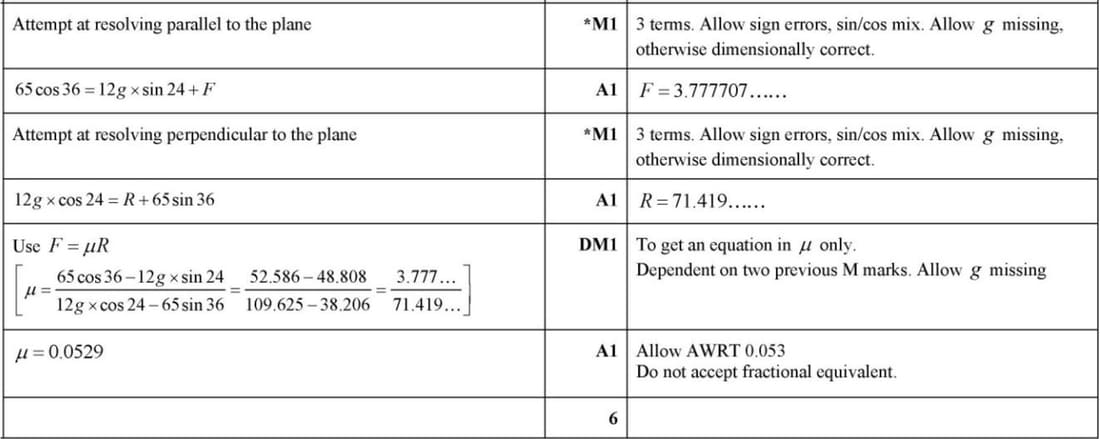
A box of mass 30 kg is at rest on a rough plane inclined at an angle \(\alpha\) to the horizontal, where \(\sin \alpha = 0.1\), acted on by a force of magnitude 40 N. The force acts upwards and parallel to a line of greatest slope of the plane. The box is on the point of slipping up the plane.
(i) Find the coefficient of friction between the box and the plane.
The force of magnitude 40 N is removed.
(ii) Determine, giving a reason, whether or not the box remains in equilibrium.
Nov 2013 p42 q4
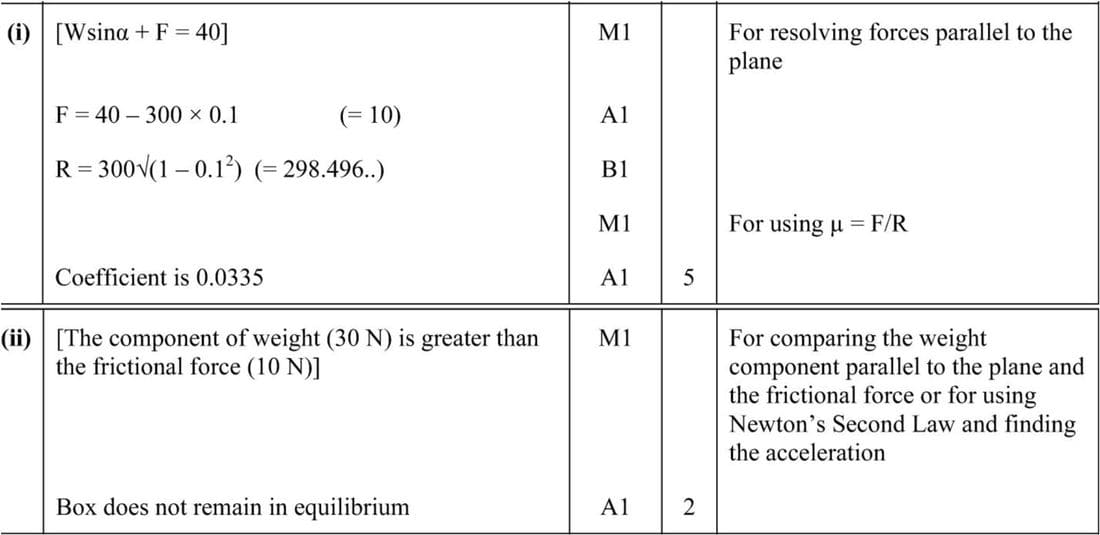
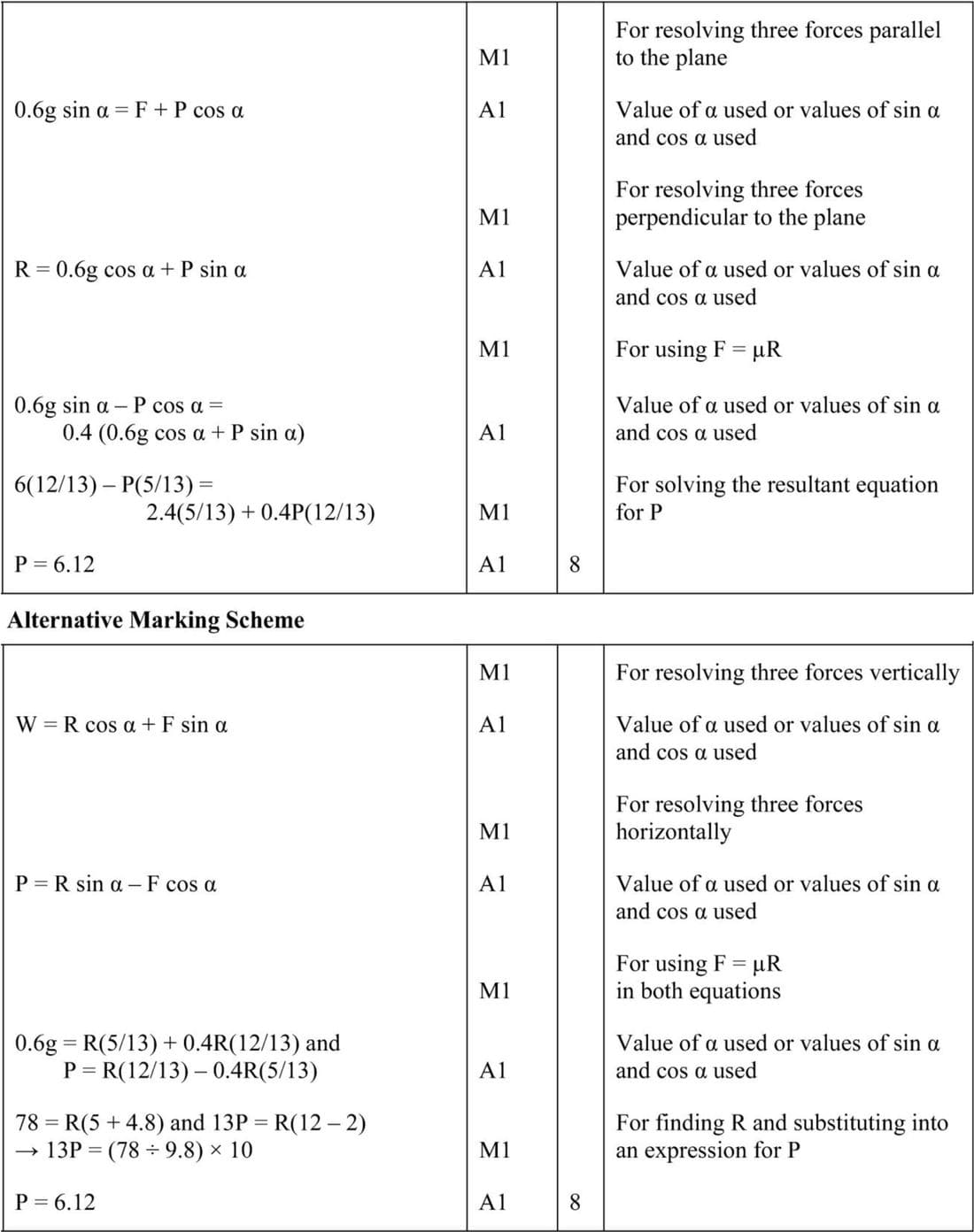
A rough plane is inclined at an angle \(\alpha\) to the horizontal, where \(\tan \alpha = 2.4\). A small block of mass 0.6 kg is held at rest on the plane by a horizontal force of magnitude \(PN\). This force acts in a vertical plane through a line of greatest slope (see diagram). The coefficient of friction between the block and the plane is 0.4. The block is on the point of slipping down the plane. By resolving forces parallel to and perpendicular to the inclined plane, or otherwise, find the value of \(P\).
Nov 2012 p43 q6
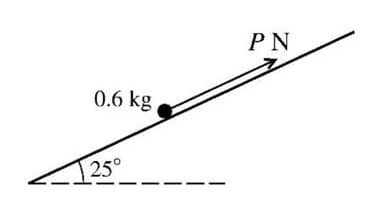
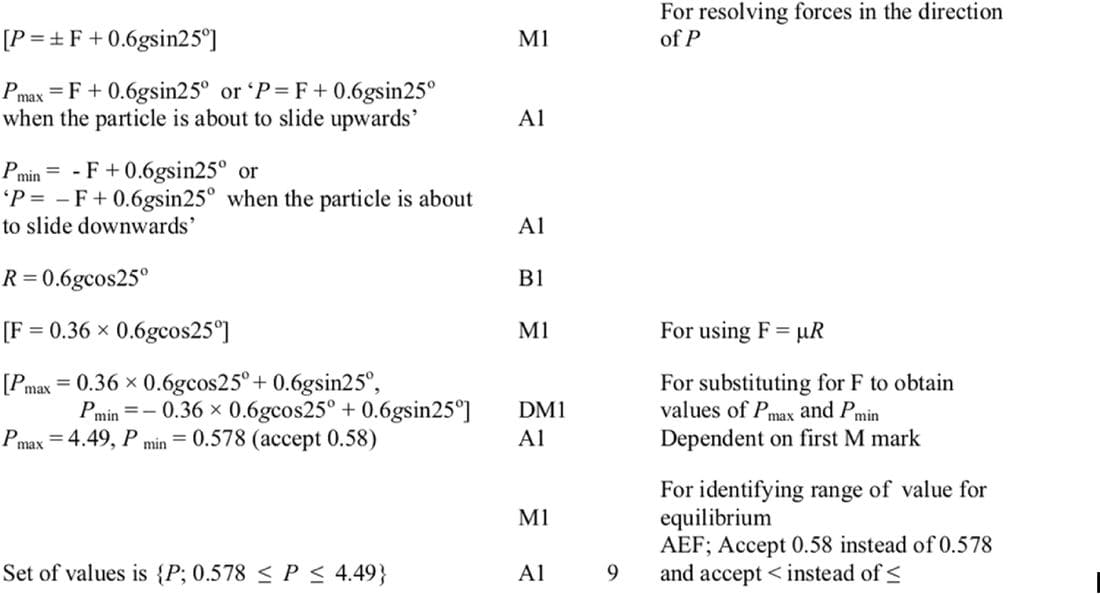
The diagram shows a particle of mass 0.6 kg on a plane inclined at 25° to the horizontal. The particle is acted on by a force of magnitude \(P\) N directed up the plane parallel to a line of greatest slope. The coefficient of friction between the particle and the plane is 0.36. Given that the particle is in equilibrium, find the set of possible values of \(P\).
Nov 2012 p41 q3
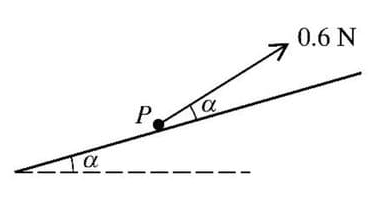
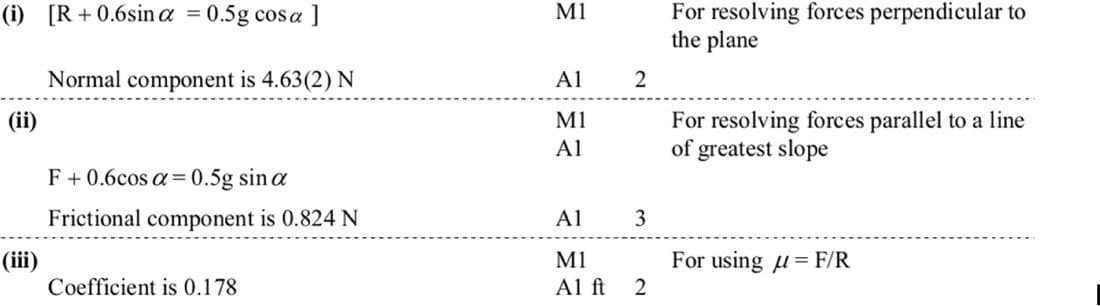
A particle P of mass 0.5 kg rests on a rough plane inclined at angle \(\alpha\) to the horizontal, where \(\sin \alpha = 0.28\). A force of magnitude 0.6 N, acting upwards on P at angle \(\alpha\) from a line of greatest slope of the plane, is just sufficient to prevent P sliding down the plane (see diagram). Find
- the normal component of the contact force on P,
- the frictional component of the contact force on P,
- the coefficient of friction between P and the plane.
June 2022 p42 q5
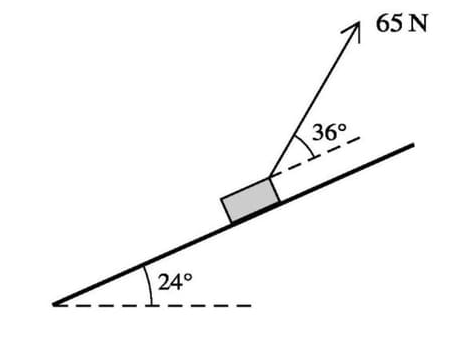
A block of mass 12 kg is placed on a plane which is inclined at an angle of 24° to the horizontal. A light string, making an angle of 36° above a line of greatest slope, is attached to the block. The tension in the string is 65 N (see diagram). The coefficient of friction between the block and plane is \(\mu\). The block is in limiting equilibrium and is on the point of sliding up the plane.
Find \(\mu\).