Exam-Style Problems
⬅ Back to SubchapterNov 2013 p61 q1
It is given that \(X \sim N(30, 49)\), \(Y \sim N(30, 16)\) and \(Z \sim N(50, 16)\). On a single diagram, with the horizontal axis going from 0 to 70, sketch three curves to represent the distributions of \(X, Y\) and \(Z\).


June 2013 p61 q4
The random variable Y is normally distributed with positive mean μ and standard deviation \(\frac{1}{2} \mu\). Find the probability that a randomly chosen value of Y is negative.

Nov 2012 p63 q5
The random variable X is such that X ~ N(82, 126).
A value of X is chosen at random and rounded to the nearest whole number. Find the probability that this whole number is 84.

Nov 2012 p62 q2
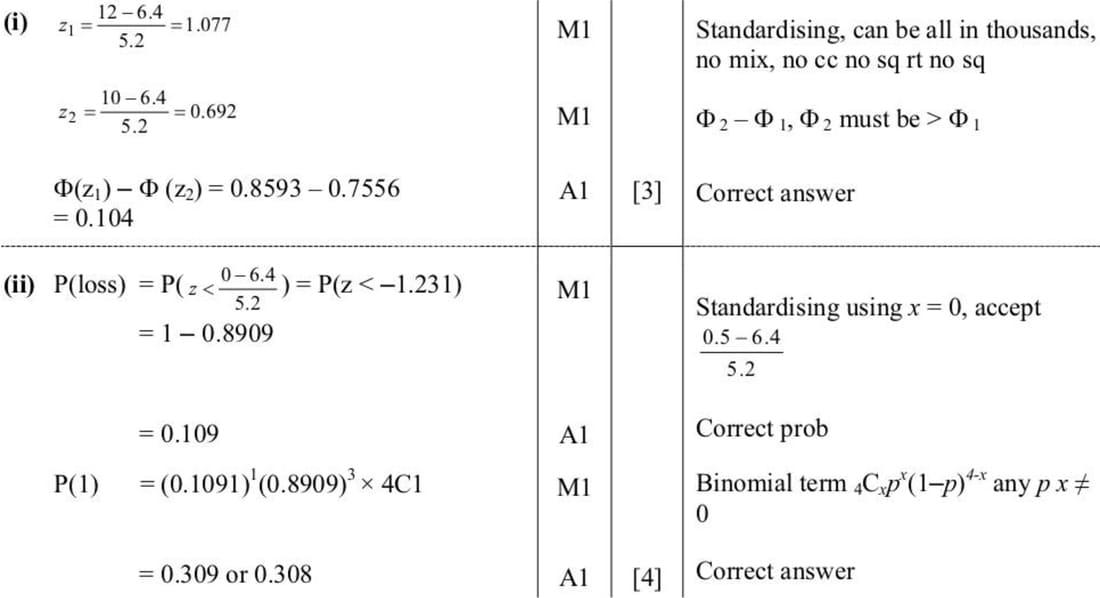
The random variable X is the daily profit, in thousands of dollars, made by a company. X is normally distributed with mean 6.4 and standard deviation 5.2.
(i) Find the probability that, on a randomly chosen day, the company makes a profit between $10,000 and $12,000.
(ii) Find the probability that the company makes a loss on exactly 1 of the next 4 consecutive days.
Nov 2022 p53 q5
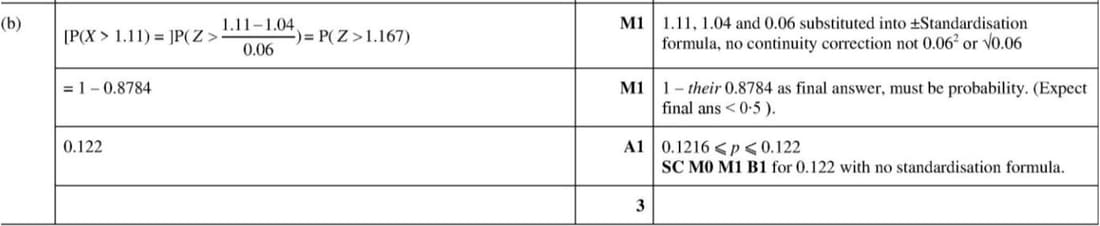
The weights of the bags of sugar produced by company B are normally distributed with mean 1.04 kg and standard deviation 0.06 kg.
Find the probability that a randomly chosen bag produced by company B weighs more than 1.11 kg.