Exam-Style Problems
⬅ Back to SubchapterJune 2015 p62 q5
A box contains 5 discs, numbered 1, 2, 4, 6, 7. William takes 3 discs at random, without replacement, and notes the numbers on the discs.
The smallest of the numbers on the 3 discs taken is denoted by the random variable \(S\).
By listing all possible selections (126, 246 and so on) draw up the probability distribution table for \(S\).

Nov 2014 p63 q7
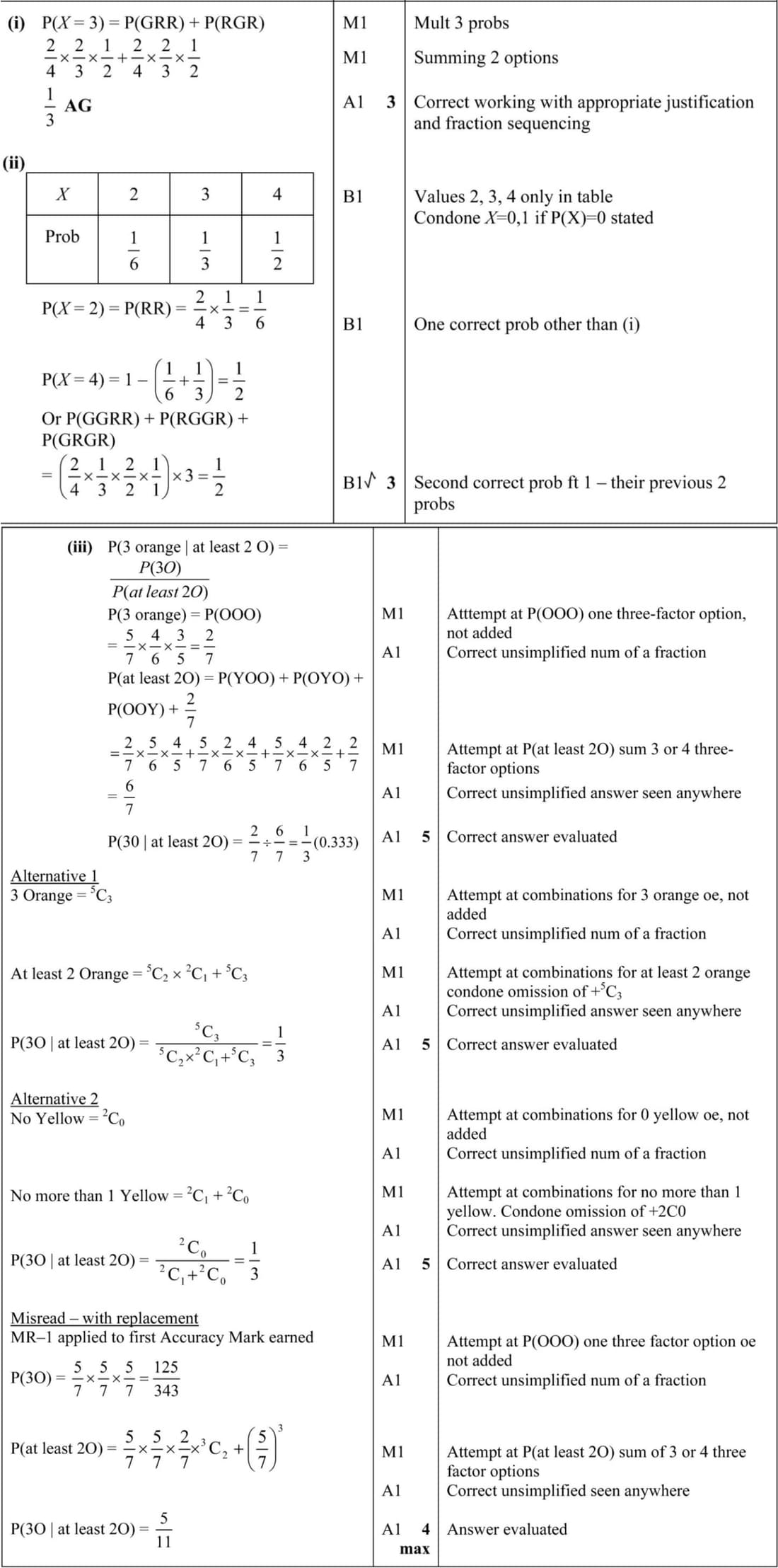
A box contains 2 green apples and 2 red apples. Apples are taken from the box, one at a time, without replacement. When both red apples have been taken, the process stops. The random variable X is the number of apples which have been taken when the process stops.
- Show that \(P(X = 3) = \frac{1}{3}\).
- Draw up the probability distribution table for \(X\).
Another box contains 2 yellow peppers and 5 orange peppers. Three peppers are taken at random from the box without replacement.
- Given that at least 2 of the peppers taken from the box are orange, find the probability that all 3 peppers are orange.
Nov 2014 p62 q4
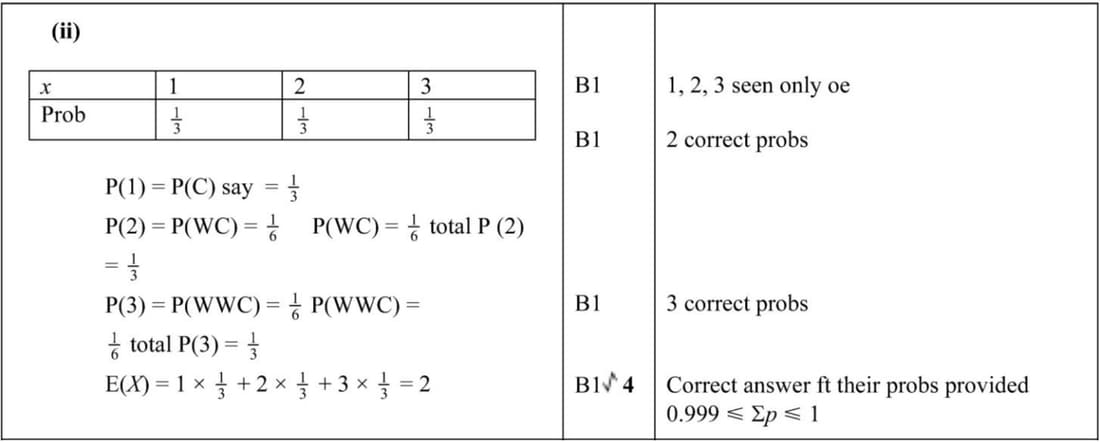
Sharik attempts a multiple choice revision question on-line. There are 3 suggested answers, one of which is correct. When Sharik chooses an answer the computer indicates whether the answer is right or wrong. Sharik first chooses one of the three suggested answers at random. If this answer is wrong, he has a second try, choosing an answer at random from the remaining 2. If this answer is also wrong Sharik then chooses the remaining answer, which must be correct.
The random variable \(X\) is the number of attempts that Sharik makes up to and including the one that the computer indicates is correct. Draw up the probability distribution table for \(X\) and find \(E(X)\).
June 2014 p63 q3
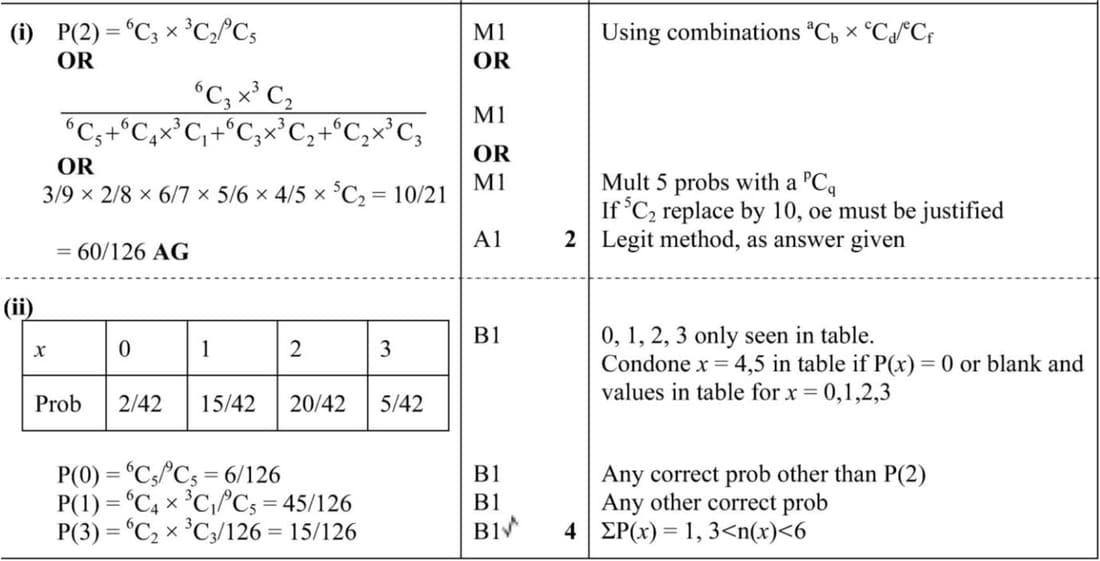
A pet shop has 6 rabbits and 3 hamsters. 5 of these pets are chosen at random. The random variable X represents the number of hamsters chosen.
- Show that the probability that exactly 2 hamsters are chosen is \(\frac{10}{21}\).
- Draw up the probability distribution table for X.
Nov 2022 p52 q5
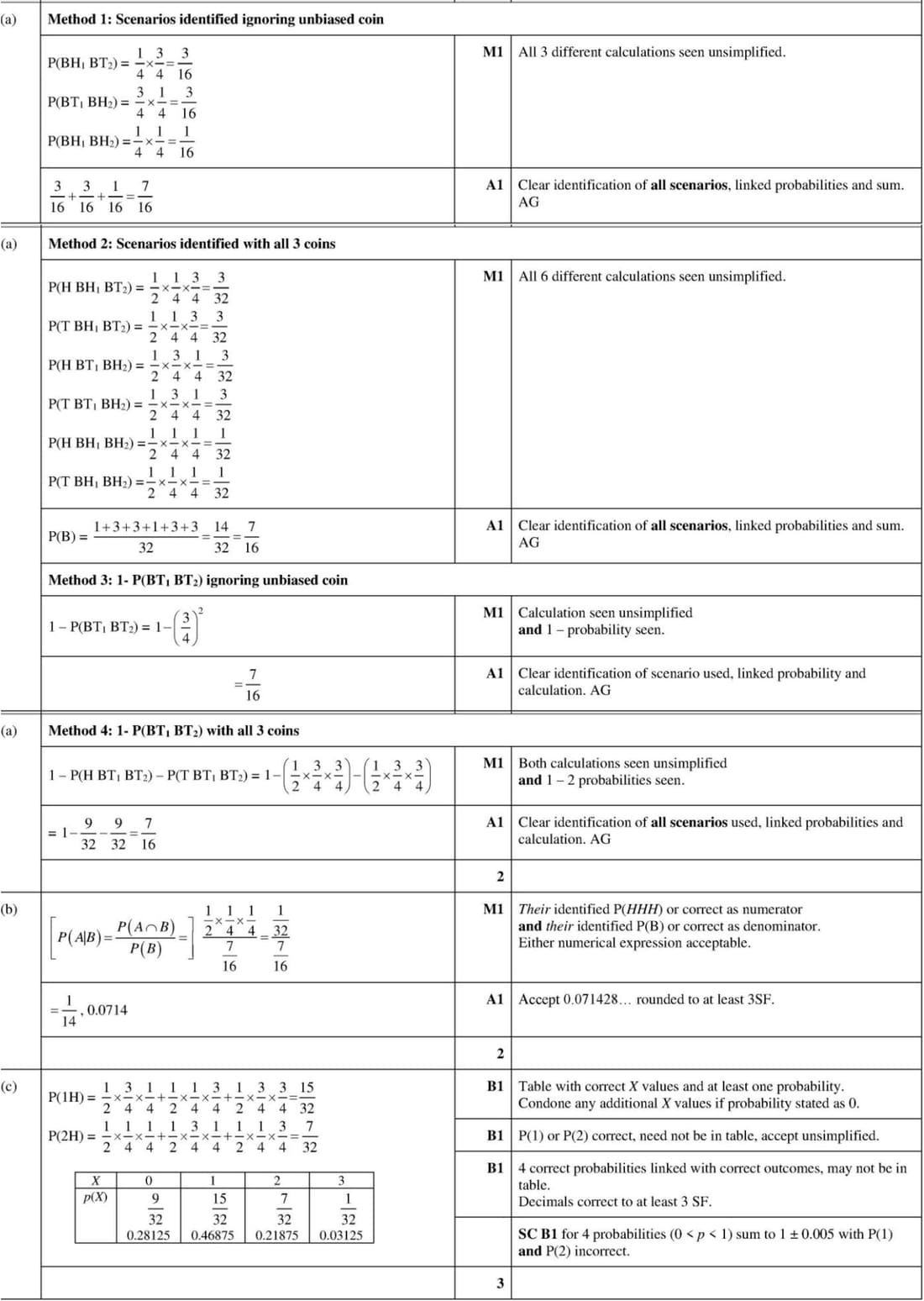
Eric has three coins. One of the coins is fair. The other two coins are each biased so that the probability of obtaining a head on any throw is \(\frac{1}{4}\), independently of all other throws. Eric throws all three coins at the same time.
Events \(A\) and \(B\) are defined as follows.
\(A\): all three coins show the same result
\(B\): at least one of the biased coins shows a head
(a) Show that \(P(B) = \frac{7}{16}\).
(b) Find \(P(A \mid B)\).
The random variable \(X\) is the number of heads obtained when Eric throws the three coins.
(c) Draw up the probability distribution table for \(X\).