Exam-Style Problems
⬅ Back to SubchapterNov 2019 p31 q4
2319
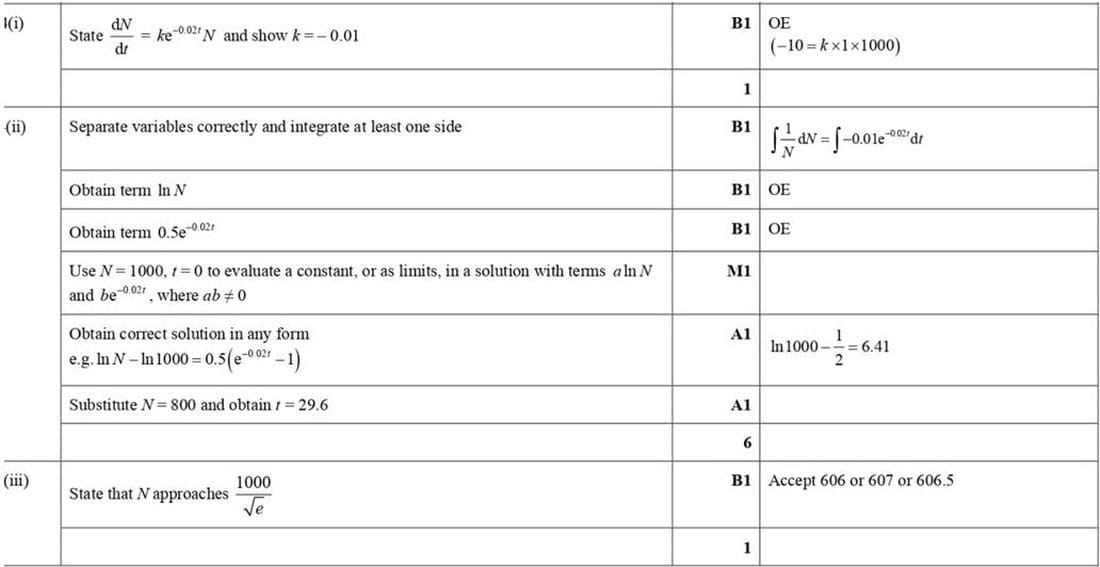
The number of insects in a population t weeks after the start of observations is denoted by N. The population is decreasing at a rate proportional to Ne-0.02t. The variables N and t are treated as continuous, and it is given that when t = 0, N = 1000 and \(\frac{dN}{dt} = -10\).
(i) Show that N and t satisfy the differential equation \(\frac{dN}{dt} = -0.01e^{-0.02t}N\).
\((ii) Solve the differential equation and find the value of t when N = 800.\)
(iii) State what happens to the value of N as t becomes large.
Nov 2018 p32 q6
2320
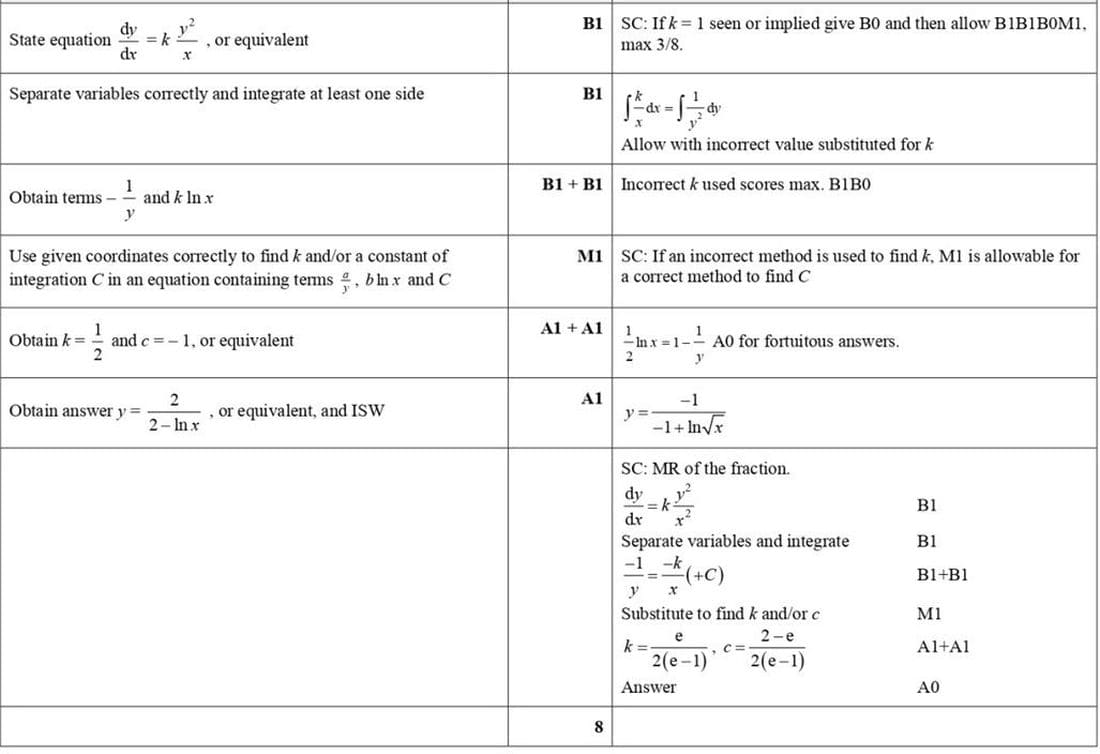
A certain curve is such that its gradient at a general point with coordinates \((x, y)\) is proportional to \(\frac{y^2}{x}\). The curve passes through the points with coordinates \((1, 1)\) and \((e, 2)\). By setting up and solving a differential equation, find the equation of the curve, expressing \(y\) in terms of \(x\).
June 2018 p32 q3
2321
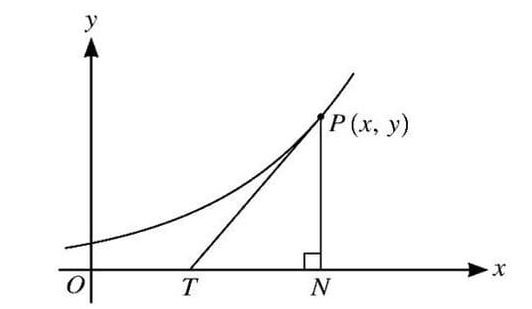
In the diagram, the tangent to a curve at the point \(P\) with coordinates \((x, y)\) meets the \(x\)-axis at \(T\). The point \(N\) is the foot of the perpendicular from \(P\) to the \(x\)-axis. The curve is such that, for all values of \(x\), the gradient of the curve is positive and \(TN = 2\).
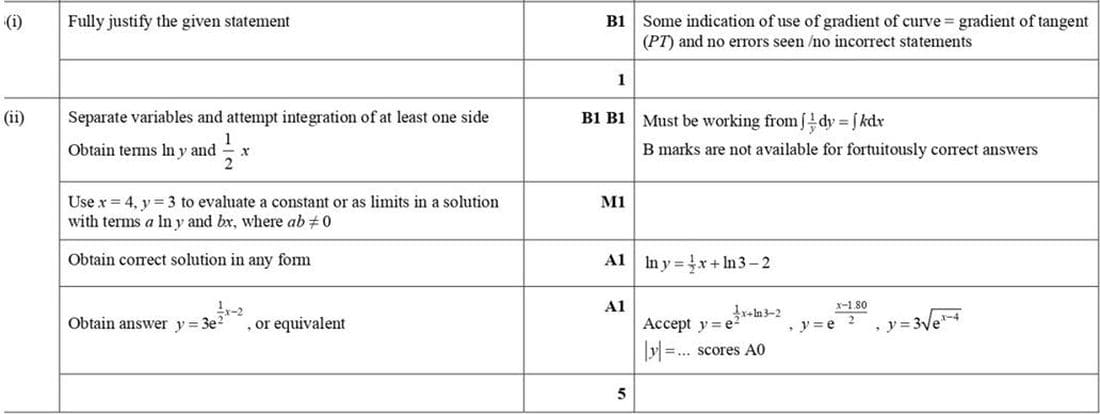
(i) Show that the differential equation satisfied by \(x\) and \(y\) is \(\frac{dy}{dx} = \frac{1}{2}y\).
The point with coordinates \((4, 3)\) lies on the curve.
(ii) Solve the differential equation to obtain the equation of the curve, expressing \(y\) in terms of \(x\).
June 2017 p33 q8
2322
In a certain chemical reaction, a compound A is formed from a compound B. The masses of A and B at time t after the start of the reaction are x and y respectively and the sum of the masses is equal to 50 throughout the reaction. At any time the rate of increase of the mass of A is proportional to the mass of B at that time.
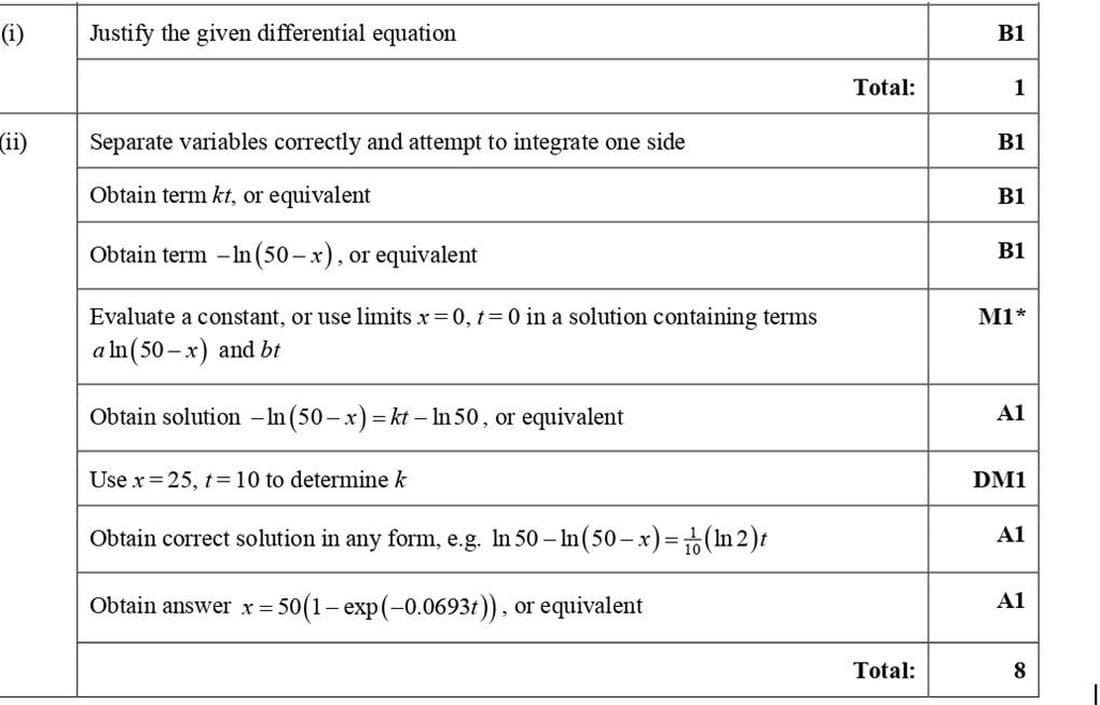
(i) Explain why \(\frac{dx}{dt} = k(50 - x)\), where k is a constant.
It is given that \(x = 0\) when \(t = 0\), and \(x = 25\) when \(t = 10\).
(ii) Solve the differential equation in part (i) and express x in terms of t.
June 2017 p32 q5
2323
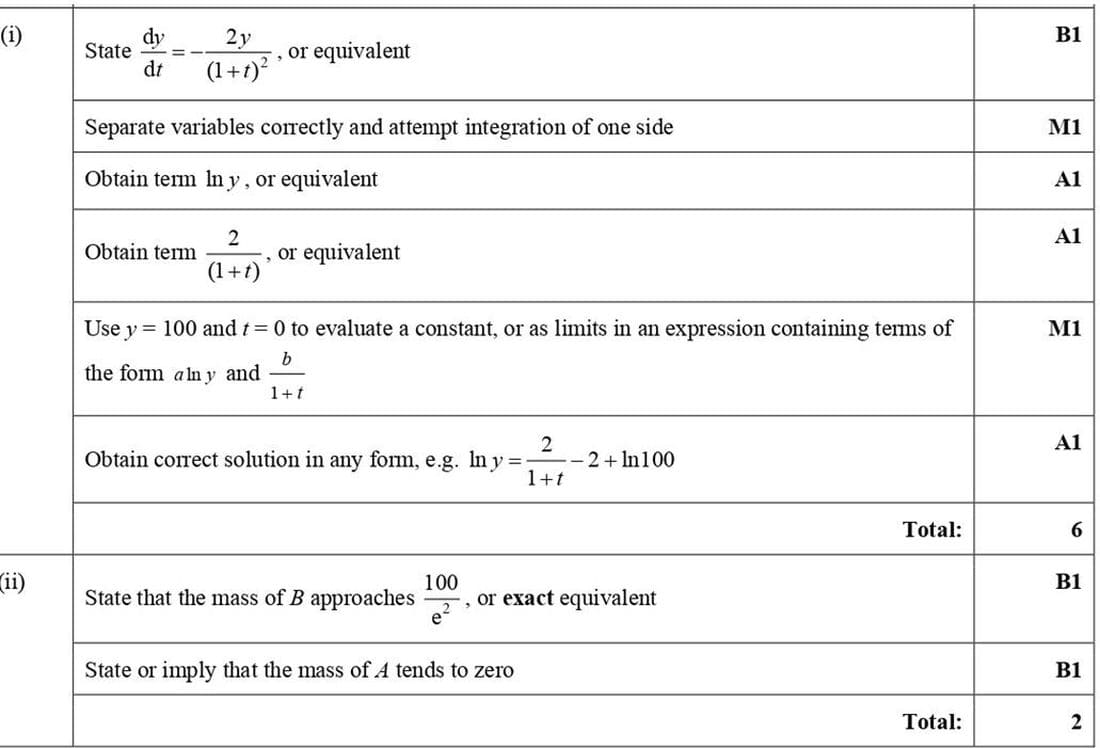
In a certain chemical process a substance A reacts with and reduces a substance B. The masses of A and B at time t after the start of the process are x and y respectively. It is given that \(\frac{dy}{dt} = -0.2xy\) and \(x = \frac{10}{(1+t)^2}\). At the beginning of the process \(y = 100\).
(i) Form a differential equation in y and t, and solve this differential equation.
(ii) Find the exact value approached by the mass of B as t becomes large. State what happens to the mass of A as t becomes large.