Exam-Style Problems
⬅ Back to SubchapterNov 2009 p31 q6
With respect to the origin O, the points A, B and C have position vectors given by \(\overrightarrow{OA} = \mathbf{i} - \mathbf{k}\), \(\overrightarrow{OB} = 3\mathbf{i} + 2\mathbf{j} - 3\mathbf{k}\) and \(\overrightarrow{OC} = 4\mathbf{i} - 3\mathbf{j} + 2\mathbf{k}\).
The mid-point of AB is M. The point N lies on AC between A and C and is such that \(AN = 2NC\).
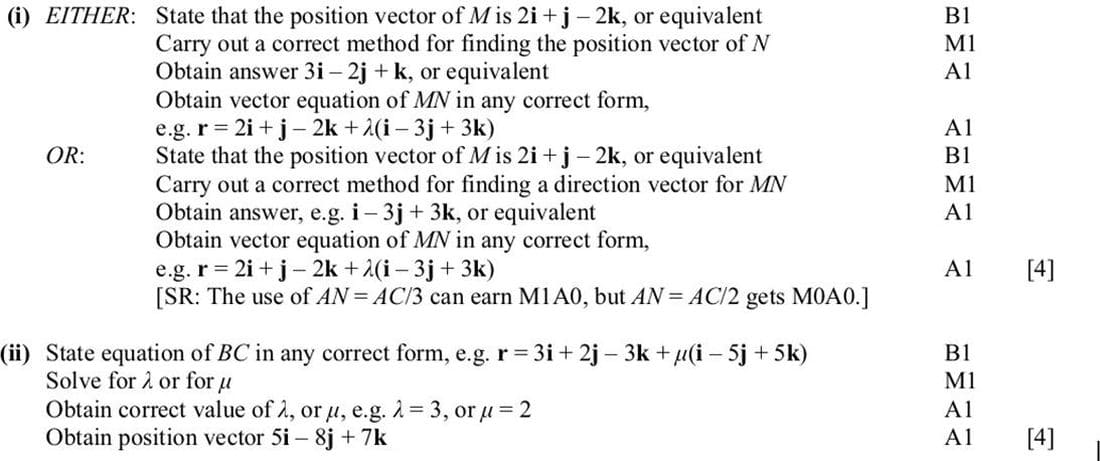
(i) Find a vector equation of the line MN.
(ii) It is given that MN intersects BC at the point P. Find the position vector of P.
June 2008 p3 q10
The points A and B have position vectors, relative to the origin O, given by \(\overrightarrow{OA} = \mathbf{i} + 2\mathbf{j} + 3\mathbf{k}\) and \(\overrightarrow{OB} = 2\mathbf{i} + \mathbf{j} + 3\mathbf{k}\).
The line \(l\) has vector equation \(\mathbf{r} = (1 - 2t)\mathbf{i} + (5 + t)\mathbf{j} + (2 - t)\mathbf{k}\).
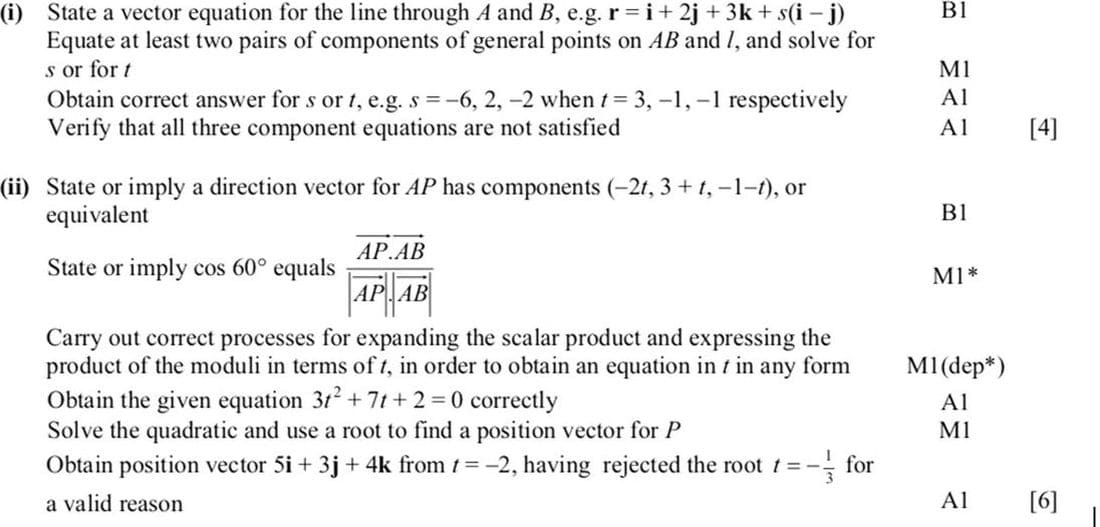
(i) Show that \(l\) does not intersect the line passing through A and B.
(ii) The point P lies on \(l\) and is such that angle \(PAB\) is equal to 60°. Given that the position vector of P is \((1 - 2t)\mathbf{i} + (5 + t)\mathbf{j} + (2 - t)\mathbf{k}\), show that \(3t^2 + 7t + 2 = 0\). Hence find the only possible position vector of P.
June 2006 p3 q10
The points A and B have position vectors, relative to the origin O, given by
\(\overrightarrow{OA} = \begin{pmatrix} -1 \\ 3 \\ 5 \end{pmatrix}\) and \(\overrightarrow{OB} = \begin{pmatrix} 3 \\ -1 \\ -4 \end{pmatrix}\).
The line l passes through A and is parallel to OB. The point N is the foot of the perpendicular from B to l.
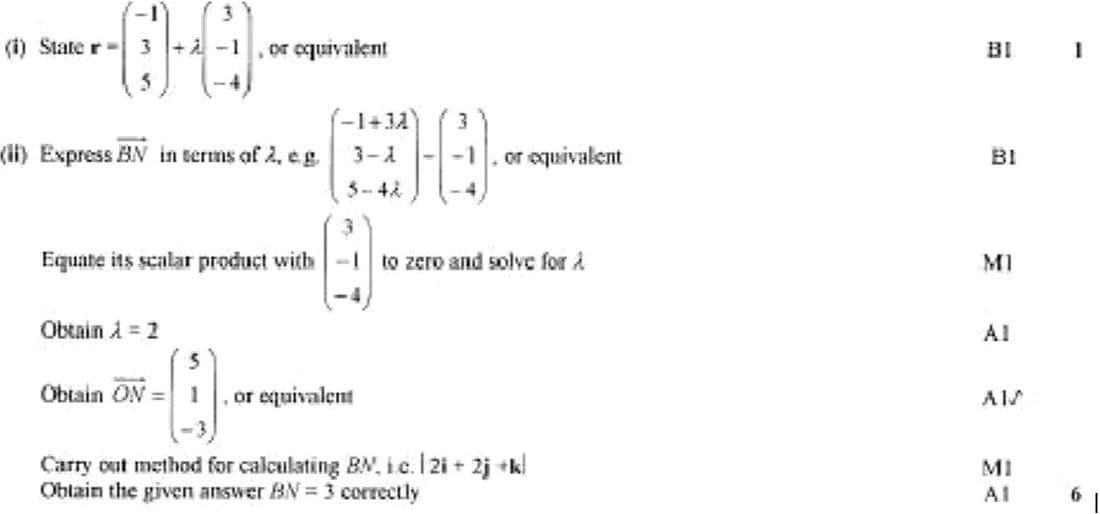
(i) State a vector equation for the line l.
(ii) Find the position vector of N and show that \(BN = 3\).
Problem 2169
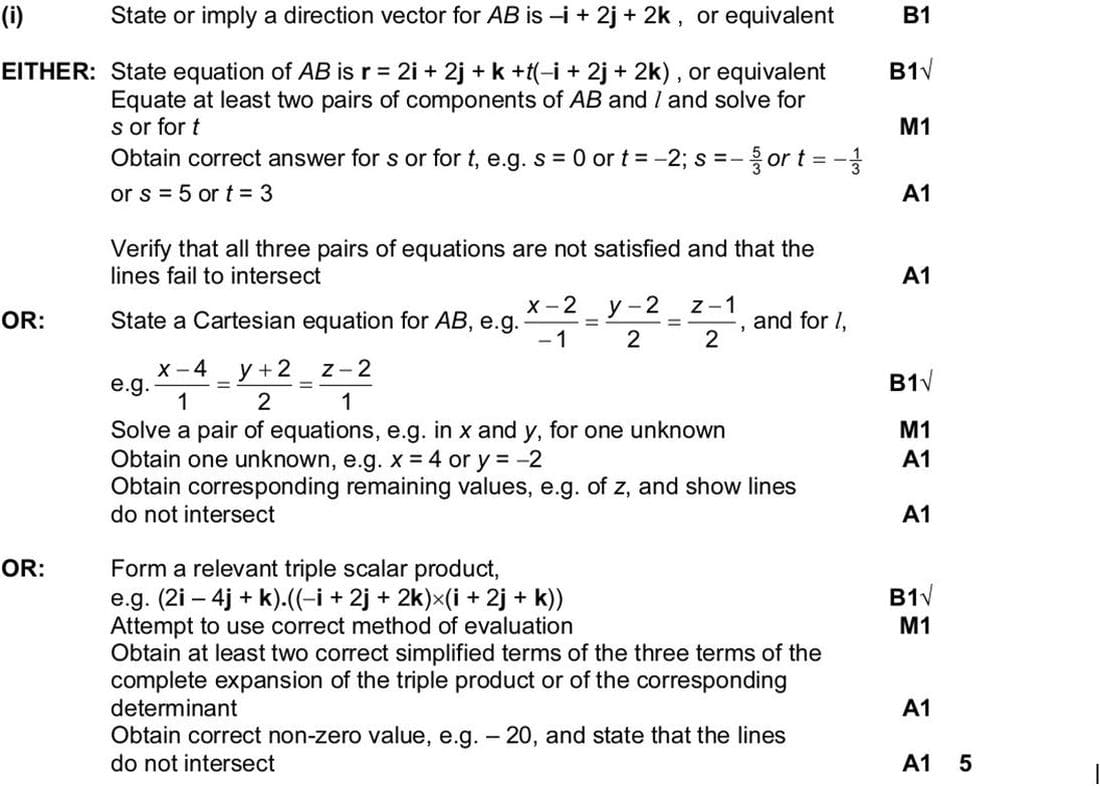
With respect to the origin O, the points A and B have position vectors given by \(\overrightarrow{OA} = 2\mathbf{i} + 2\mathbf{j} + \mathbf{k}\) and \(\overrightarrow{OB} = \mathbf{i} + 4\mathbf{j} + 3\mathbf{k}\).
The line l has vector equation \(\mathbf{r} = 4\mathbf{i} - 2\mathbf{j} + 2\mathbf{k} + s(\mathbf{i} + 2\mathbf{j} + \mathbf{k})\).
Prove that the line l does not intersect the line through A and B.
Problem 2170
With respect to the origin O, the points A, B, C and D have position vectors given by
\(\overrightarrow{OA} = \begin{pmatrix} 3 \\ -1 \\ 2 \end{pmatrix}, \quad \overrightarrow{OB} = \begin{pmatrix} 1 \\ 2 \\ -3 \end{pmatrix}, \quad \overrightarrow{OC} = \begin{pmatrix} 1 \\ -2 \\ 5 \end{pmatrix} \quad \text{and} \quad \overrightarrow{OD} = \begin{pmatrix} 5 \\ -6 \\ 11 \end{pmatrix}.\)
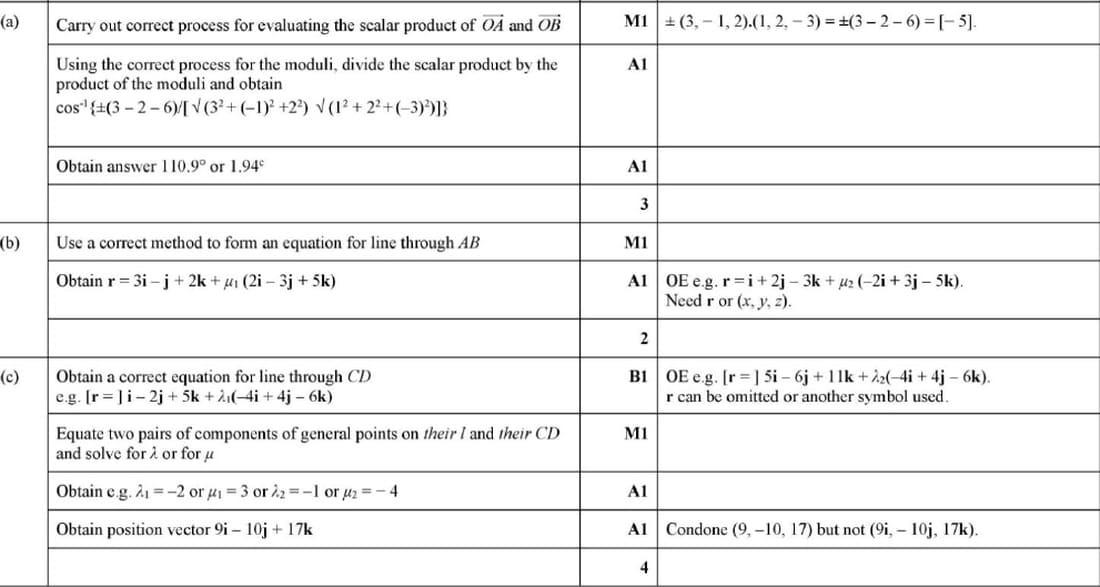
(a) Find the obtuse angle between the vectors \(\overrightarrow{OA}\) and \(\overrightarrow{OB}\).
The line \(l\) passes through the points \(A\) and \(B\).
(b) Find a vector equation for the line \(l\).
(c) Find the position vector of the point of intersection of the line \(l\) and the line passing through \(C\) and \(D\).