Exam-Style Problems
⬅ Back to SubchapterNov 2020 p31 q2
1945
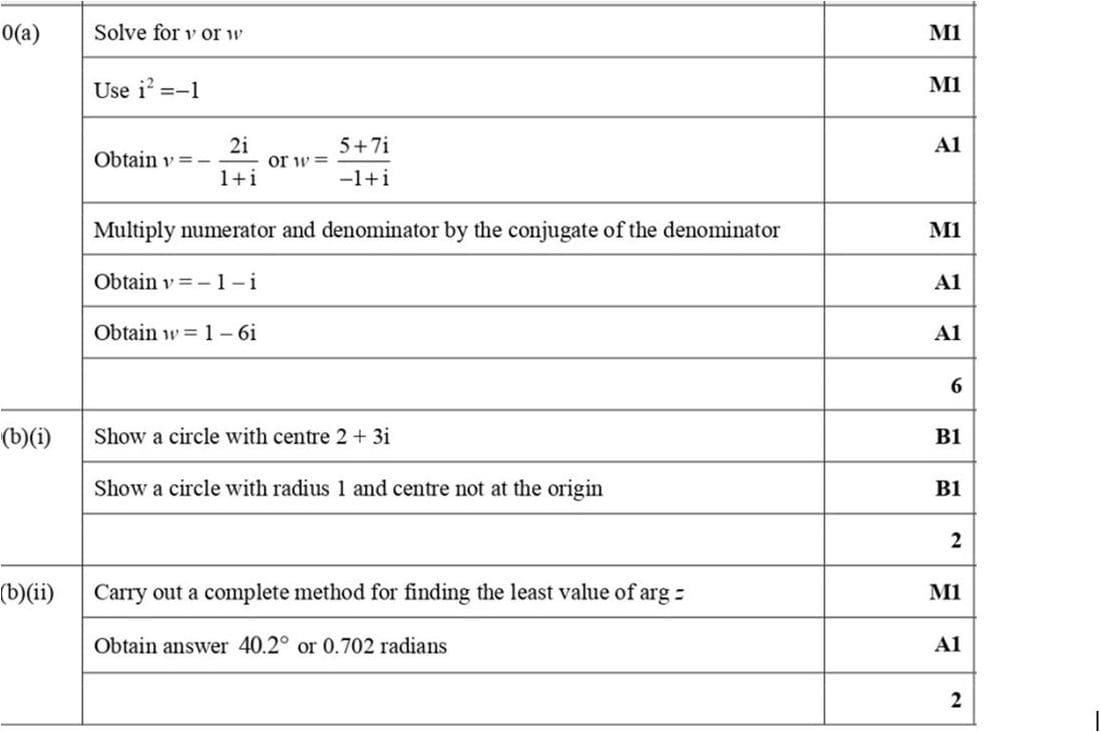
On a sketch of an Argand diagram, shade the region whose points represent complex numbers \(z\) satisfying the inequalities \(|z| \geq 2\) and \(|z - 1 + i| \leq 1\).
June 2020 p33 q9
1946
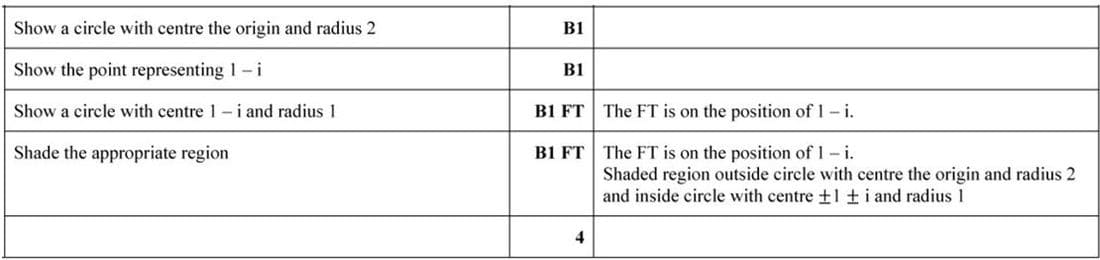
(a) The complex numbers u and w are such that
\(u - w = 2i\) and \(uw = 6\).
Find u and w, giving your answers in the form x + iy, where x and y are real and exact.
(b) On a sketch of an Argand diagram, shade the region whose points represent complex numbers z satisfying the inequalities
\(|z - 2 - 2i| \leq 2\), \(0 \leq \arg z \leq \frac{\pi}{4}\) and \(\text{Re } z \leq 3\).
June 2020 p32 q8
1947
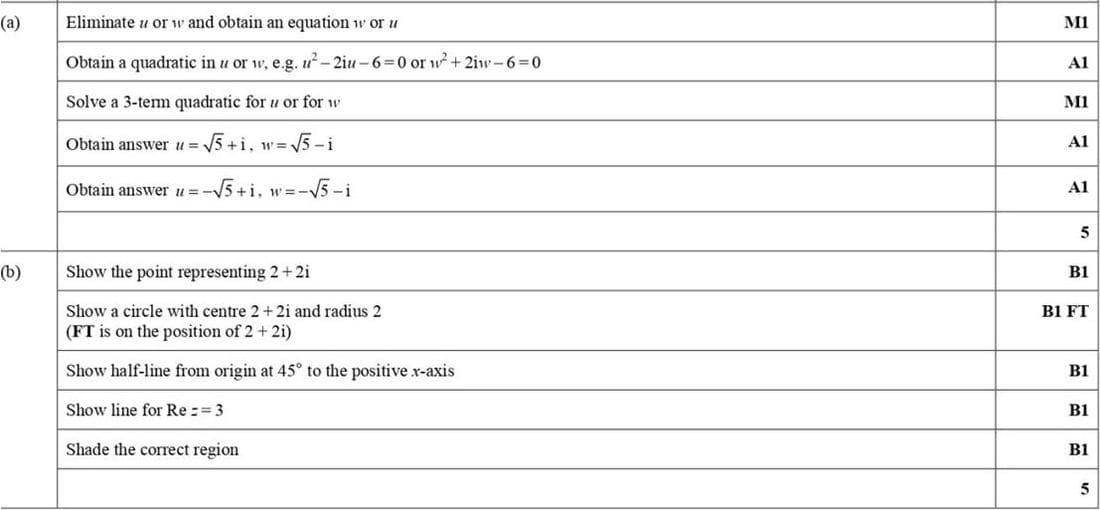
(a) Solve the equation \((1 + 2i)w + iw^* = 3 + 5i\). Give your answer in the form \(x + iy\), where \(x\) and \(y\) are real.
(b) (i) On a sketch of an Argand diagram, shade the region whose points represent complex numbers \(z\) satisfying the inequalities \(|z - 2 - 2i| \leq 1\) and \(\arg(z - 4i) \geq -\frac{1}{4}\pi\).
(ii) Find the least value of \(\text{Im } z\) for points in this region, giving your answer in an exact form.
June 2020 p31 q10
1948
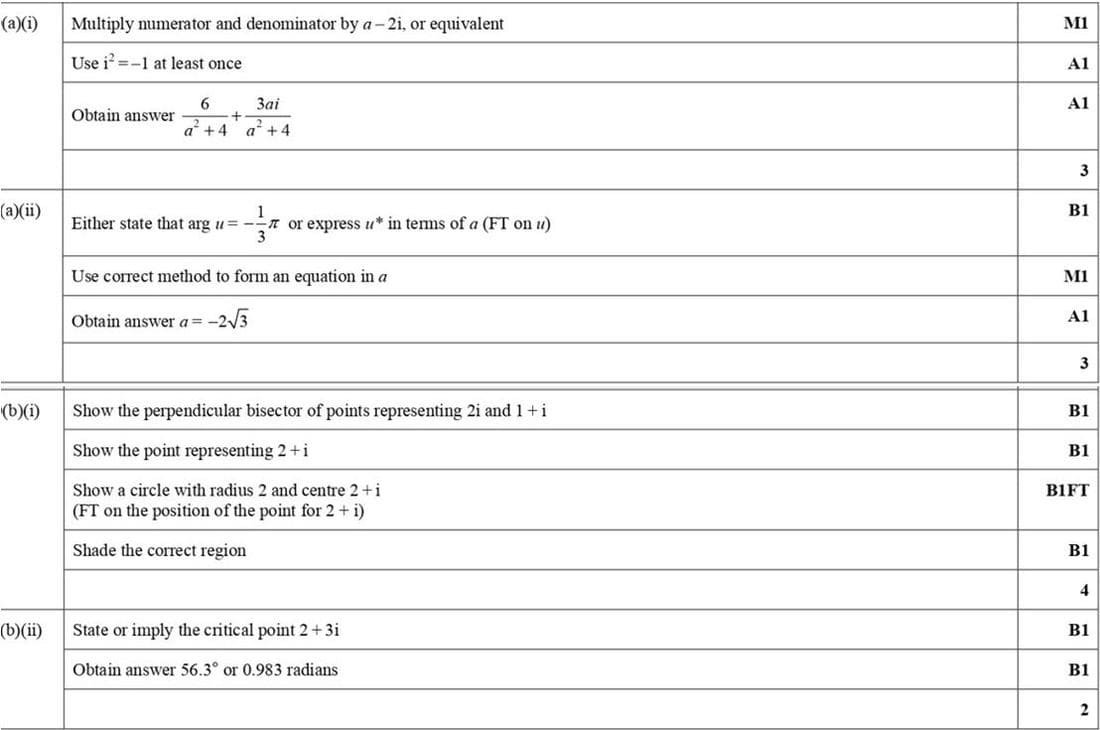
(a) The complex number u is defined by \(u = \frac{3i}{a + 2i}\), where a is real.
- Express u in the Cartesian form x + iy, where x and y are in terms of a.
- Find the exact value of a for which \(\arg u^* = \frac{1}{3} \pi\).
(b)
- On a sketch of an Argand diagram, shade the region whose points represent complex numbers z satisfying the inequalities \(|z - 2i| \leq |z - 1 - i|\) and \(|z - 2 - i| < 2\).
- Calculate the least value of \(\arg z\) for points in this region.
Feb/Mar 2020 p32 q10
1949
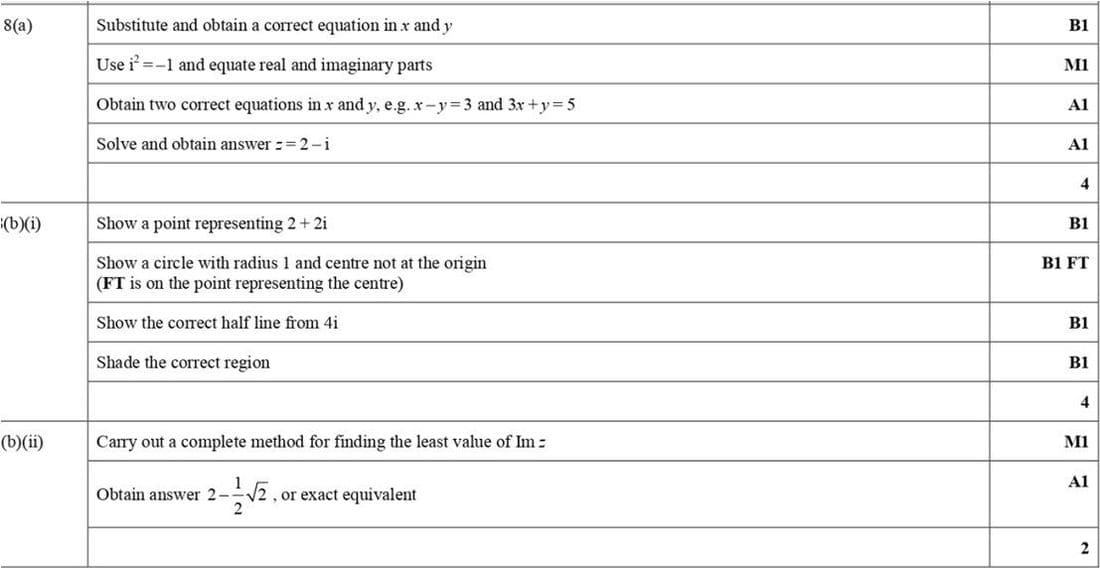
(a) The complex numbers \(v\) and \(w\) satisfy the equations
\(v + iw = 5\) and \((1 + 2i)v - w = 3i\).
Solve the equations for \(v\) and \(w\), giving your answers in the form \(x + iy\), where \(x\) and \(y\) are real.
(b) (i) On an Argand diagram, sketch the locus of points representing complex numbers \(z\) satisfying \(|z - 2 - 3i| = 1\).
(ii) Calculate the least value of \(\arg z\) for points on this locus.