Exam-Style Problems
⬅ Back to SubchapterNov 2017 p31 q9
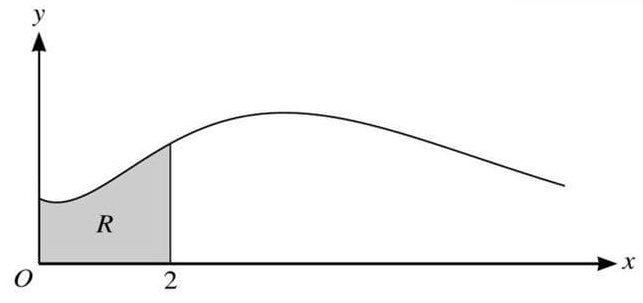
The diagram shows the curve \(y = (1 + x^2) e^{-\frac{1}{2}x}\) for \(x \geq 0\). The shaded region \(R\) is enclosed by the curve, the \(x\)-axis and the lines \(x = 0\) and \(x = 2\).
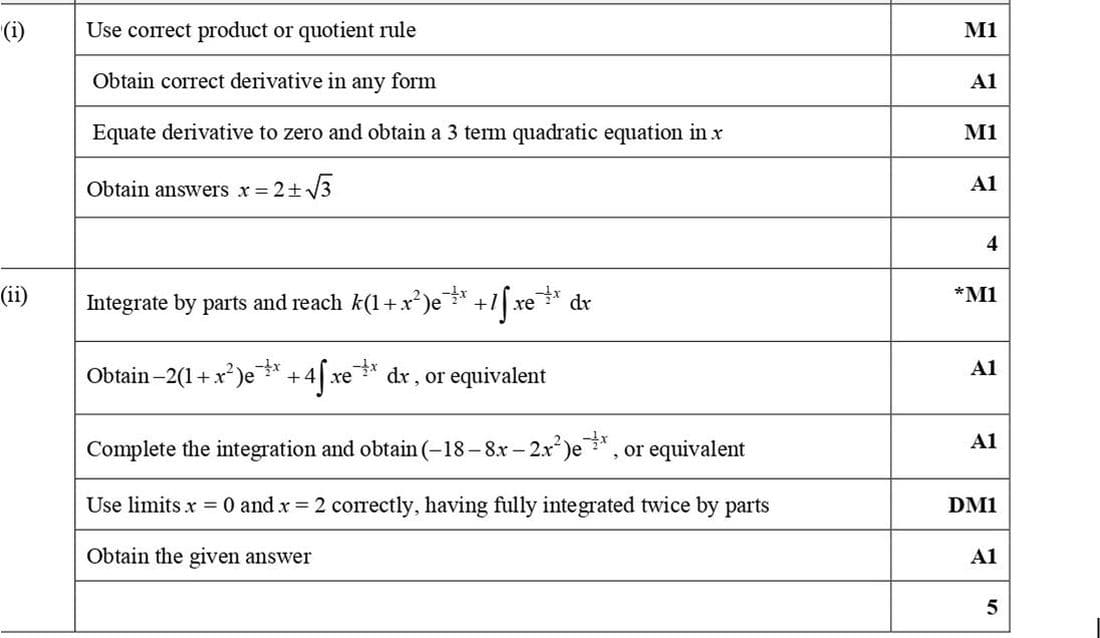
(i) Find the exact values of the \(x\)-coordinates of the stationary points of the curve.
(ii) Show that the exact value of the area of \(R\) is \(18 - \frac{42}{e}\).
Feb/Mar 2017 p32 q10
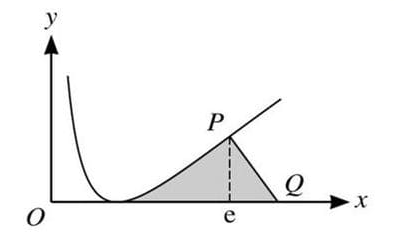
The diagram shows the curve \(y = (\ln x)^2\). The x-coordinate of the point \(P\) is equal to \(e\), and the normal to the curve at \(P\) meets the x-axis at \(Q\).
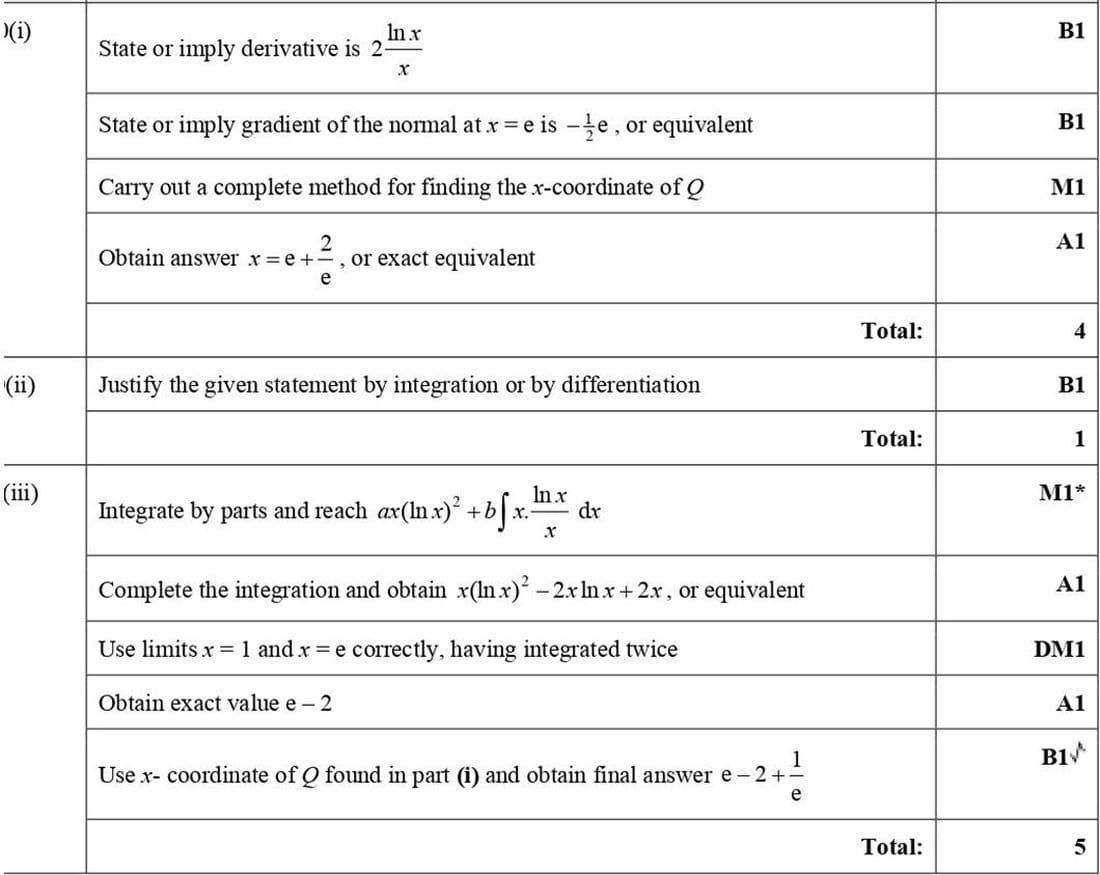
(i) Find the x-coordinate of \(Q\).
(ii) Show that \(\int \ln x \, dx = x \ln x - x + c\), where \(c\) is a constant.
(iii) Using integration by parts, or otherwise, find the exact value of the area of the shaded region between the curve, the x-axis and the normal \(PQ\).
Nov 2016 p31 q7
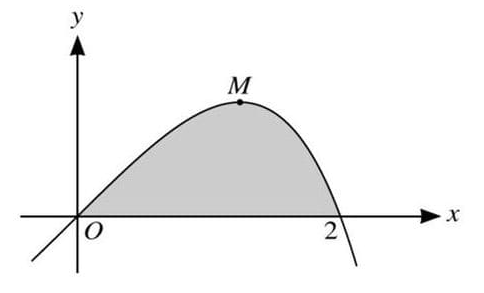
The diagram shows part of the curve \(y = (2x - x^2)e^{\frac{1}{2}x}\) and its maximum point \(M\).
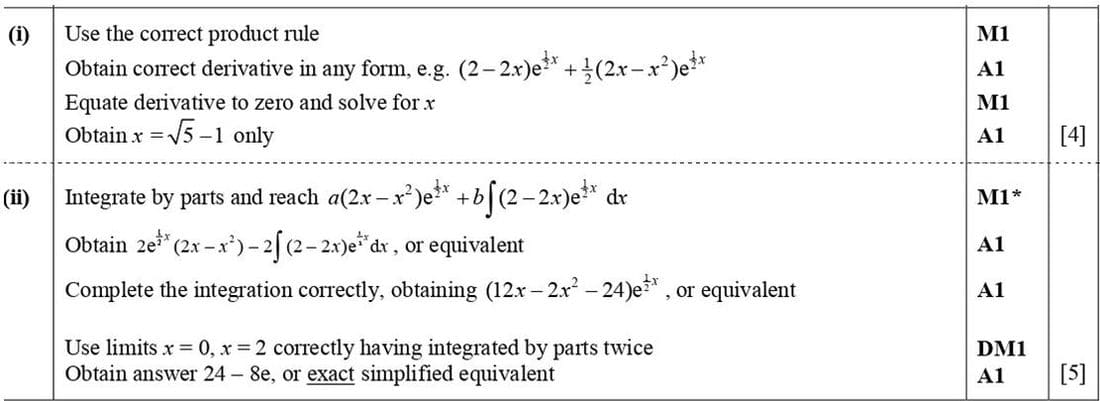
(i) Find the exact \(x\)-coordinate of \(M\).
(ii) Find the exact value of the area of the shaded region bounded by the curve and the positive \(x\)-axis.
June 2023 p33 q7
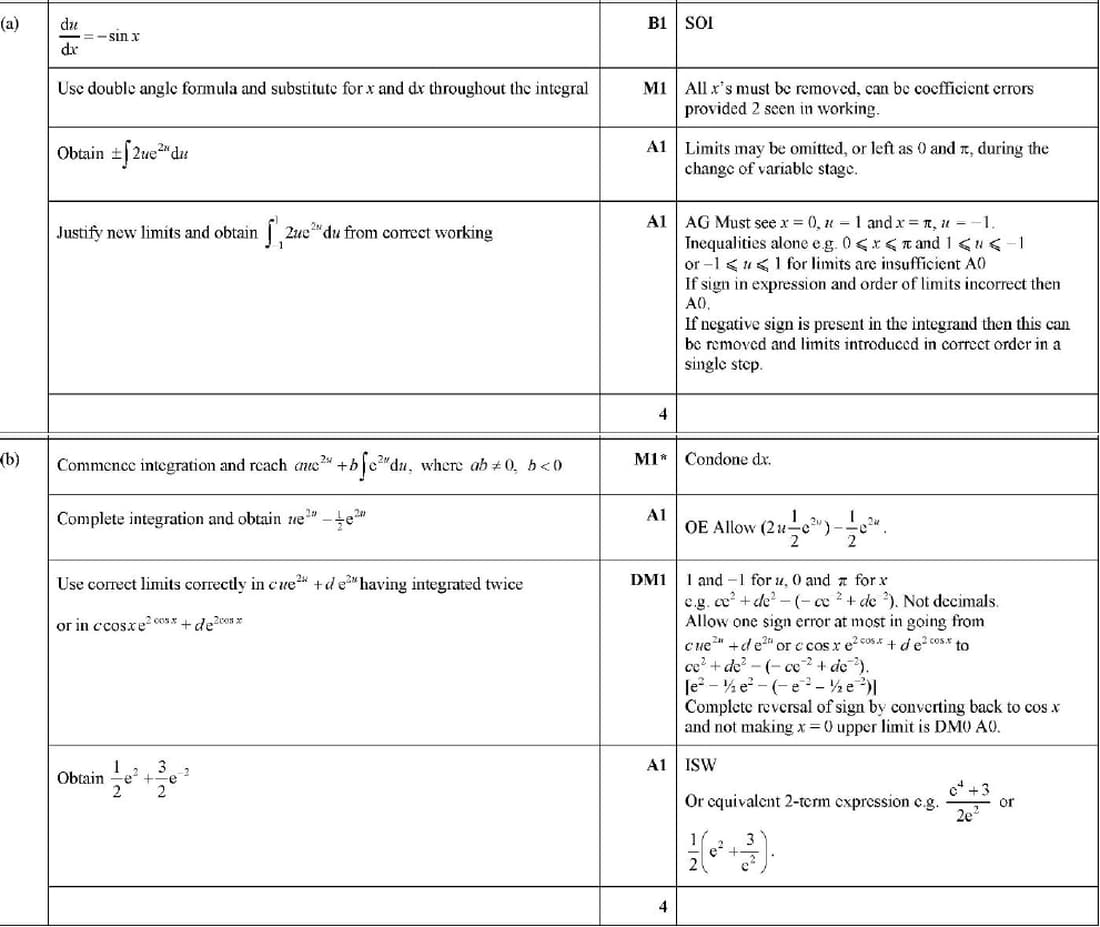
(a) Use the substitution \(u = \, \cos x\) to show that \(\int_{0}^{\pi} \sin 2x \, e^{2 \cos x} \, dx = \int_{-1}^{1} 2u e^{2u} \, du\).
(b) Hence find the exact value of \(\int_{0}^{\pi} \sin 2x \, e^{2 \cos x} \, dx\).
Problem 1775
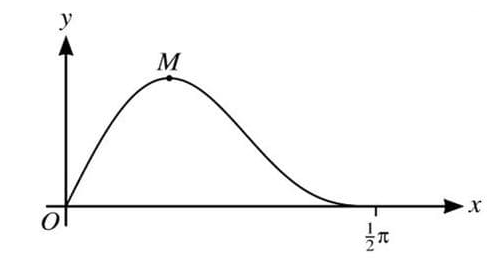
The diagram shows the curve \(y = \\sin 2x \\cos^2 x\) for \(0 \leq x \leq \frac{1}{2}\pi\), and its maximum point \(M\).
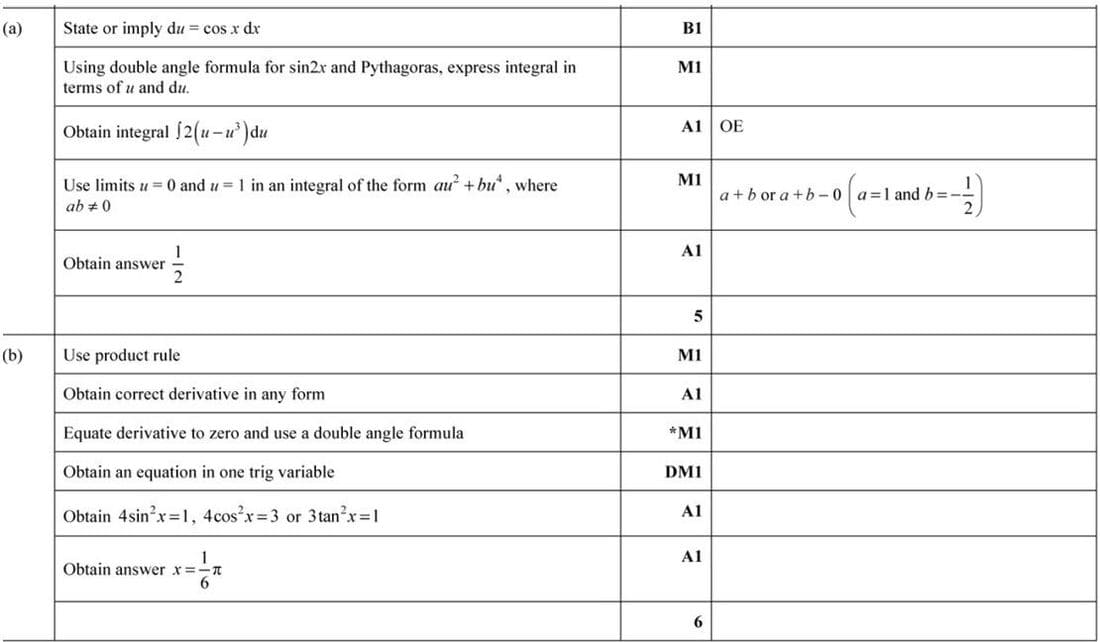
(a) Using the substitution \(u = \\sin x\), find the exact area of the region bounded by the curve and the \(x\)-axis.
(b) Find the exact \(x\)-coordinate of \(M\).