Exam-Style Problems
⬅ Back to SubchapterJune 2013 p13 q11
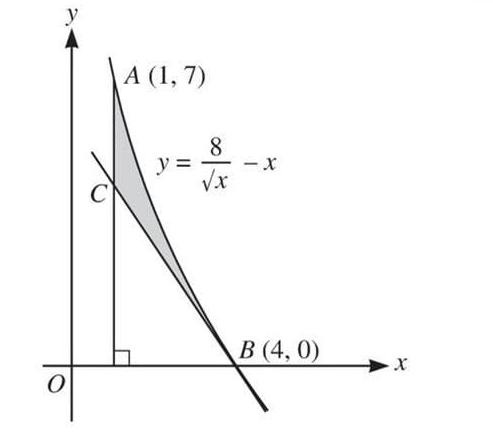
The diagram shows part of the curve \(y = \frac{8}{\sqrt{x}} - x\) and points \(A (1, 7)\) and \(B (4, 0)\) which lie on the curve. The tangent to the curve at \(B\) intersects the line \(x = 1\) at the point \(C\).
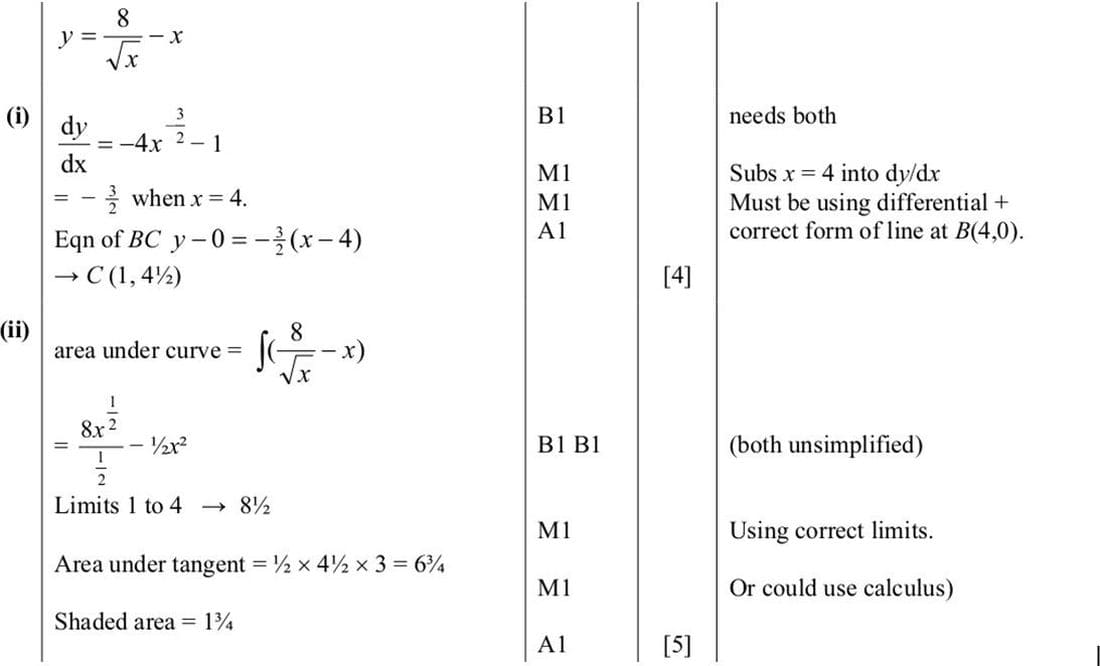
(i) Find the coordinates of \(C\).
(ii) Find the area of the shaded region.
June 2013 p12 q11
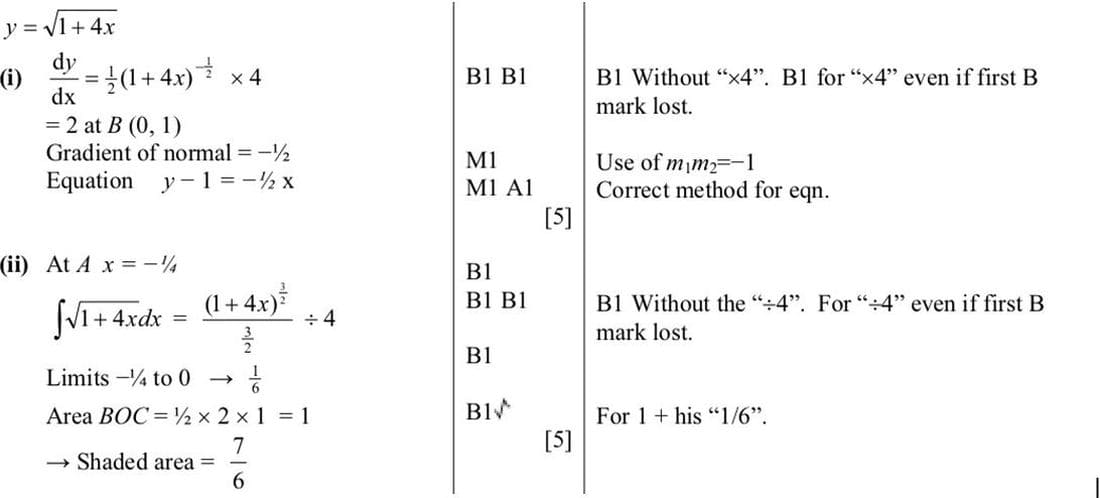
The diagram shows the curve \(y = \sqrt{1 + 4x}\), which intersects the x-axis at \(A\) and the y-axis at \(B\). The normal to the curve at \(B\) meets the x-axis at \(C\). Find
(i) the equation of \(BC\),
(ii) the area of the shaded region.

June 2013 p11 q10
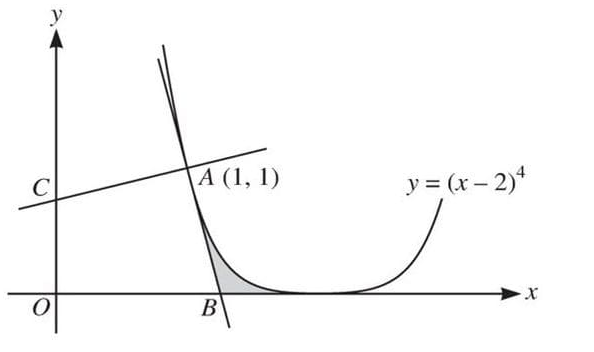
The diagram shows part of the curve \(y = (x - 2)^4\) and the point \(A (1, 1)\) on the curve. The tangent at \(A\) cuts the \(x\)-axis at \(B\) and the normal at \(A\) cuts the \(y\)-axis at \(C\).
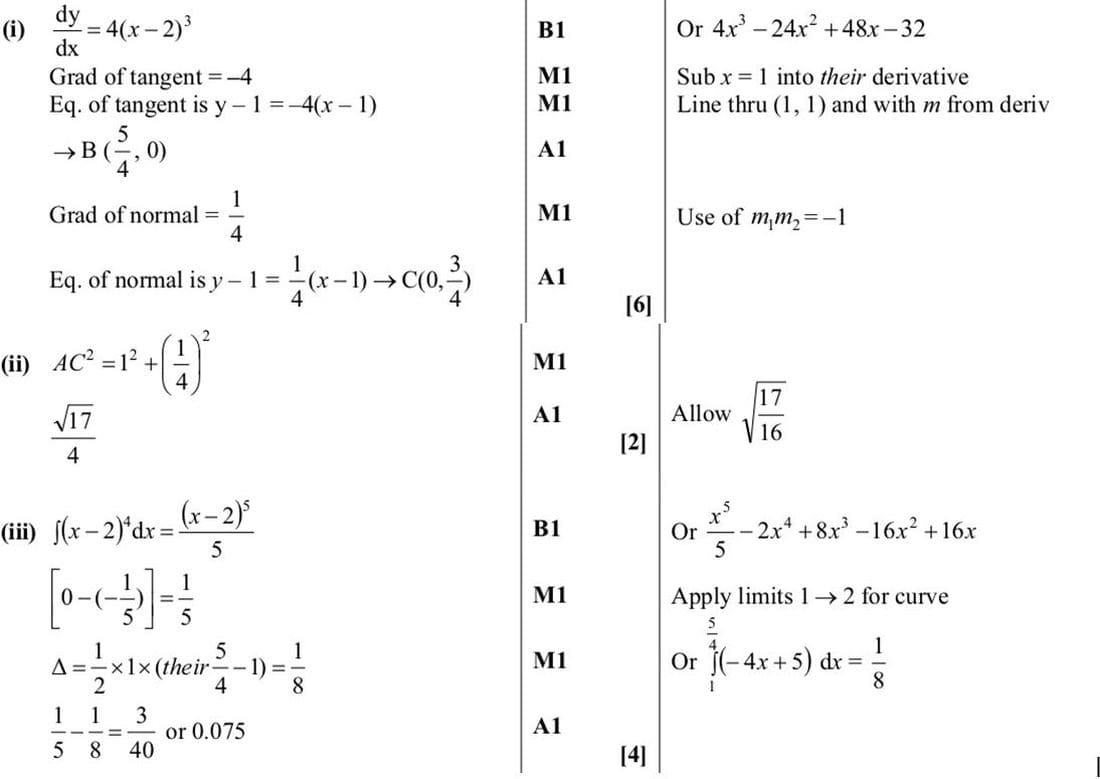
- Find the coordinates of \(B\) and \(C\).
- Find the distance \(AC\), giving your answer in the form \(\frac{\sqrt{a}}{b}\), where \(a\) and \(b\) are integers.
- Find the area of the shaded region.
Nov 2012 p13 q11
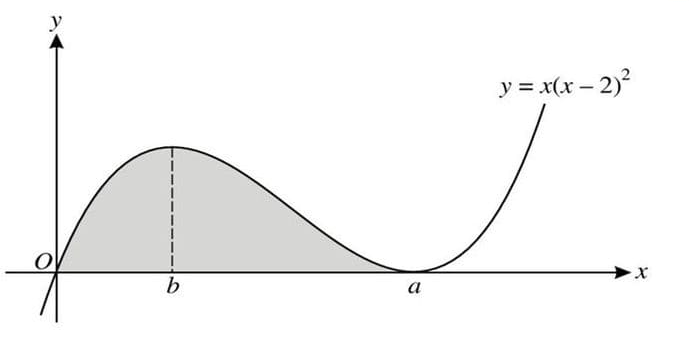
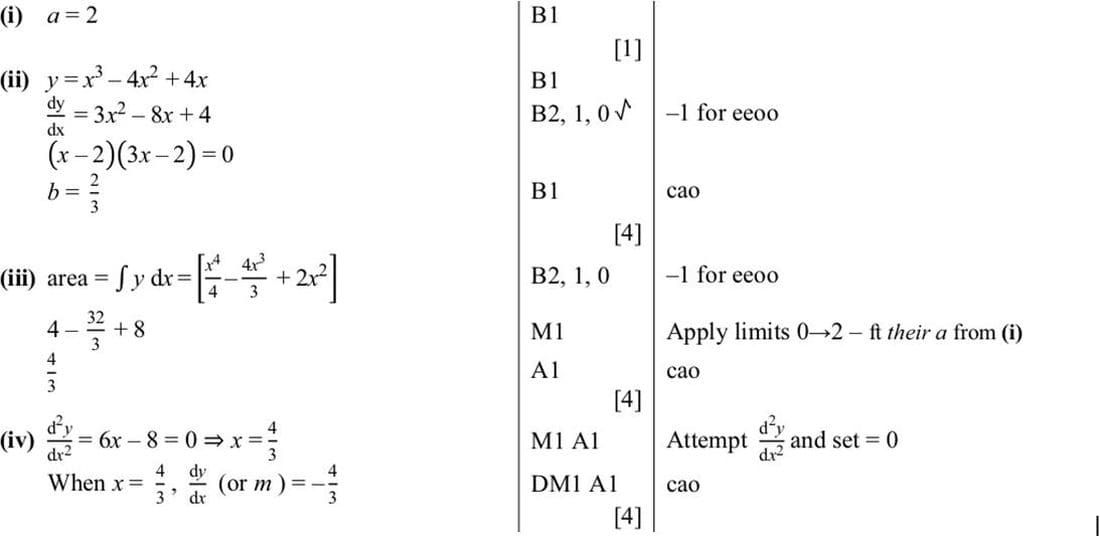
The diagram shows the curve with equation \(y = x(x - 2)^2\). The minimum point on the curve has coordinates \((a, 0)\) and the \(x\)-coordinate of the maximum point is \(b\), where \(a\) and \(b\) are constants.
- State the value of \(a\).
- Find the value of \(b\).
- Find the area of the shaded region.
- The gradient, \(\frac{dy}{dx}\), of the curve has a minimum value \(m\). Find the value of \(m\).
Nov 2012 p11 q8
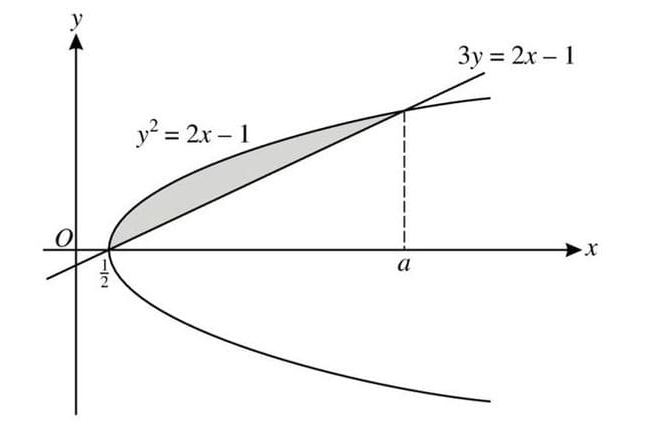
The diagram shows the curve \(y^2 = 2x - 1\) and the straight line \(3y = 2x - 1\). The curve and straight line intersect at \(x = \frac{1}{2}\) and \(x = a\), where \(a\) is a constant.
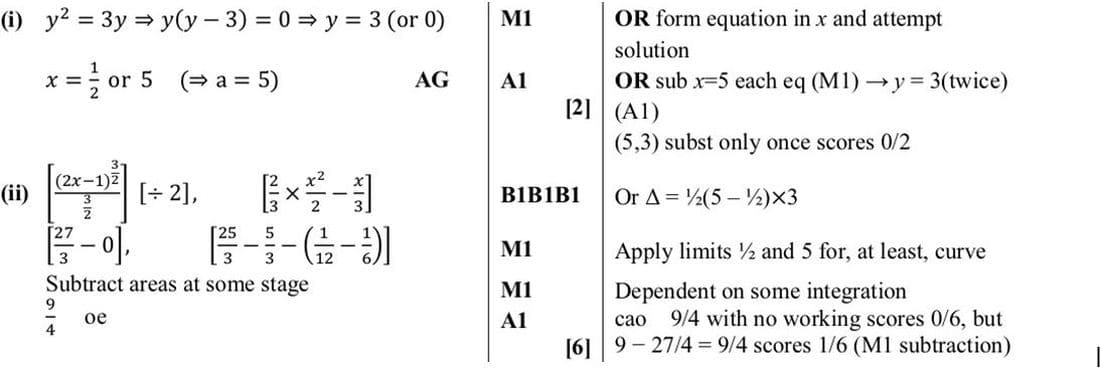
(i) Show that \(a = 5\).
(ii) Find, showing all necessary working, the area of the shaded region.