Exam-Style Problems
⬅ Back to SubchapterFM Nov 2024 p12 q01
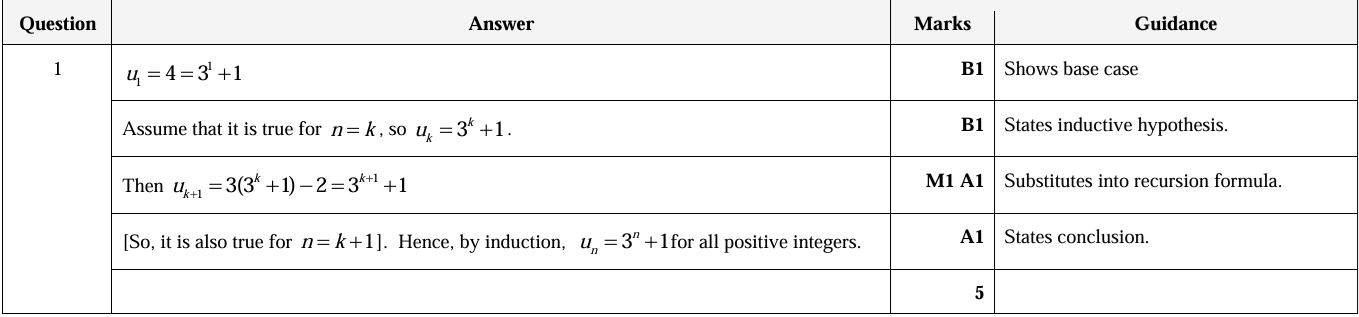
The sequence \(u_1, u_2, u_3, \ldots\) is such that \(u_1 = 4\) and \(u_{n+1} = 3u_n - 2\) for \(n \geq 1\).
Prove by induction that \(u_n = 3^n + 1\) for all positive integers \(n\).
FM Nov 2024 p12 q02
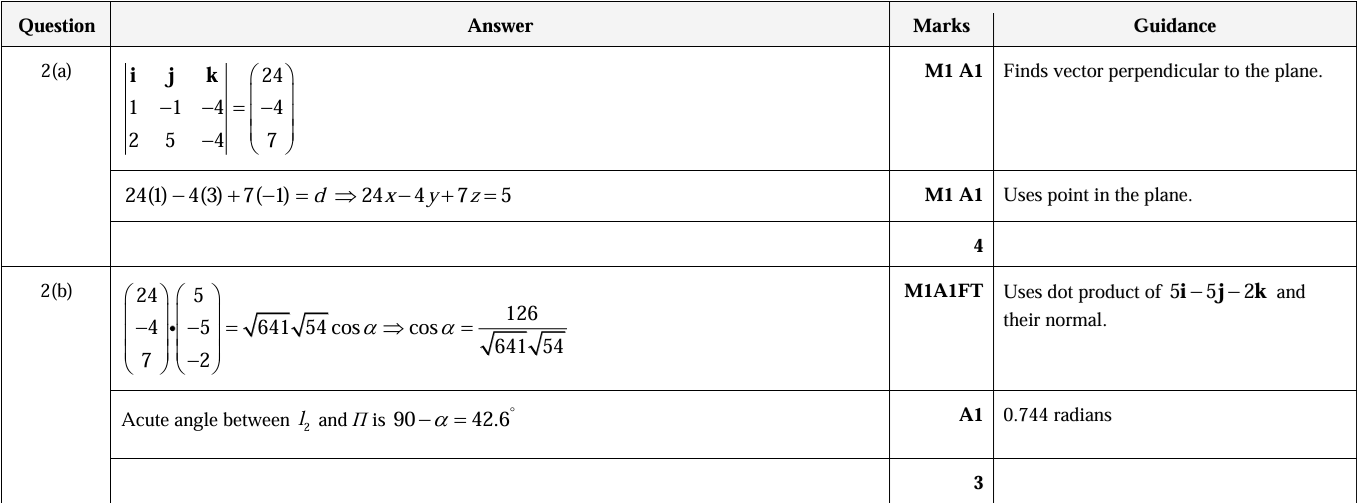
The line \(l_1\) has equation \(\mathbf{r} = \mathbf{i} + 3\mathbf{j} - \mathbf{k} + \lambda (\mathbf{i} - \mathbf{j} - 4\mathbf{k})\).
The plane \(\Pi\) contains \(l_1\) and is parallel to the vector \(2\mathbf{i} + 5\mathbf{j} - 4\mathbf{k}\).
(a) Find the equation of \(\Pi\), giving your answer in the form \(ax + by + cz = d\).
The line \(l_2\) is parallel to the vector \(5\mathbf{i} - 5\mathbf{j} - 2\mathbf{k}\).
(b) Find the acute angle between \(l_2\) and \(\Pi\).
FM Nov 2024 p12 q03
It is given that
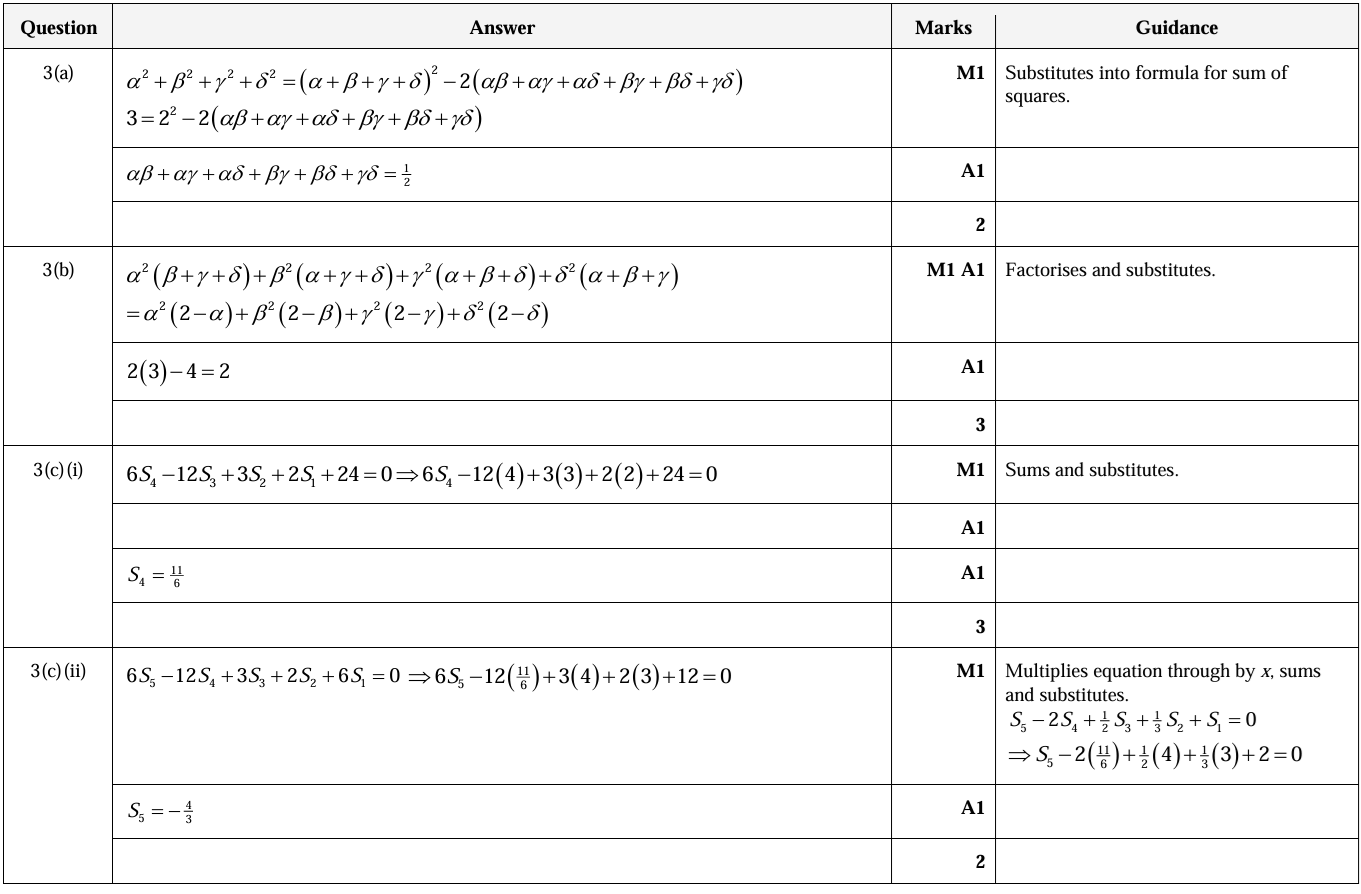
\(\alpha + \beta + \gamma + \delta = 2,\)
\(\alpha^2 + \beta^2 + \gamma^2 + \delta^2 = 3,\)
\(\alpha^3 + \beta^3 + \gamma^3 + \delta^3 = 4.\)
(a) Find the value of \(\alpha \beta + \alpha \gamma + \alpha \delta + \beta \gamma + \beta \delta + \gamma \delta.\)
(b) Find the value of \(\alpha^2 \beta + \alpha^2 \gamma + \alpha^2 \delta + \beta^2 \alpha + \beta^2 \gamma + \beta^2 \delta + \gamma^2 \alpha + \gamma^2 \beta + \gamma^2 \delta + \delta^2 \alpha + \delta^2 \beta + \delta^2 \gamma.\)
(c) It is given that \(\alpha, \beta, \gamma, \delta\) are the roots of the equation
\(6x^4 - 12x^3 + 3x^2 + 2x + 6 = 0.\)
(i) Find the value of \(\alpha^4 + \beta^4 + \gamma^4 + \delta^4.\)
(ii) Find the value of \(\alpha^5 + \beta^5 + \gamma^5 + \delta^5.\)
FM Nov 2024 p12 q04
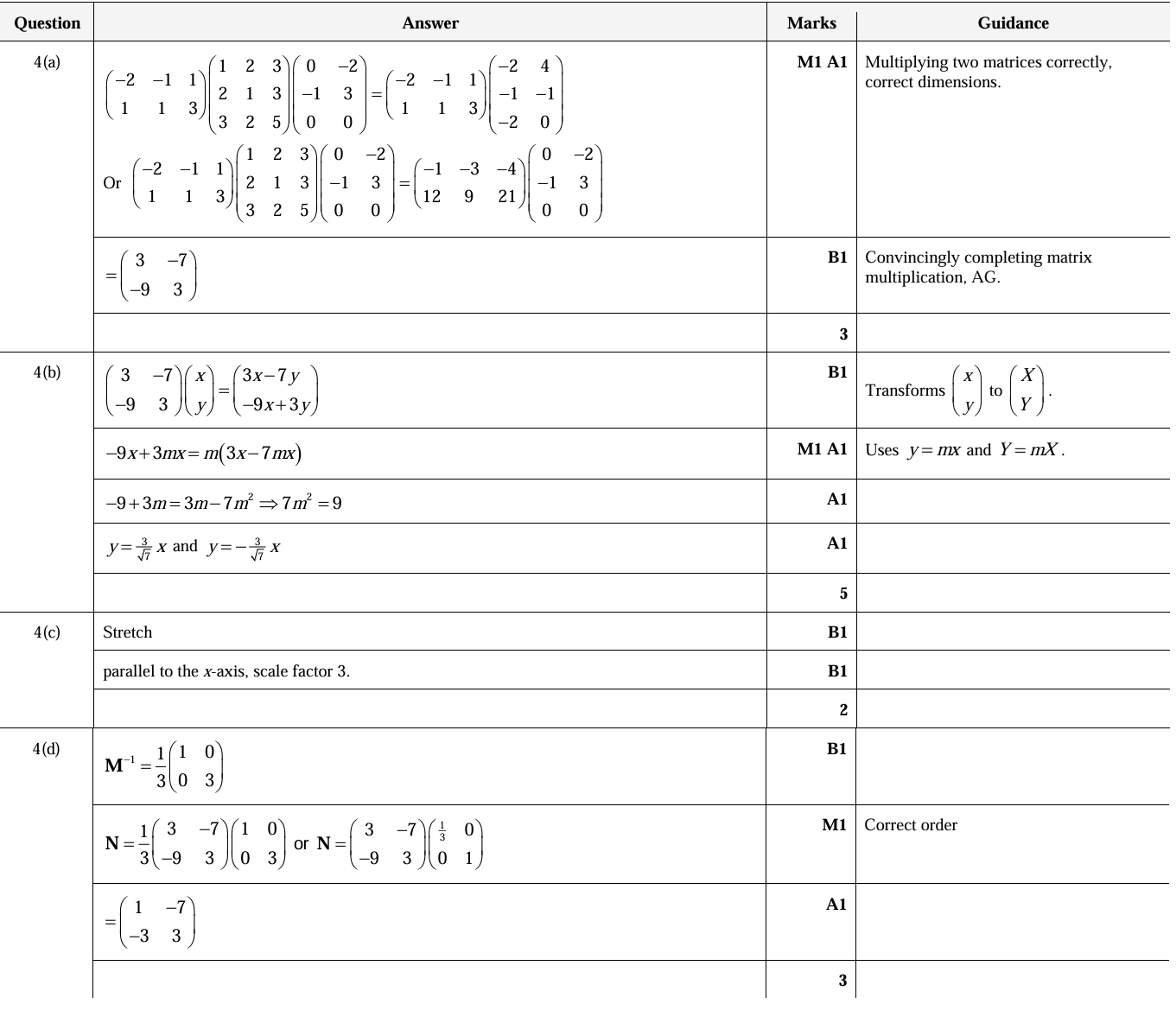
The matrices A, B and C are given by
\(A = \begin{pmatrix} 1 & 2 & 3 \\ 2 & 1 & 3 \\ 3 & 2 & 5 \end{pmatrix}, \ B = \begin{pmatrix} 0 & -2 \\ -1 & 3 \\ 0 & 0 \end{pmatrix} \text{ and } C = \begin{pmatrix} -2 & -1 \\ 1 & 1 \end{pmatrix}.\)
(a) Show that \(CAB = \begin{pmatrix} 3 & -7 \\ -9 & 3 \end{pmatrix}.\) [3]
(b) Find the equations of the invariant lines, through the origin, of the transformation in the \(x-y\) plane represented by \(CAB.\) [5]
Let \(M = \begin{pmatrix} 3 & 0 \\ 0 & 1 \end{pmatrix}.\)
(c) Give full details of the transformation represented by \(M.\) [2]
(d) Find the matrix \(N\) such that \(NM = CAB.\) [3]
FM Nov 2024 p12 q05
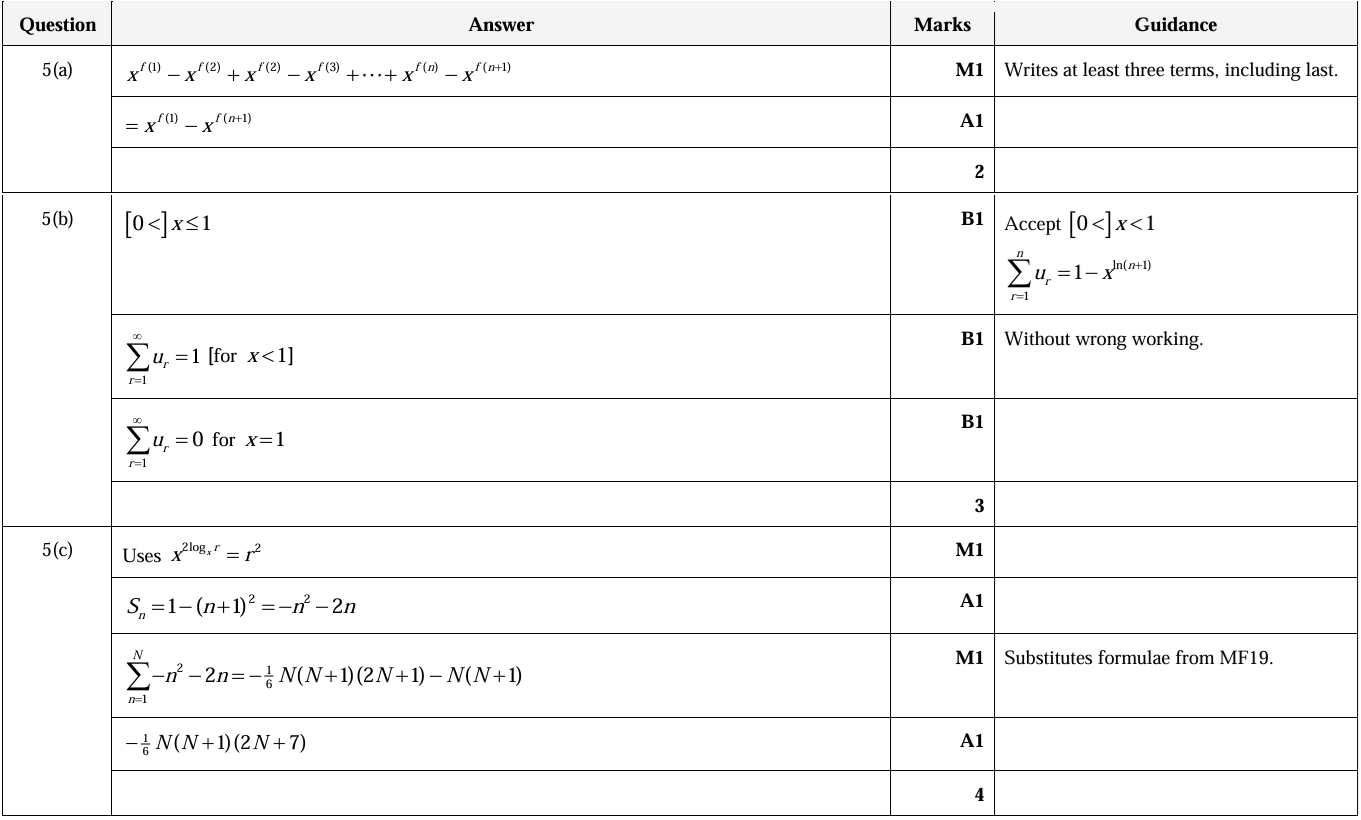
It is given that \(S_n = \sum_{r=1}^{n} u_r\), where \(u_r = x^{f(r)} - x^{f(r+1)}\) and \(x > 0\).
(a) Find \(S_n\) in terms of \(n, x\) and the function \(f\).
(b) Given that \(f(r) = \ln r\), find the set of values of \(x\) for which the infinite series \(u_1 + u_2 + u_3 + \ldots\) is convergent and give the sum to infinity when this exists.
(c) Given instead that \(f(r) = 2 \log_x r\) where \(x \neq 1\), use standard results from the List of formulae (MF19) to find \(\sum_{n=1}^{N} S_n\) in terms of \(N\). Fully factorise your answer.