Exam-Style Problems
⬅ Back to SubchapterNov 2015 p42 q6
4090
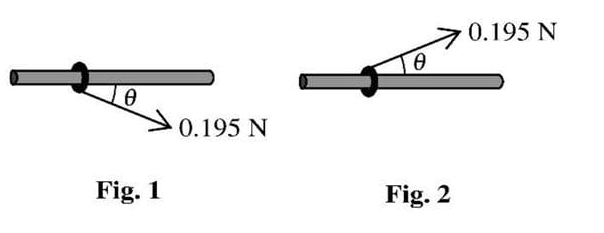
A small ring of mass 0.024 kg is threaded on a fixed rough horizontal rod. A light inextensible string is attached to the ring and the string is pulled with a force of magnitude 0.195 N at an angle of \(\theta\) with the horizontal, where \(\sin \theta = \frac{5}{13}\). When the angle \(\theta\) is below the horizontal (see Fig. 1) the ring is in limiting equilibrium.
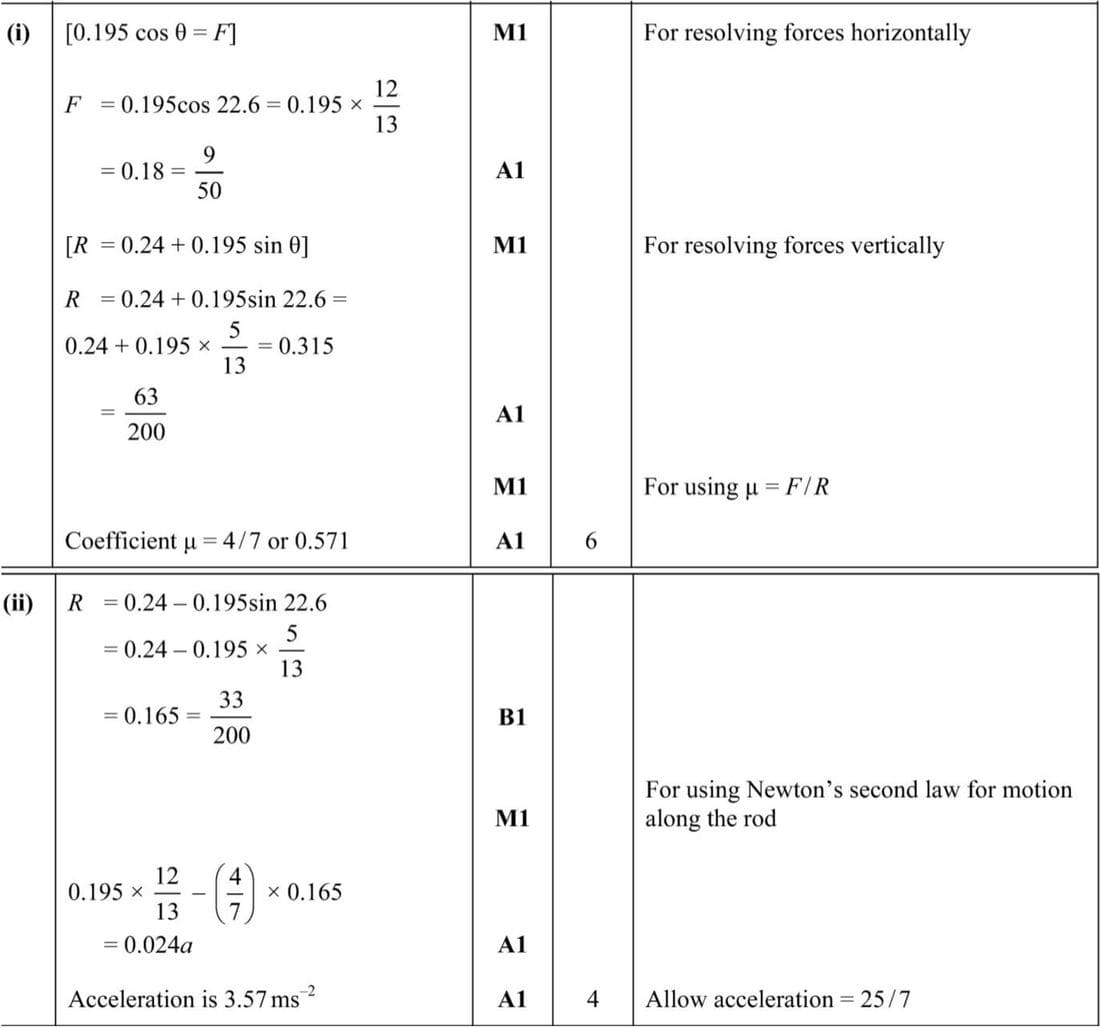
(i) Find the coefficient of friction between the ring and the rod.
When the angle \(\theta\) is above the horizontal (see Fig. 2) the ring moves.
(ii) Find the acceleration of the ring.
Nov 2009 p42 q5
4091
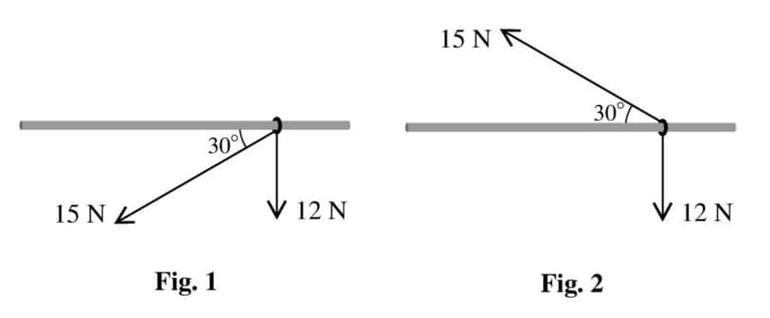
A small ring of weight 12 N is threaded on a fixed rough horizontal rod. A light string is attached to the ring and the string is pulled with a force of 15 N at an angle of 30° to the horizontal.
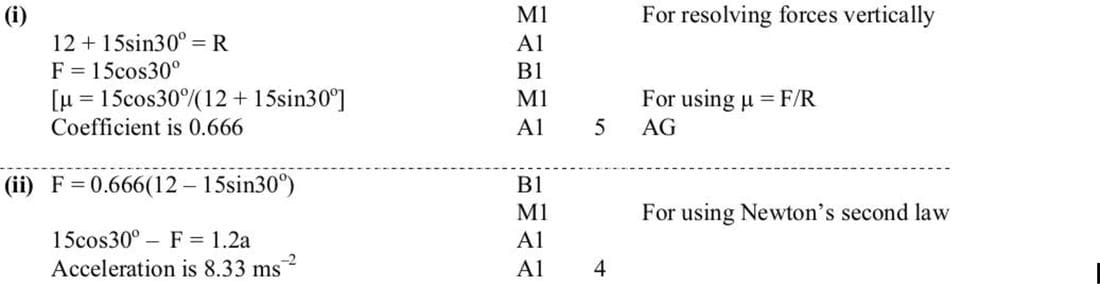
(i) When the angle of 30° is below the horizontal (see Fig. 1), the ring is in limiting equilibrium. Show that the coefficient of friction between the ring and the rod is 0.666, correct to 3 significant figures.
(ii) When the angle of 30° is above the horizontal (see Fig. 2), the ring is moving with acceleration a m s−2. Find the value of a.
Feb/Mar 2019 p42 q1
4092
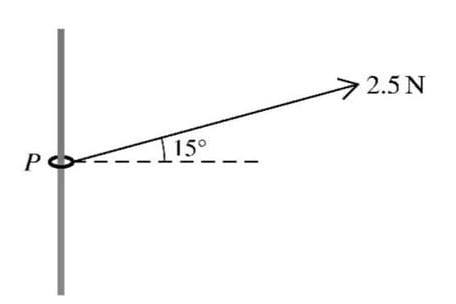
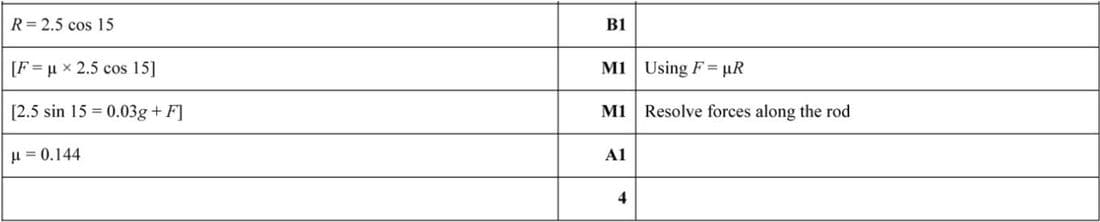
A small ring P of mass 0.03 kg is threaded on a rough vertical rod. A light inextensible string is attached to the ring and is pulled upwards at an angle of 15° to the horizontal. The tension in the string is 2.5 N (see diagram). The ring is in limiting equilibrium and on the point of sliding up the rod. Find the coefficient of friction between the ring and the rod.
Nov 2011 p43 q6
4093
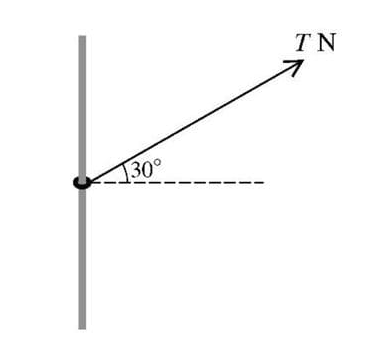
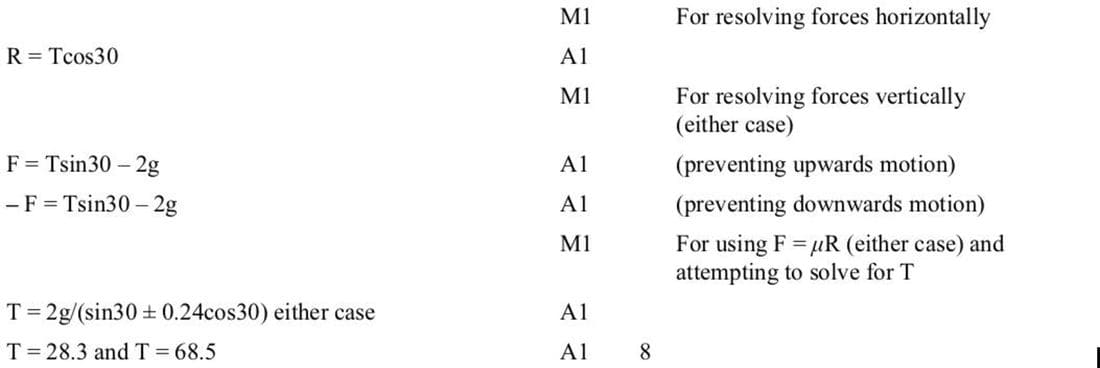
The diagram shows a ring of mass 2 kg threaded on a fixed rough vertical rod. A light string is attached to the ring and is pulled upwards at an angle of 30° to the horizontal. The tension in the string is \(T\) N. The coefficient of friction between the ring and the rod is 0.24. Find the two values of \(T\) for which the ring is in limiting equilibrium.
Nov 2007 p4 q5
4094
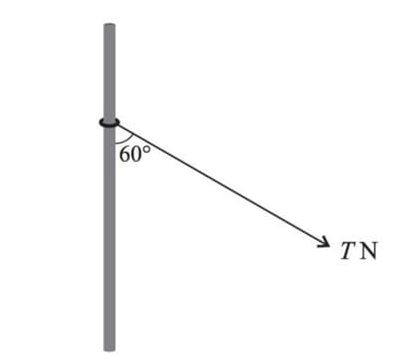
A ring of mass 4 kg is threaded on a fixed rough vertical rod. A light string is attached to the ring, and is pulled with a force of magnitude \(T\) N acting at an angle of \(60^\circ\) to the downward vertical (see diagram). The ring is in equilibrium.
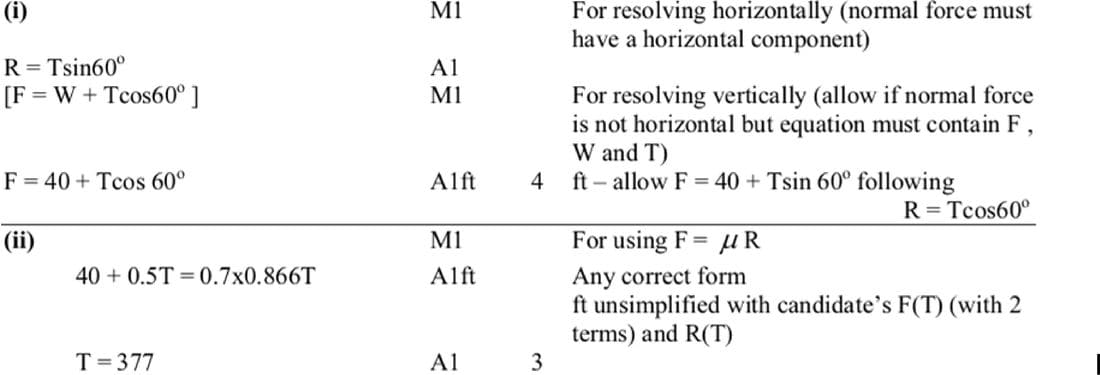
(i) The normal and frictional components of the contact force exerted on the ring by the rod are \(R\) N and \(F\) N respectively. Find \(R\) and \(F\) in terms of \(T\).
(ii) The coefficient of friction between the rod and the ring is 0.7. Find the value of \(T\) for which the ring is about to slip.