Exam-Style Problems
⬅ Back to SubchapterJune 2016 p43 q5
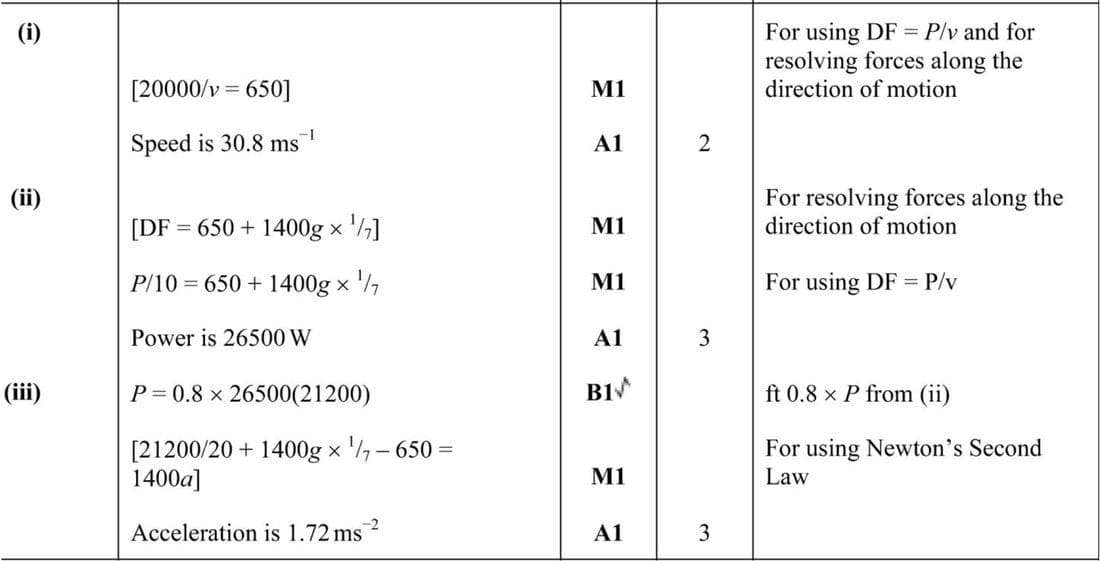
The motion of a car of mass 1400 kg is resisted by a constant force of magnitude 650 N.
- Find the constant speed of the car on a horizontal road, assuming that the engine works at a rate of 20 kW.
- The car is travelling at a constant speed of 10 m s-1 up a hill inclined at an angle of \(\theta\) to the horizontal, where \(\sin \theta = \frac{1}{7}\). Find the power of the car’s engine.
- The car descends the same hill with the engine working at 80% of the power found in part (ii). Find the acceleration of the car at an instant when the speed is 20 m s-1.
June 2016 p42 q6
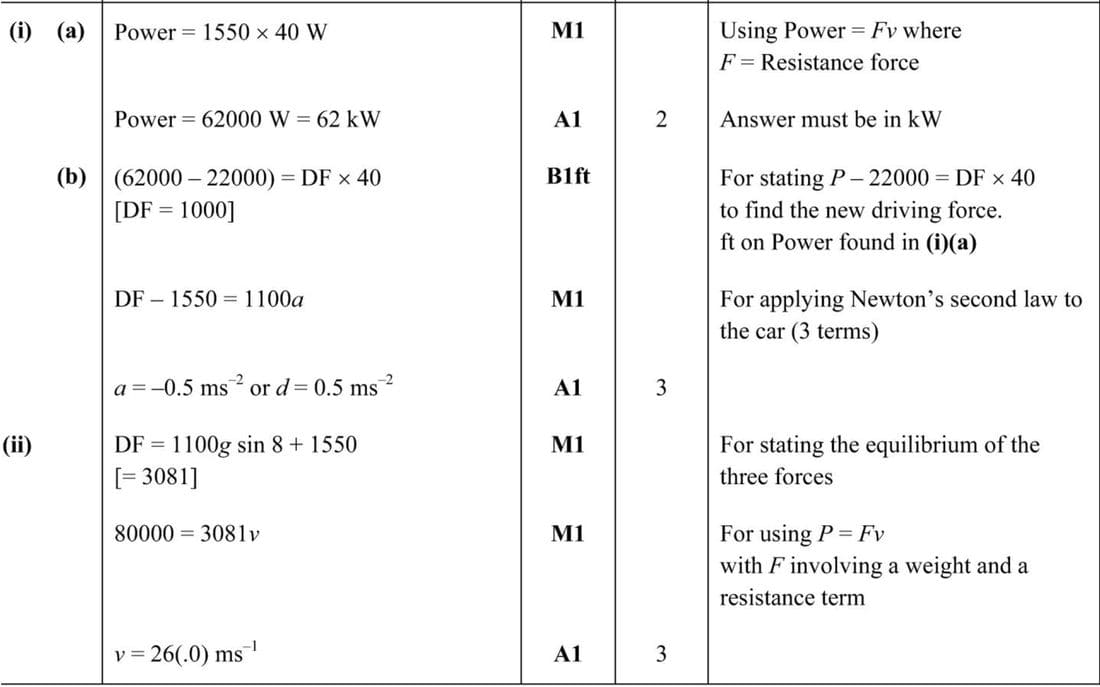
A car of mass 1100 kg is moving on a road against a constant force of 1550 N resisting the motion.
(i) The car moves along a straight horizontal road at a constant speed of 40 m s-1.
- Calculate, in kW, the power developed by the engine of the car. [2]
- Given that this power is suddenly decreased by 22 kW, find the instantaneous deceleration of the car. [3]
(ii) The car now travels at constant speed up a straight road inclined at 8° to the horizontal, with the engine working at 80 kW. Assuming the resistance force remains the same, find this constant speed. [3]
June 2016 p41 q3
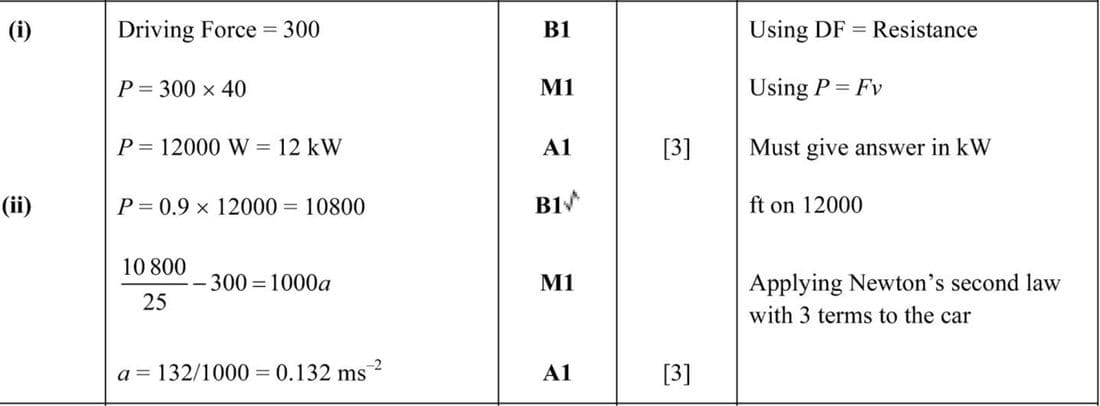
A car of mass 1000 kg is moving along a straight horizontal road against resistances of total magnitude 300 N.
(i) Find, in kW, the rate at which the engine of the car is working when the car has a constant speed of 40 m s-1.
(ii) Find the acceleration of the car when its speed is 25 m s-1 and the engine is working at 90% of the power found in part (i).
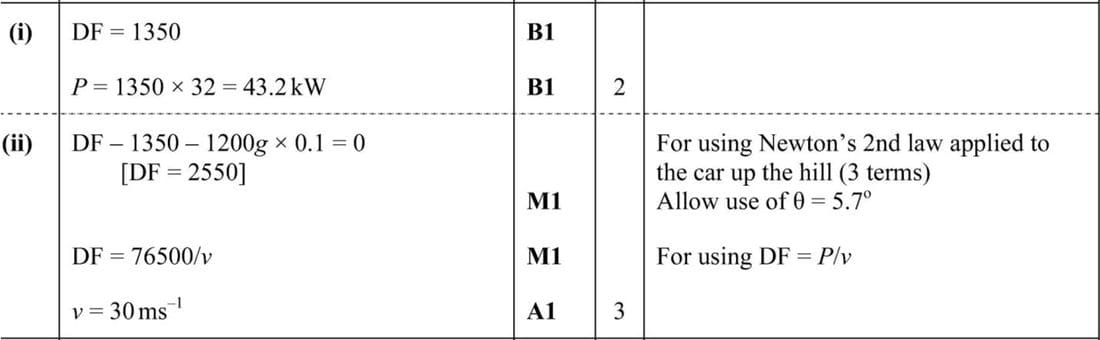
Feb/Mar 2016 p42 q2
A constant resistance of magnitude 1350 N acts on a car of mass 1200 kg.
- The car is moving along a straight level road at a constant speed of 32 m s-1. Find, in kW, the rate at which the engine of the car is working.
- The car travels at a constant speed up a hill inclined at an angle of \(\theta\) to the horizontal, where \(\sin \theta = 0.1\), with the engine working at 76.5 kW. Find this speed.
Nov 2015 p43 q5
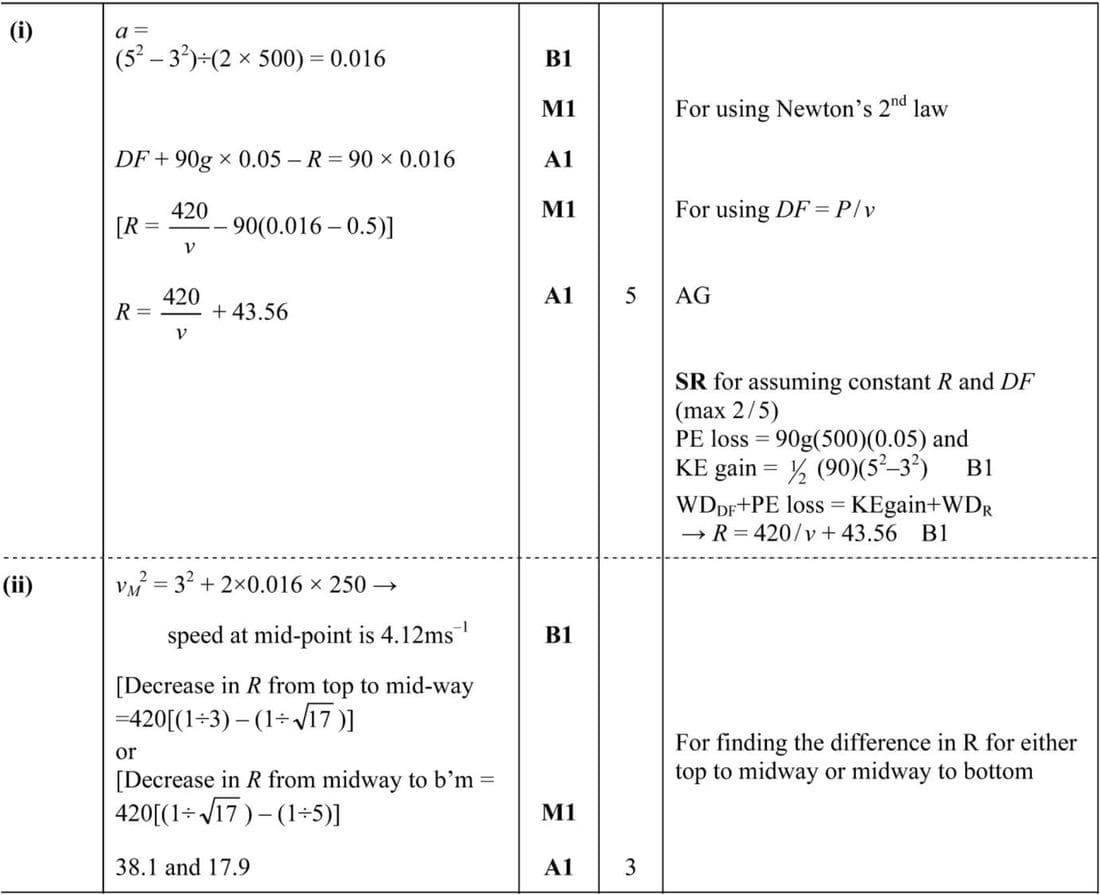
A cyclist and his bicycle have a total mass of 90 kg. The cyclist starts to move with speed 3 m s-1 from the top of a straight hill, of length 500 m, which is inclined at an angle of sin-1 0.05 to the horizontal. The cyclist moves with constant acceleration until he reaches the bottom of the hill with speed 5 m s-1. The cyclist generates 420 W of power while moving down the hill. The resistance to the motion of the cyclist and his bicycle, R N, and the cyclist’s speed, v m s-1, both vary.
- Show that \(R = \frac{420}{v} + 43.56\).
- Find the cyclist’s speed at the mid-point of the hill. Hence find the decrease in the value of \(R\) when the cyclist moves from the top of the hill to the mid-point of the hill, and when the cyclist moves from the mid-point of the hill to the bottom of the hill.