Exam-Style Problems
⬅ Back to SubchapterJune 2017 p42 q2
3528
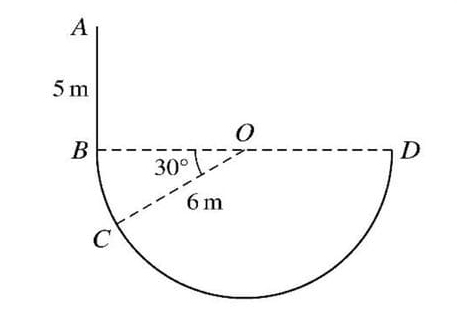
The diagram shows a wire ABCD consisting of a straight part AB of length 5 m and a part BCD in the shape of a semicircle of radius 6 m and centre O. The diameter BD of the semicircle is horizontal and AB is vertical. A small ring is threaded onto the wire and slides along the wire. The ring starts from rest at A. The part AB of the wire is rough, and the ring accelerates at a constant rate of 2.5 m/s2 between A and B.
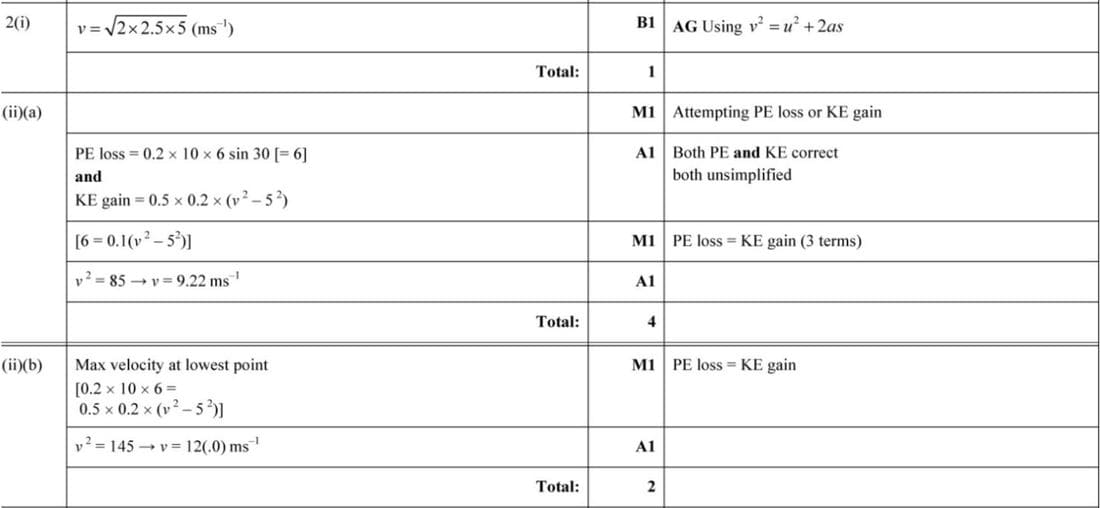
- Show that the speed of the ring as it reaches B is 5 m/s-1. [1]
The part BCD of the wire is smooth. The mass of the ring is 0.2 kg.
- (a) Find the speed of the ring at C, where angle BOC = 30°. [4]
- (b) Find the greatest speed of the ring. [2]
June 2017 p41 q4
3529
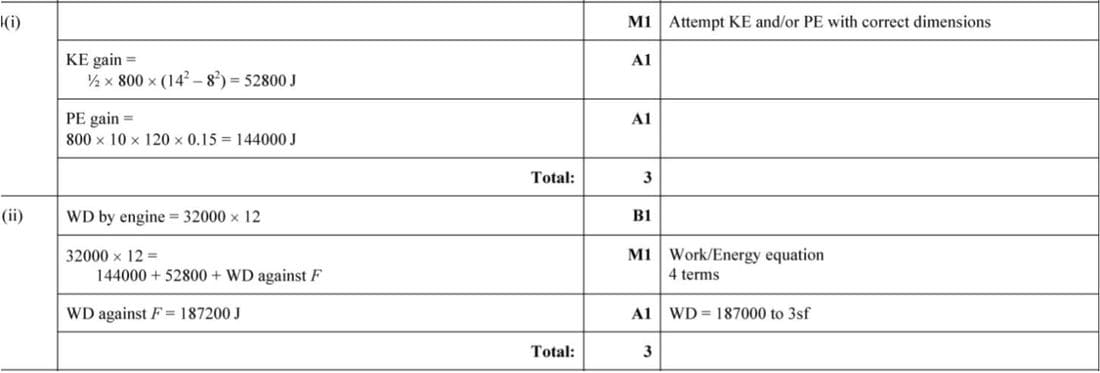
A car of mass 800 kg is moving up a hill inclined at \(\theta\) to the horizontal, where \(\sin \theta = 0.15\). The initial speed of the car is 8 m s\(^{-1}\). Twelve seconds later the car has travelled 120 m up the hill and has speed 14 m s\(^{-1}\).
(i) Find the change in the kinetic energy and the change in gravitational potential energy of the car. [3]
(ii) The engine of the car is working at a constant rate of 32 kW. Find the total work done against the resistive forces during the twelve seconds. [3]
Feb/Mar 2017 p42 q1
3530
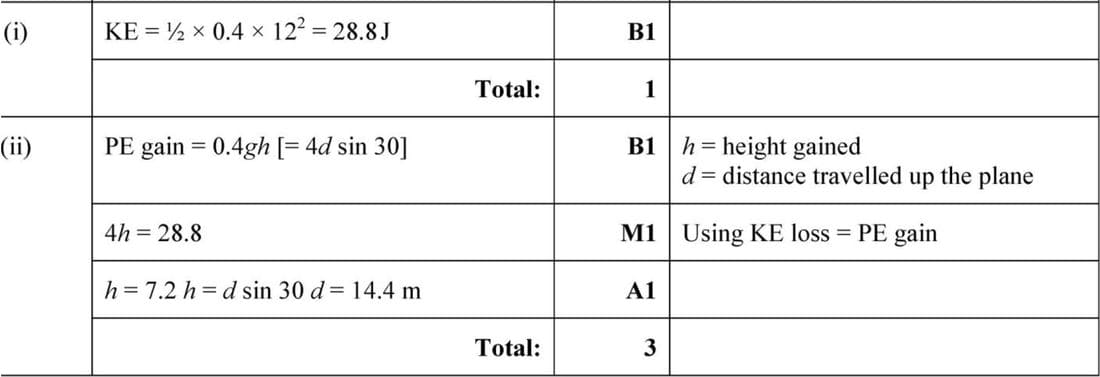
A particle of mass 0.4 kg is projected with a speed of 12 m s-1 up a line of greatest slope of a smooth plane inclined at 30° to the horizontal.
- Find the initial kinetic energy of the particle.
- Use an energy method to find the distance the particle moves up the plane before coming to instantaneous rest.
Nov 2016 p43 q7
3531
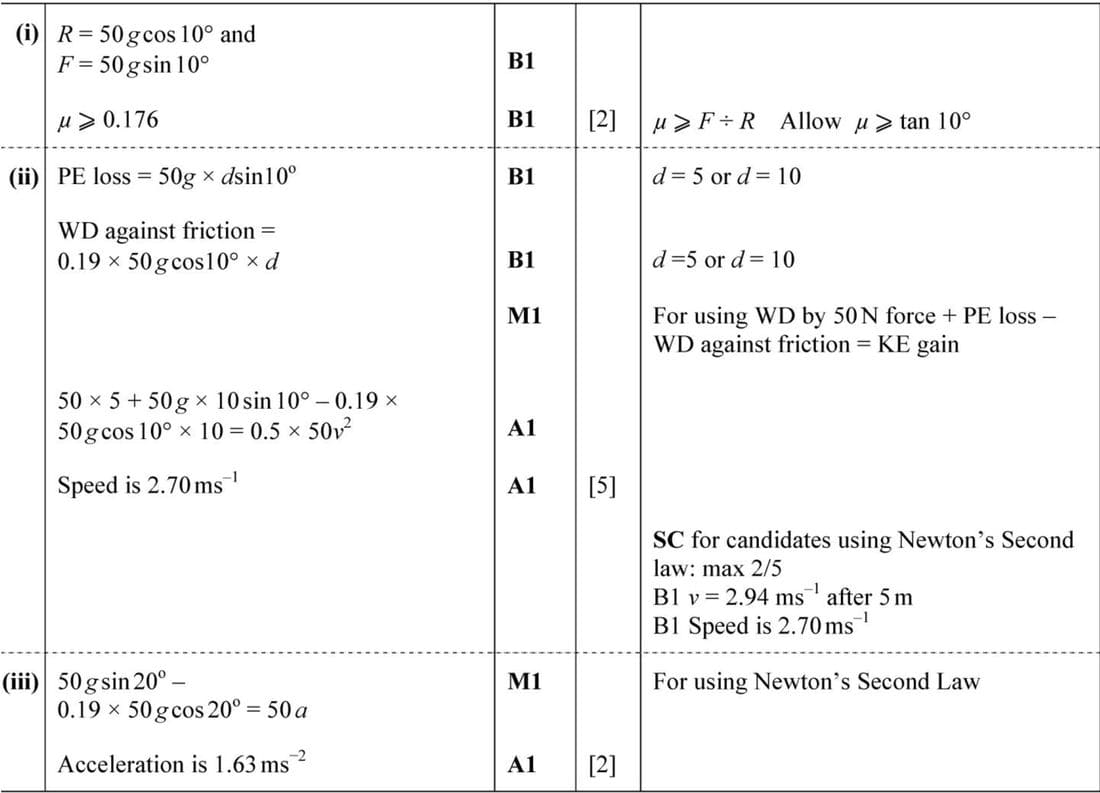
A box of mass 50 kg is at rest on a plane inclined at 10° to the horizontal.
- Find an inequality for the coefficient of friction between the box and the plane. [2]
In fact the coefficient of friction between the box and the plane is 0.19.
- A girl pushes the box with a force of 50 N, acting down a line of greatest slope of the plane, for a distance of 5 m. She then stops pushing. Use an energy method to find the speed of the box when it has travelled a further 5 m. [5]
The box then comes to a plane inclined at 20° below the horizontal. The box moves down a line of greatest slope of this plane. The coefficient of friction is still 0.19 and the girl is not pushing the box.
- Find the acceleration of the box. [2]
Nov 2016 p41 q6
3532
A block of mass 25 kg is pulled along horizontal ground by a force of magnitude 50 N inclined at 10° above the horizontal. The block starts from rest and travels a distance of 20 m. There is a constant resistance force of magnitude 30 N opposing motion.
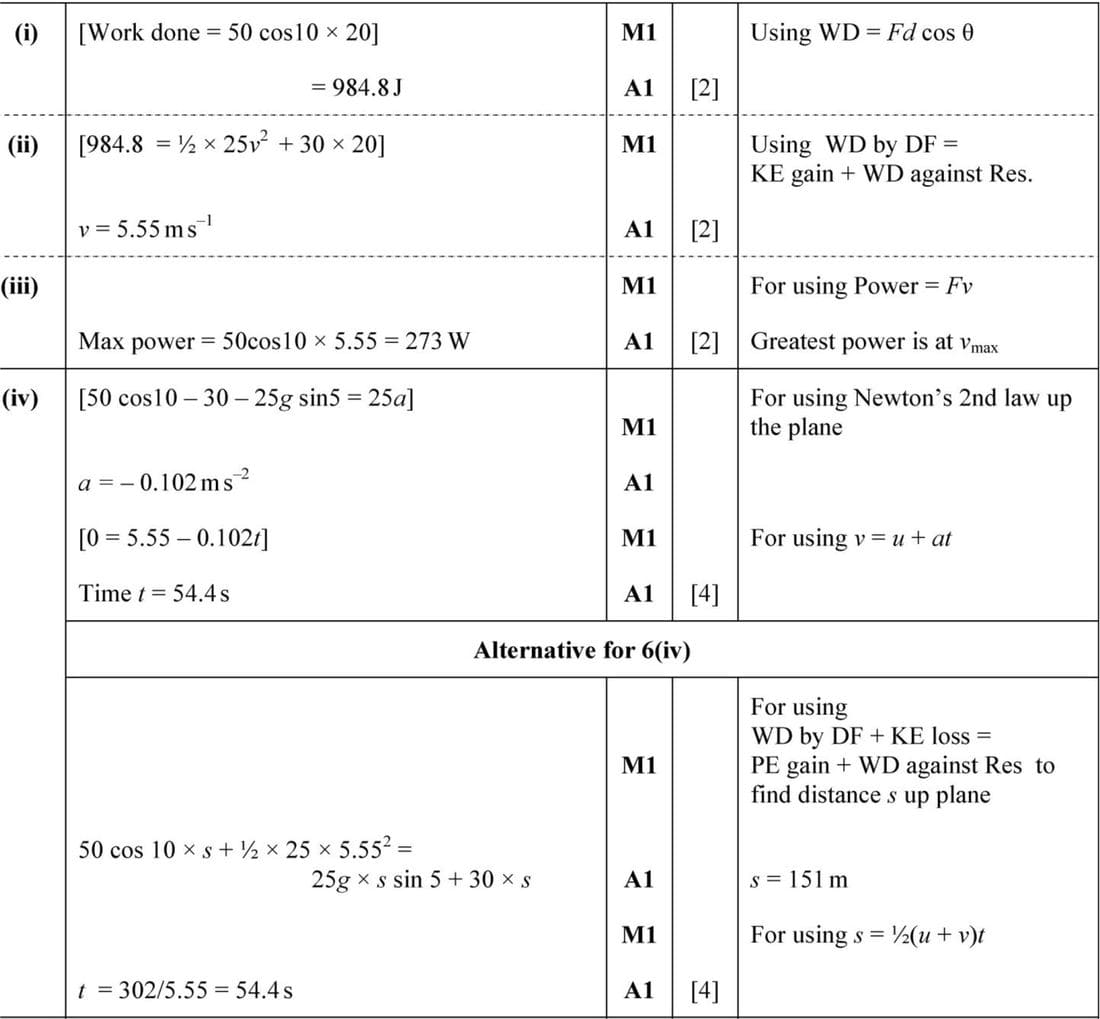
- Find the work done by the pulling force.
- Use an energy method to find the speed of the block when it has moved a distance of 20 m.
- Find the greatest power exerted by the 50 N force.
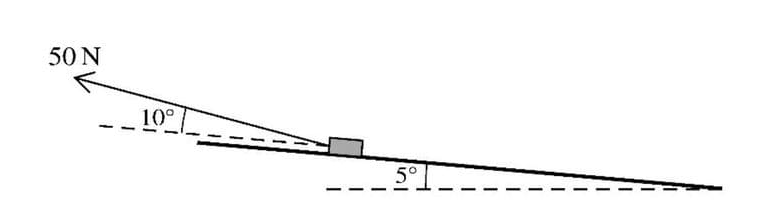
After the block has travelled the 20 m, it comes to a plane inclined at 5° to the horizontal. The force of 50 N is now inclined at an angle of 10° to the plane and pulls the block directly up the plane (see diagram). The resistance force remains 30 N.
- Find the time it takes for the block to come to rest from the instant when it reaches the foot of the inclined plane.