Exam-Style Problems
⬅ Back to SubchapterNov 2022 p32 q7
2359
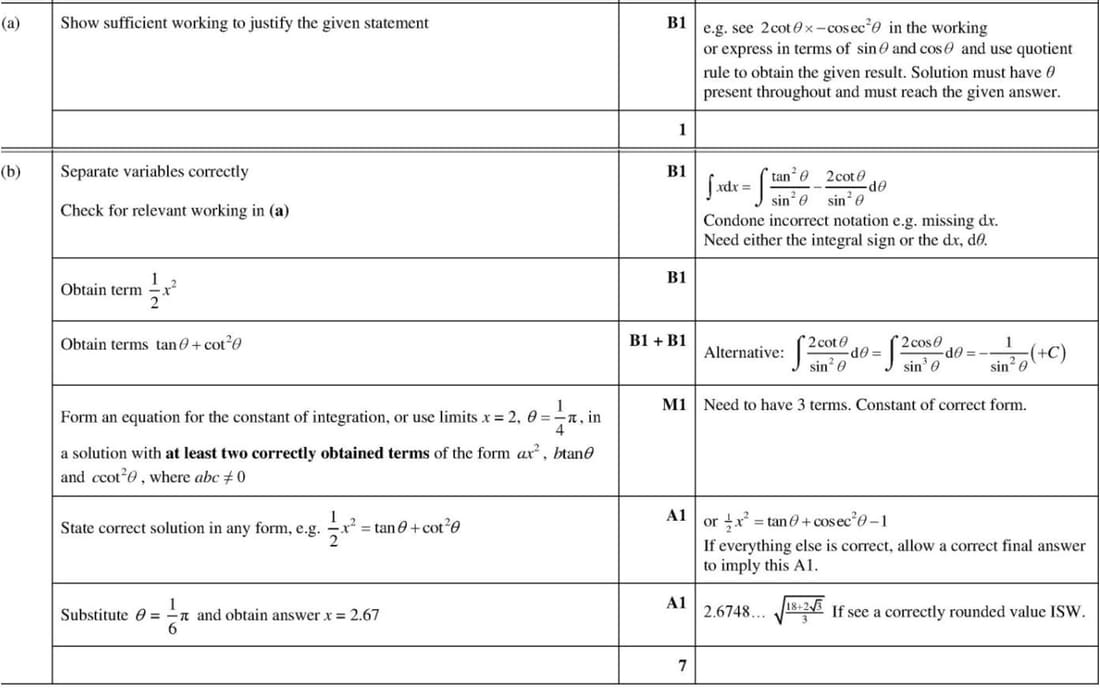
The variables x and θ satisfy the differential equation
\(x \sin^2 \theta \frac{dx}{d\theta} = \tan^2 \theta - 2 \cot \theta,\)
for \(0 < \theta < \frac{1}{2}\pi\) and \(x > 0\). It is given that \(x = 2\) when \(\theta = \frac{1}{4}\pi\).
(a) Show that \(\frac{d}{d\theta}(\cot^2 \theta) = -\frac{2 \cot \theta}{\sin^2 \theta}\).
(You may assume without proof that the derivative of \(\cot \theta\) with respect to \(\theta\) is \(-\csc^2 \theta\).) [1]
(b) Solve the differential equation and find the value of \(x\) when \(\theta = \frac{1}{6}\pi\). [7]
Nov 2021 p31 q7
2360
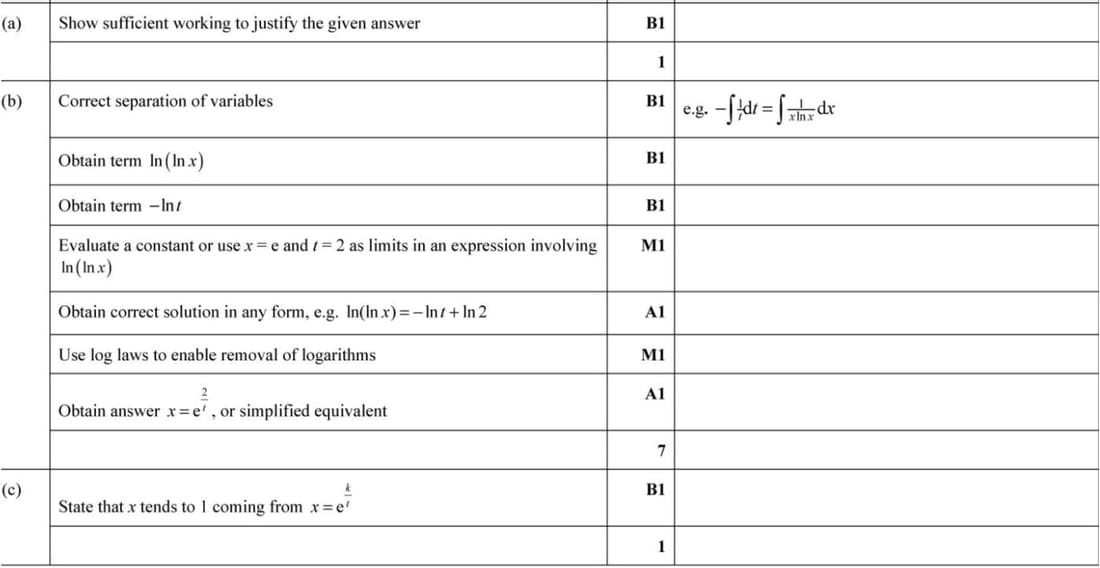
(a) Given that \(y = \ln(\ln x)\), show that \(\frac{dy}{dx} = \frac{1}{x \ln x}\).
The variables \(x\) and \(t\) satisfy the differential equation \(x \ln x + t \frac{dx}{dt} = 0\).
It is given that \(x = e\) when \(t = 2\).
(b) Solve the differential equation obtaining an expression for \(x\) in terms of \(t\), simplifying your answer.
(c) Hence state what happens to the value of \(x\) as \(t\) tends to infinity.
Feb/Mar 2021 p32 q4
2361
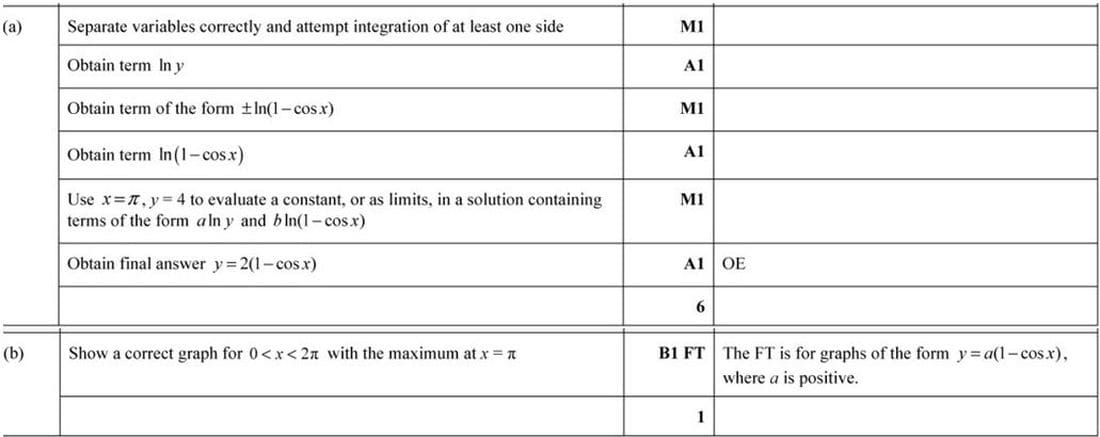
The variables x and y satisfy the differential equation
\((1 - \\cos x) \frac{dy}{dx} = y \sin x.\)
It is given that \(y = 4\) when \(x = \pi.\)
(a) Solve the differential equation, obtaining an expression for \(y\) in terms of \(x.\) [6]
(b) Sketch the graph of \(y\) against \(x\) for \(0 < x < 2\pi.\) [1]
Nov 2020 p32 q7
2362
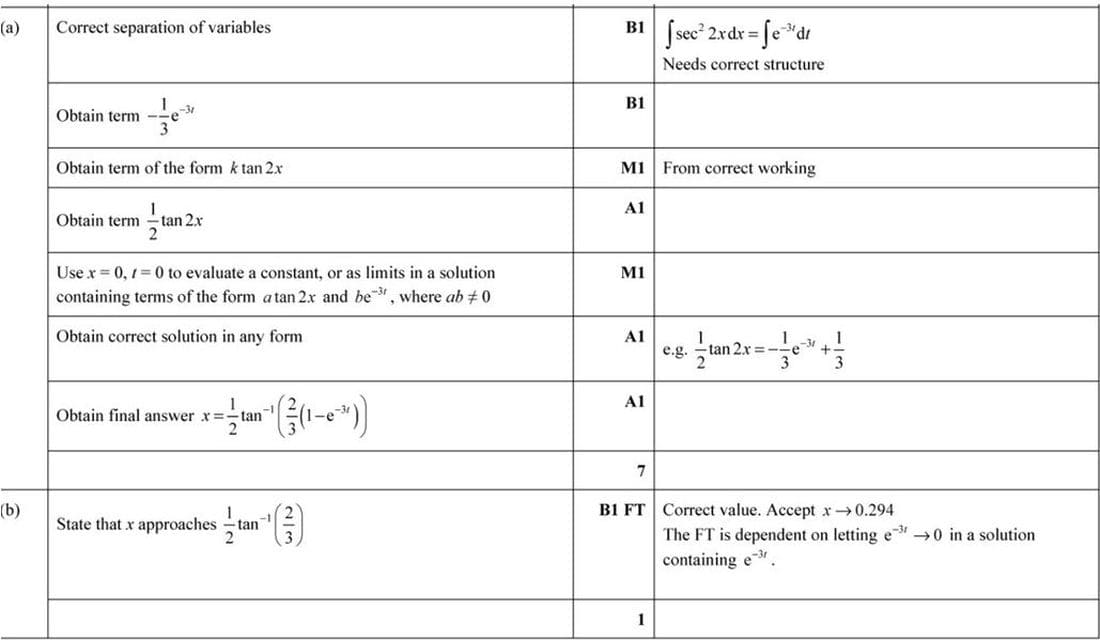
The variables x and t satisfy the differential equation
\(e^{3t} \frac{dx}{dt} = \cos^2 2x\),
for \(t \geq 0\). It is given that \(x = 0\) when \(t = 0\).
(a) Solve the differential equation and obtain an expression for \(x\) in terms of \(t\). [7]
(b) State what happens to the value of \(x\) when \(t\) tends to infinity. [1]