Exam-Style Problems
⬅ Back to SubchapterJune 2003 p3 q7
2314
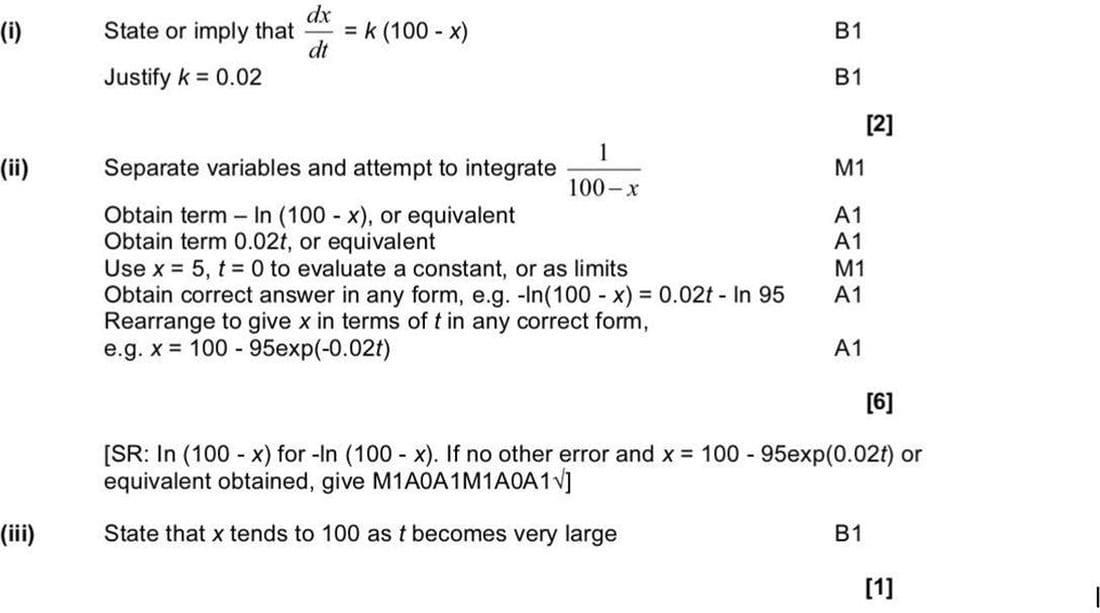
In a chemical reaction a compound X is formed from a compound Y. The masses in grams of X and Y present at time t seconds after the start of the reaction are x and y respectively. The sum of the two masses is equal to 100 grams throughout the reaction. At any time, the rate of formation of X is proportional to the mass of Y at that time. When t = 0, x = 5 and \(\frac{dx}{dt} = 1.9\).
(i) Show that x satisfies the differential equation \(\frac{dx}{dt} = 0.02(100 - x)\). [2]
(ii) Solve this differential equation, obtaining an expression for x in terms of t. [6]
(iii) State what happens to the value of x as t becomes very large. [1]
Nov 2002 p3 q9
2315
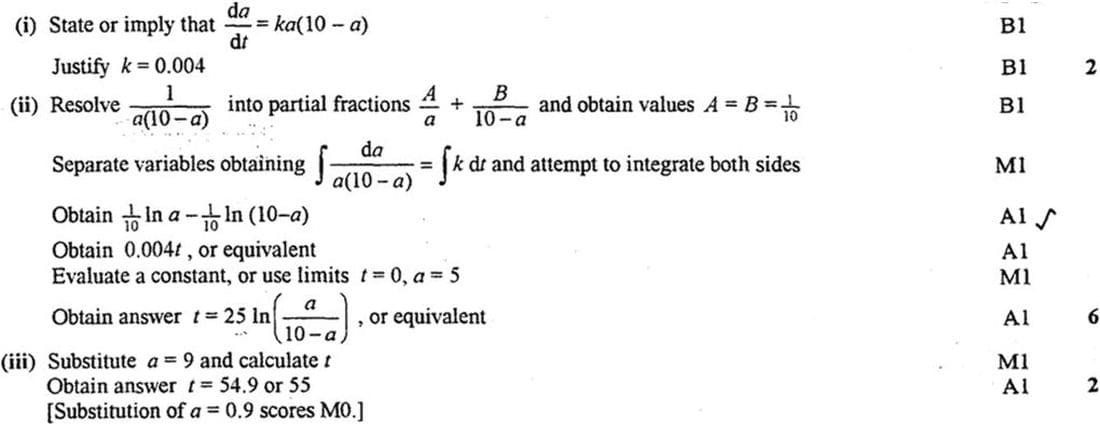
In an experiment to study the spread of a soil disease, an area of 10 m2 of soil was exposed to infection. In a simple model, it is assumed that the infected area grows at a rate which is proportional to the product of the infected area and the uninfected area. Initially, 5 m2 was infected and the rate of growth of the infected area was 0.1 m2 per day. At time t days after the start of the experiment, an area a m2 is infected and an area (10 - a) m2 is uninfected.
- Show that \(\frac{da}{dt} = 0.004a(10 - a)\).
- By first expressing \(\frac{1}{a(10-a)}\) in partial fractions, solve this differential equation, obtaining an expression for t in terms of a.
- Find the time taken for 90% of the soil area to become infected, according to this model.
June 2020 p33 q10
2316
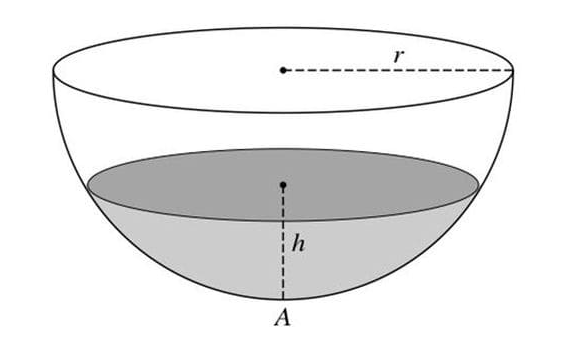
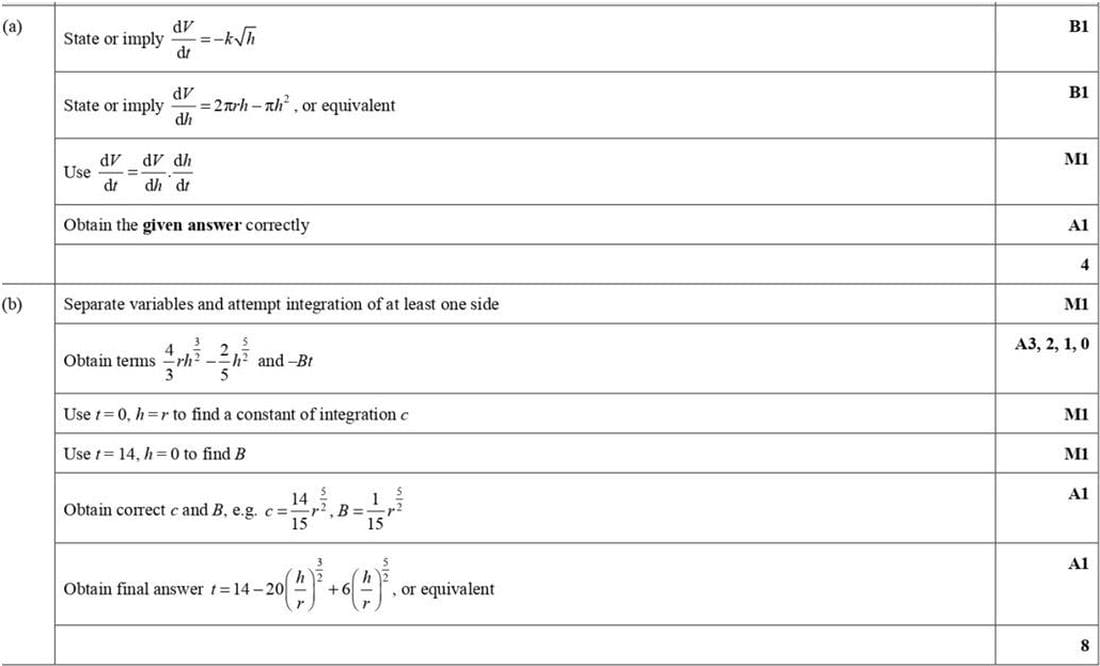
A tank containing water is in the form of a hemisphere. The axis is vertical, the lowest point is A and the radius is r, as shown in the diagram. The depth of water at time t is h. At time t = 0 the tank is full and the depth of the water is r. At this instant a tap at A is opened and water begins to flow out at a rate proportional to \(\sqrt{h}\). The tank becomes empty at time t = 14.
The volume of water in the tank is V when the depth is h. It is given that \(V = \frac{1}{3} \pi (3rh^2 - h^3)\).
(a) Show that h and t satisfy a differential equation of the form \(\frac{dh}{dt} = -\frac{B}{2rh^2 - h^3}\)
where B is a positive constant.
(b) Solve the differential equation and obtain an expression for t in terms of h and r.
June 2002 p3 q7
2317
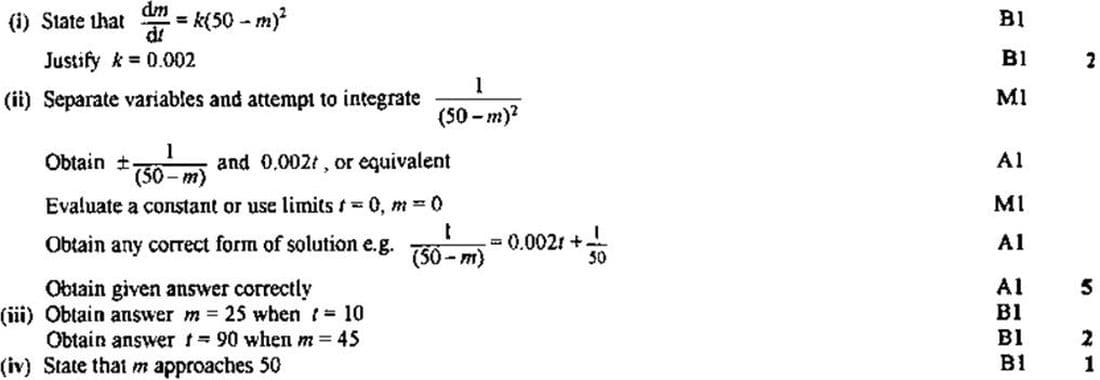
In a certain chemical process a substance is being formed, and t minutes after the start of the process there are m grams of the substance present. In the process the rate of increase of m is proportional to \((50 - m)^2\). When \(t = 0\), \(m = 0\) and \(\frac{dm}{dt} = 5\).
(i) Show that m satisfies the differential equation \(\frac{dm}{dt} = 0.002(50 - m)^2\).
(ii) Solve the differential equation, and show that the solution can be expressed in the form \(m = 50 - \frac{500}{t + 10}\).
(iii) Calculate the mass of the substance when \(t = 10\), and find the time taken for the mass to increase from 0 to 45 grams.
(iv) State what happens to the mass of the substance as t becomes very large.
June 2020 p31 q8
2318
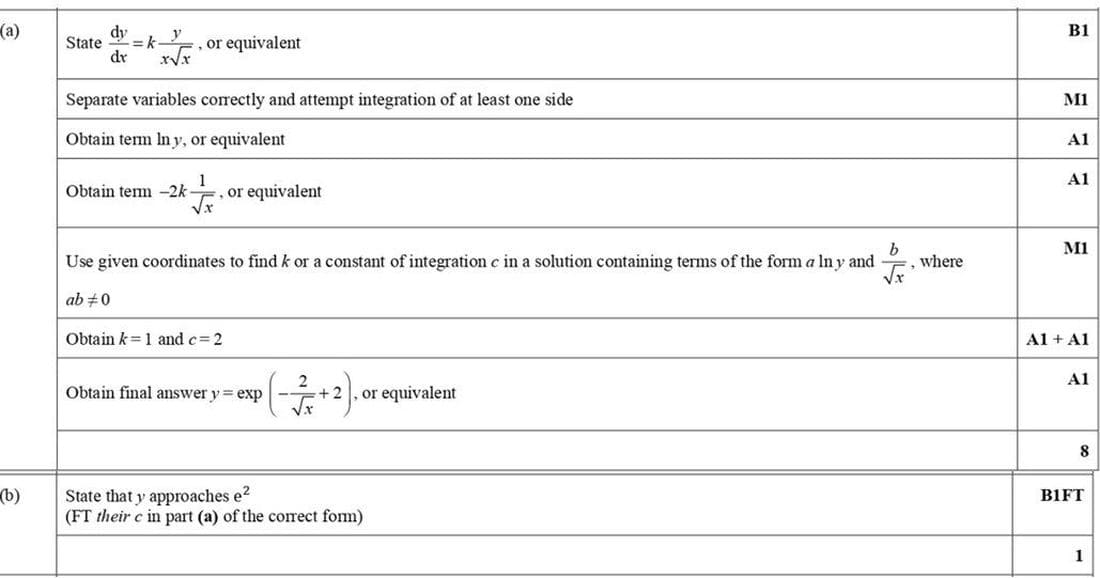
A certain curve is such that its gradient at a point \((x, y)\) is proportional to \(\frac{y}{x\sqrt{x}}\). The curve passes through the points with coordinates \((1, 1)\) and \((4, e)\).
(a) By setting up and solving a differential equation, find the equation of the curve, expressing \(y\) in terms of \(x\). [8]
(b) Describe what happens to \(y\) as \(x\) tends to infinity. [1]