Exam-Style Problems
⬅ Back to SubchapterJune 2012 p31 q8
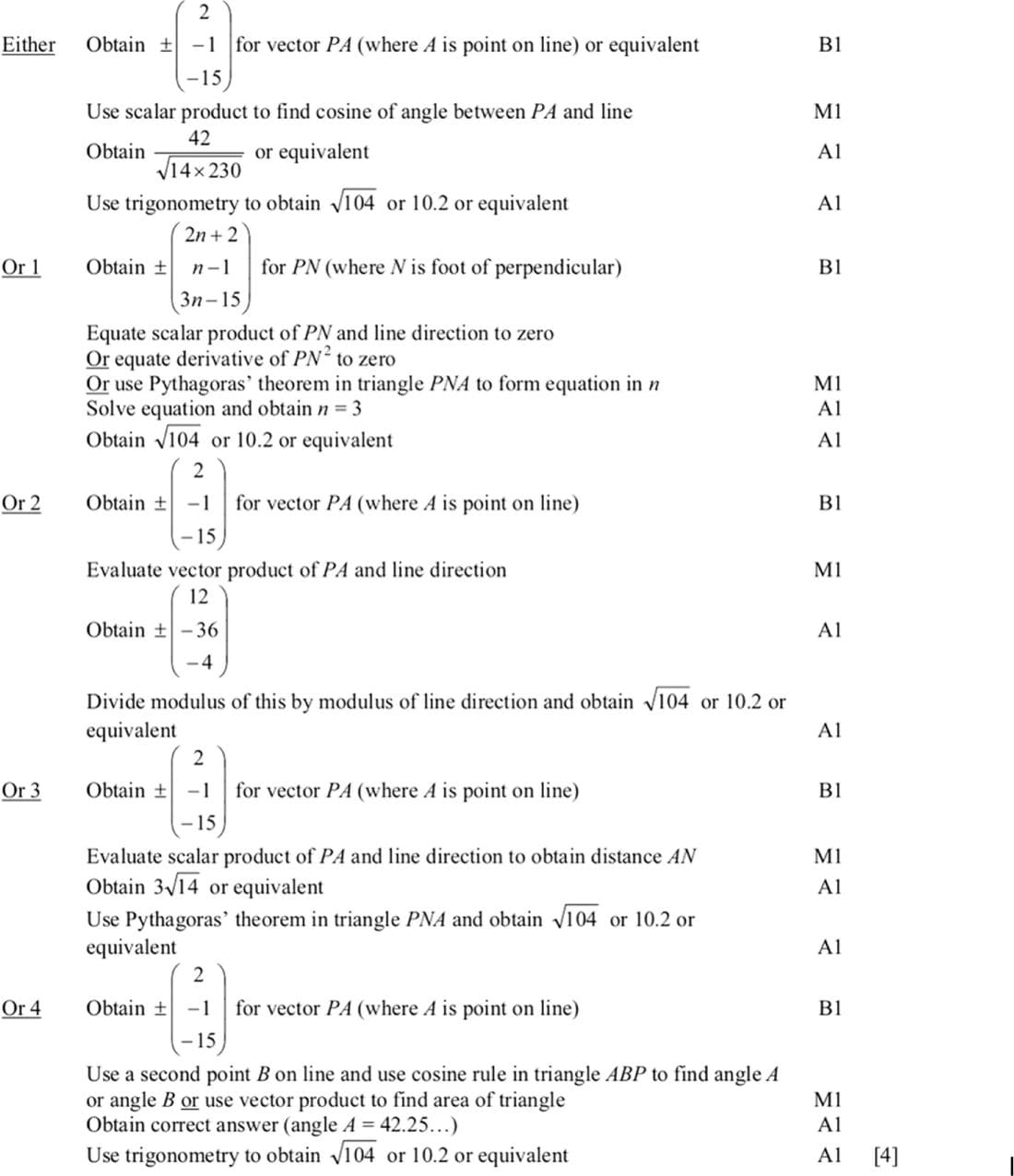
The point P has coordinates (-1, 4, 11) and the line l has equation \(\mathbf{r} = \begin{pmatrix} 1 \\ 3 \\ -4 \end{pmatrix} + \lambda \begin{pmatrix} 2 \\ 1 \\ 3 \end{pmatrix}\).
Find the perpendicular distance from P to l.
Nov 2011 p31 q7
With respect to the origin O, the position vectors of two points A and B are given by \(\overrightarrow{OA} = \mathbf{i} + 2\mathbf{j} + 2\mathbf{k}\) and \(\overrightarrow{OB} = 3\mathbf{i} + 4\mathbf{j}\). The point P lies on the line through A and B, and \(\overrightarrow{AP} = \lambda \overrightarrow{AB}\).
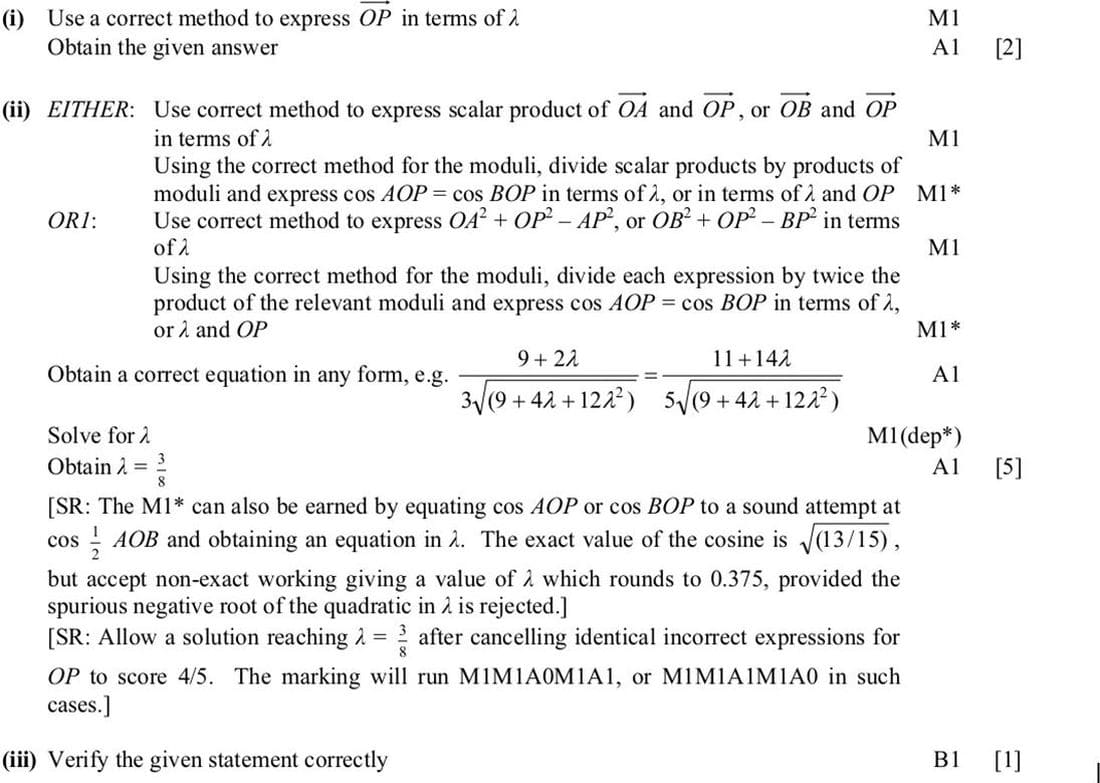
- Show that \(\overrightarrow{OP} = (1 + 2\lambda)\mathbf{i} + (2 + 2\lambda)\mathbf{j} + (2 - 2\lambda)\mathbf{k}\).
- By equating expressions for \(\cos AOP\) and \(\cos BOP\) in terms of \(\lambda\), find the value of \(\lambda\) for which \(OP\) bisects the angle \(AOB\).
- When \(\lambda\) has this value, verify that \(AP : PB = OA : OB\).
June 2011 p33 q10
With respect to the origin O, the lines l and m have vector equations r = 2i + k + \(\lambda\)(i - j + 2k) and r = 2j + 6k + \(\mu\)(i + 2j - 2k) respectively.
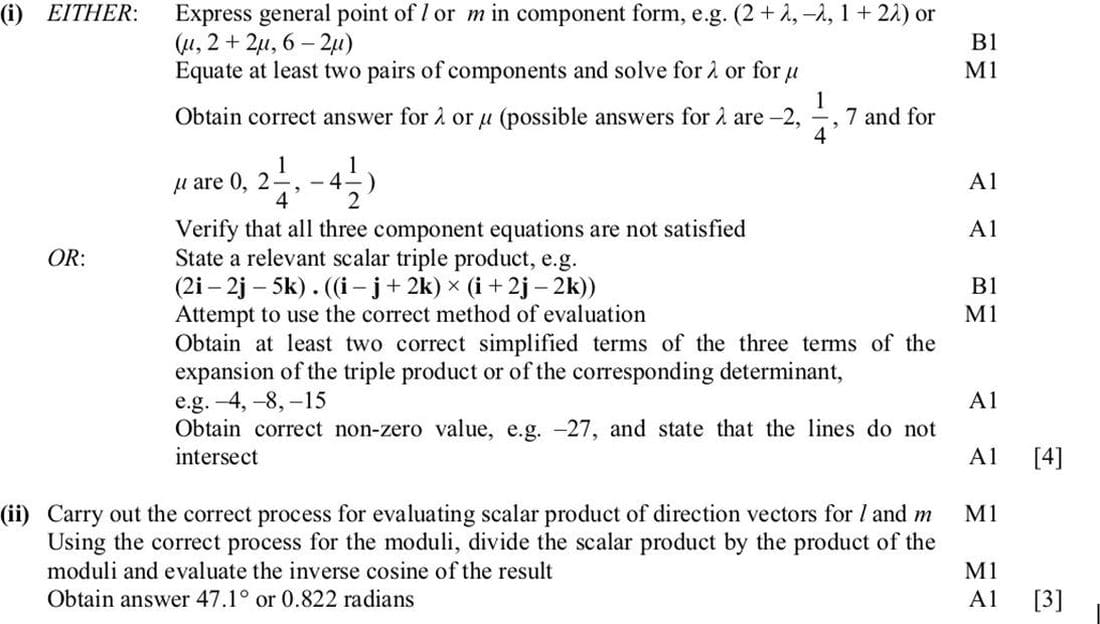
- Prove that l and m do not intersect.
- Calculate the acute angle between the directions of l and m.
Nov 2010 p31 q7
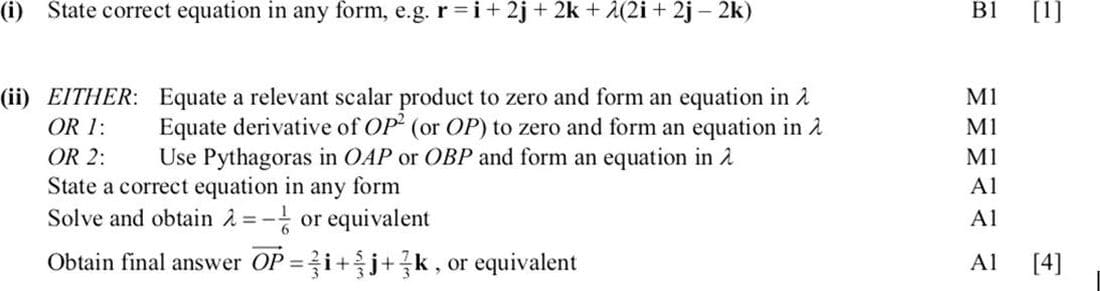
With respect to the origin O, the points A and B have position vectors given by \(\overrightarrow{OA} = \mathbf{i} + 2\mathbf{j} + 2\mathbf{k}\) and \(\overrightarrow{OB} = 3\mathbf{i} + 4\mathbf{j}\). The point P lies on the line AB and OP is perpendicular to AB.
(i) Find a vector equation for the line AB.
(ii) Find the position vector of P.
June 2010 p31 q10
The lines l and m have vector equations
\(\mathbf{r} = \mathbf{i} + \mathbf{j} + \mathbf{k} + s(\mathbf{i} - \mathbf{j} + 2\mathbf{k})\)
and
\(\mathbf{r} = 4\mathbf{i} + 6\mathbf{j} + \mathbf{k} + t(2\mathbf{i} + 2\mathbf{j} + \mathbf{k})\)
respectively.
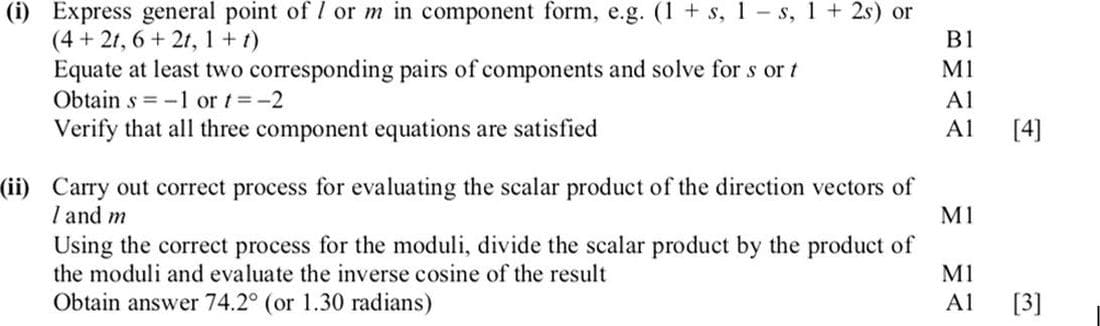
- Show that l and m intersect.
- Calculate the acute angle between the lines.