Exam-Style Problems
⬅ Back to SubchapterJune 2021 p32 q2
1940
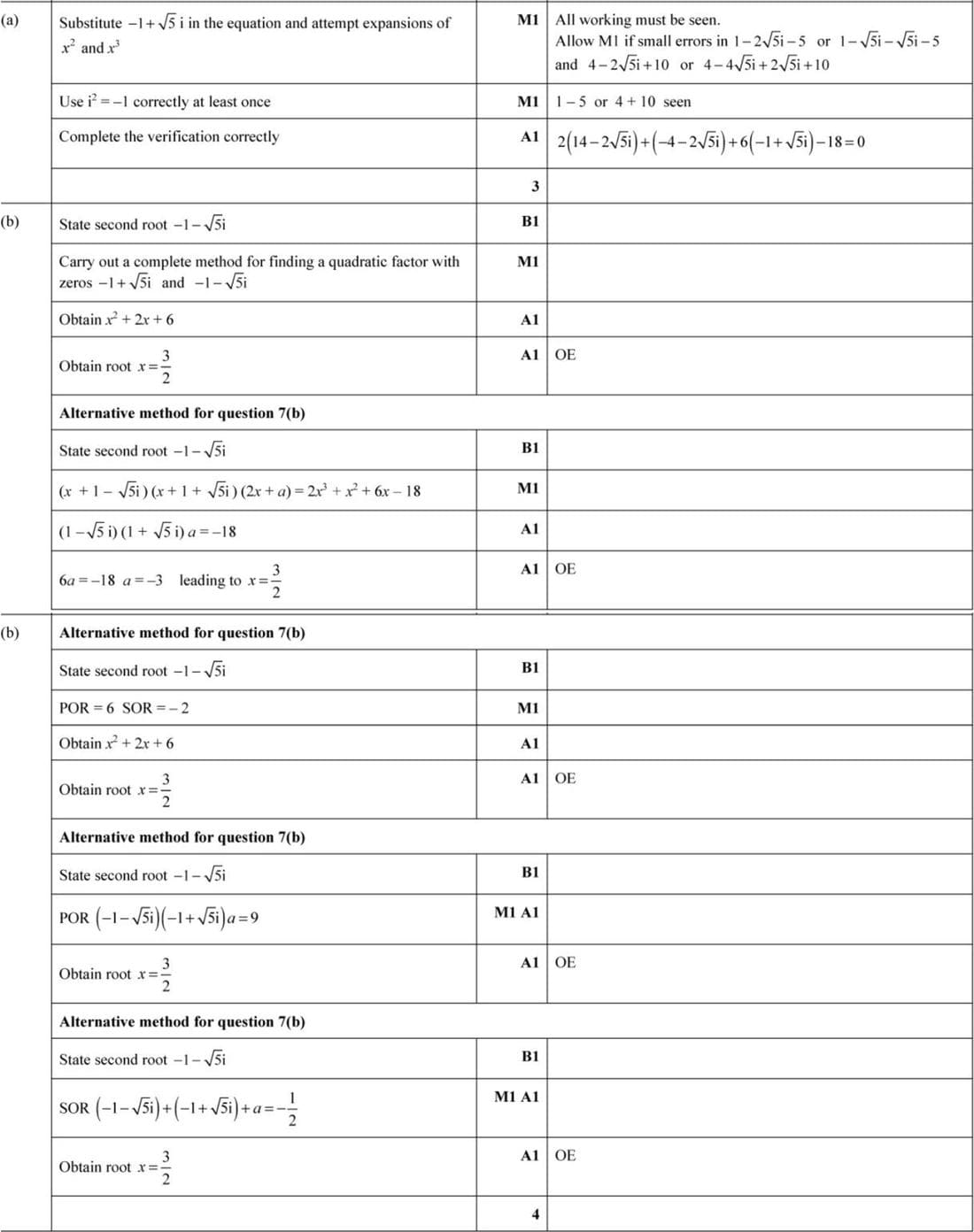
On a sketch of an Argand diagram, shade the region whose points represent complex numbers \(z\) satisfying the inequalities \(|z + 1 - i| \leq 1\) and \(\arg(z - 1) \leq \frac{3}{4}\pi\).
June 2021 p31 q5
1941
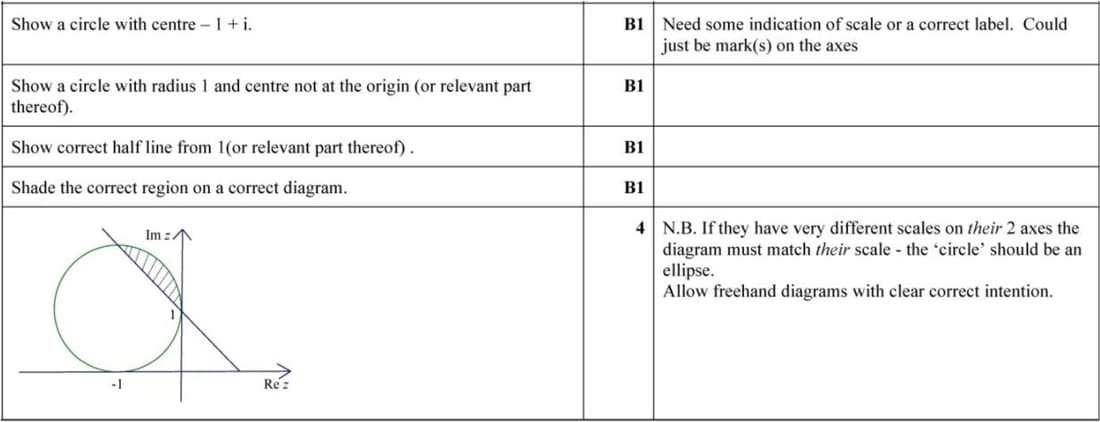
(a) Solve the equation \(z^2 - 2piz - q = 0\), where \(p\) and \(q\) are real constants.
In an Argand diagram with origin \(O\), the roots of this equation are represented by the distinct points \(A\) and \(B\).
(b) Given that \(A\) and \(B\) lie on the imaginary axis, find a relation between \(p\) and \(q\).
(c) Given instead that triangle \(OAB\) is equilateral, express \(q\) in terms of \(p\).
Problem 1942
1942
\(The complex numbers u and v are defined by u = -4 + 2i and v = 3 + i.\)
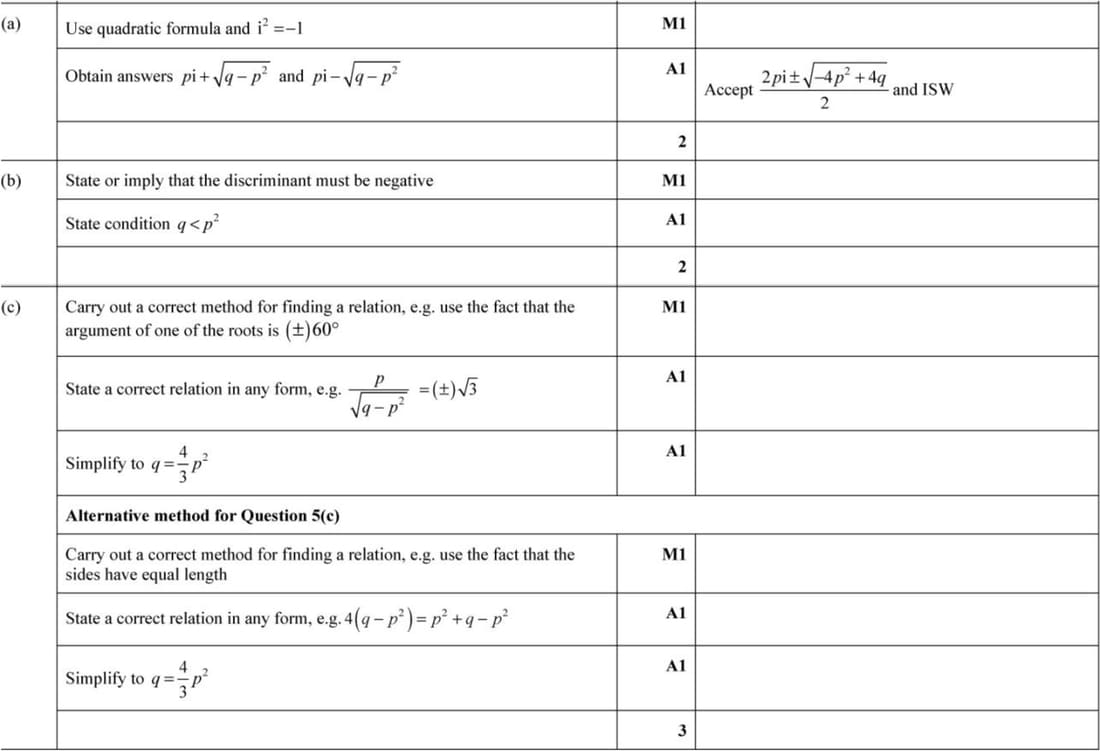
(a) Find \(\frac{u}{v}\) in the form x + iy, where x and y are real.
(b) Hence express \(\frac{u}{v}\) in the form \(re^{i\theta}\), where r and \(\theta\) are exact.
In an Argand diagram, with origin O, the points A, B and C represent the complex numbers u, v and 2u + v respectively.
(c) State fully the geometrical relationship between OA and BC.
(d) Prove that angle AOB = \(\frac{3}{4}\pi\).
Nov 2020 p32 q6
1943
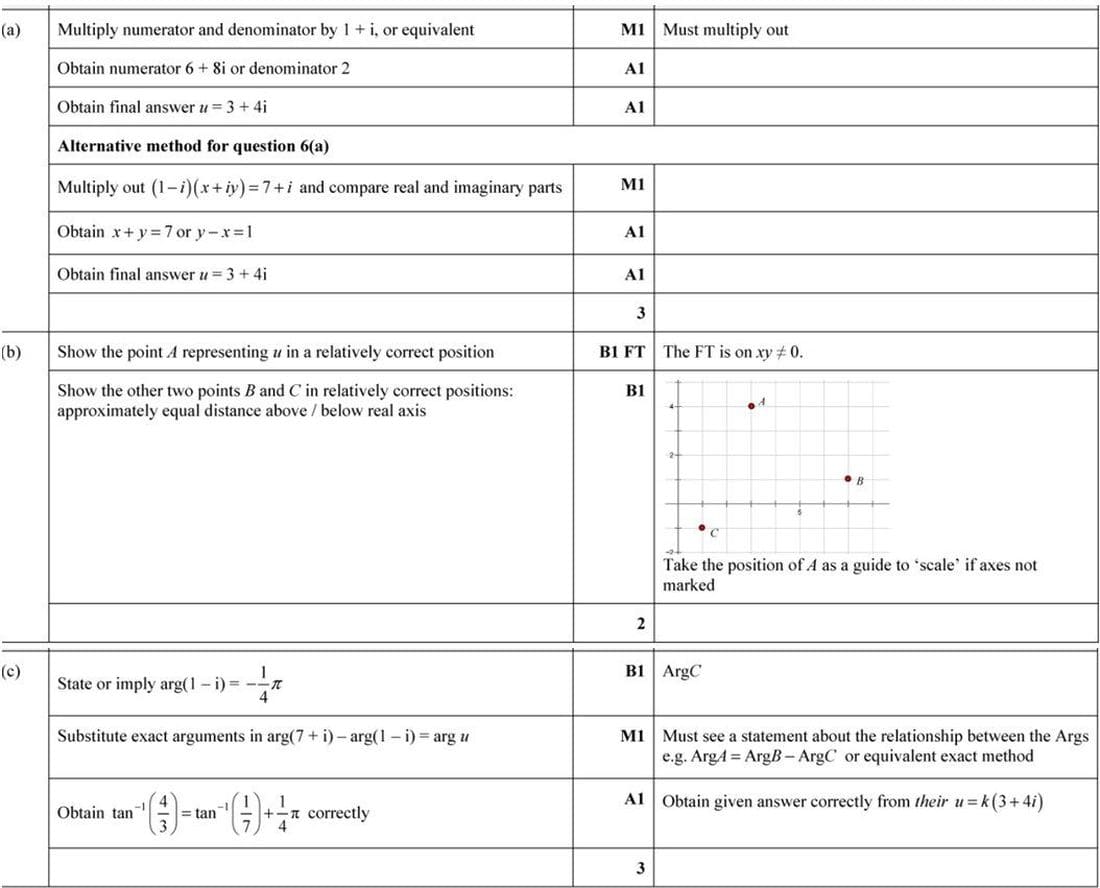
The complex number u is defined by
\(u = \frac{7+i}{1-i}\).
(a) Express u in the form \(x + iy\), where \(x\) and \(y\) are real.
(b) Show on a sketch of an Argand diagram the points A, B and C representing u, \(7 + i\) and \(1 - i\) respectively.
(c) By considering the arguments of \(7 + i\) and \(1 - i\), show that
\(\arctan\left(\frac{4}{3}\right) = \arctan\left(\frac{1}{7}\right) + \frac{1}{4}\pi\).
Nov 2020 p31 q7
1944
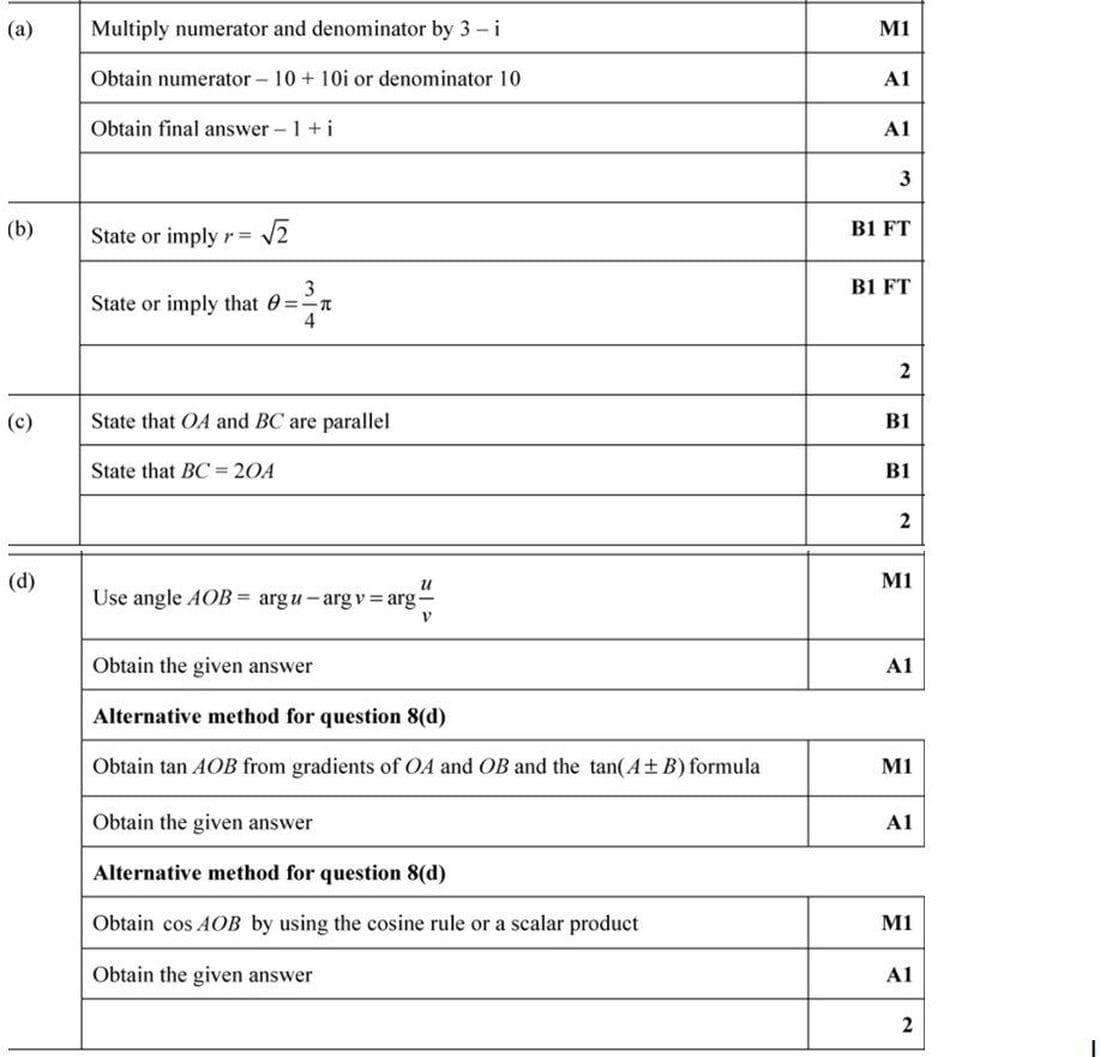
(a) Verify that \(-1 + \sqrt{5}i\) is a root of the equation \(2x^3 + x^2 + 6x - 18 = 0\).
(b) Find the other roots of this equation.