Exam-Style Problems
⬅ Back to SubchapterJune 2021 p31 q2
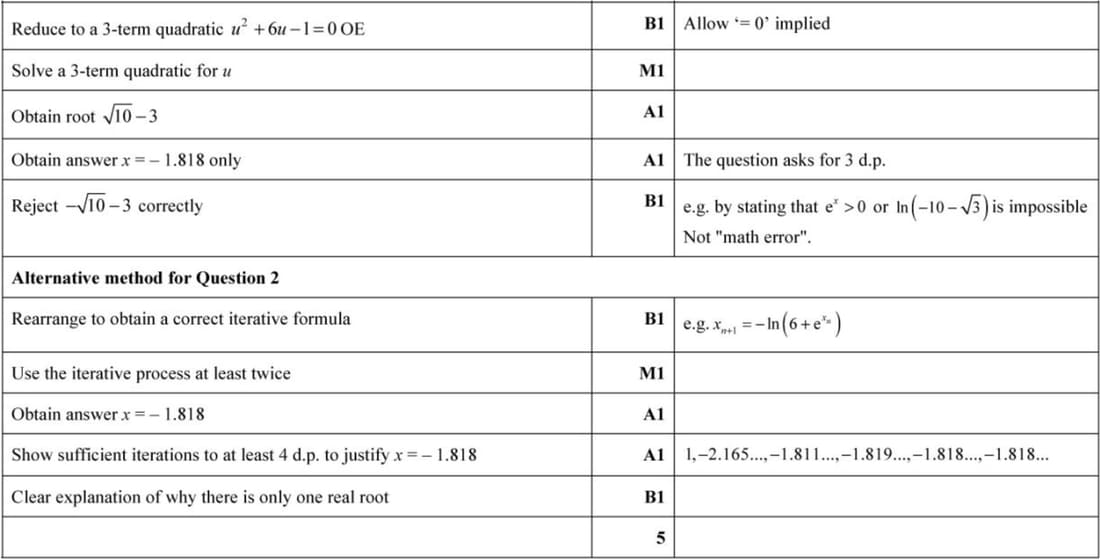
Find the real root of the equation \(\frac{2e^x + e^{-x}}{2 + e^x} = 3\), giving your answer correct to 3 decimal places. Your working should show clearly that the equation has only one real root.
June 2020 p33 q3
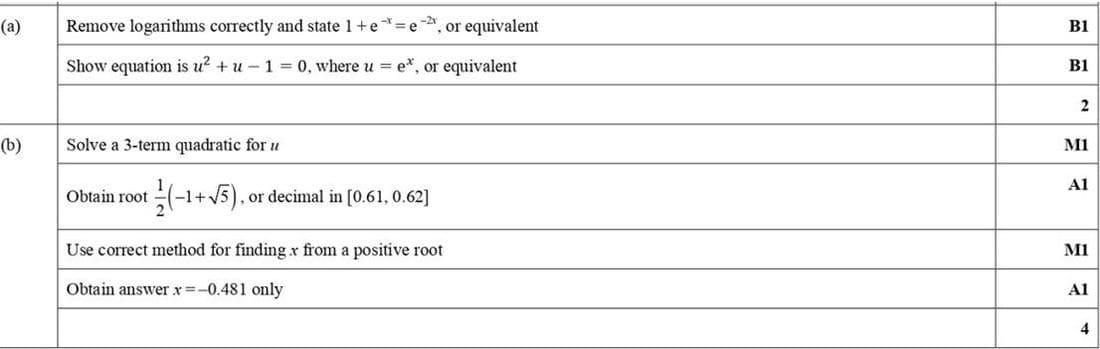
(a) Show that the equation \(\ln(1 + e^{-x}) + 2x = 0\) can be expressed as a quadratic equation in \(e^x\).
(b) Hence solve the equation \(\ln(1 + e^{-x}) + 2x = 0\), giving your answer correct to 3 decimal places.
Nov 2018 p32 q4
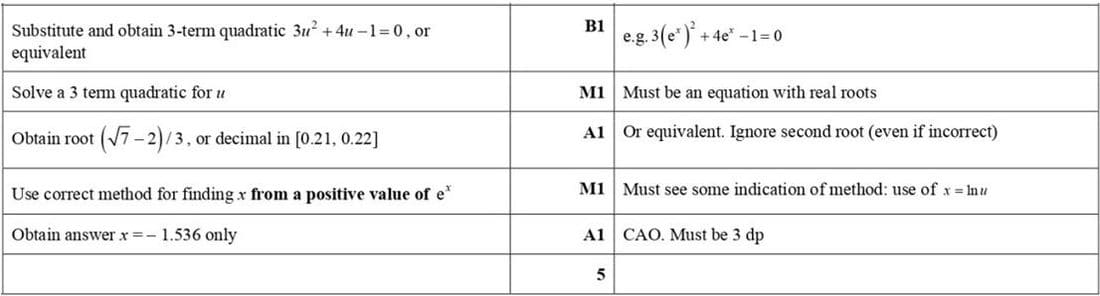
Showing all necessary working, solve the equation
\(\frac{e^x + e^{-x}}{e^x + 1} = 4\),
giving your answer correct to 3 decimal places.
Nov 2018 p31 q2
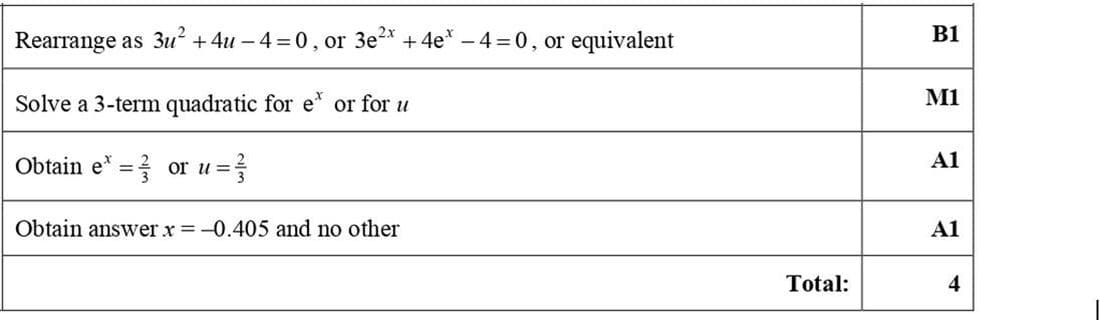
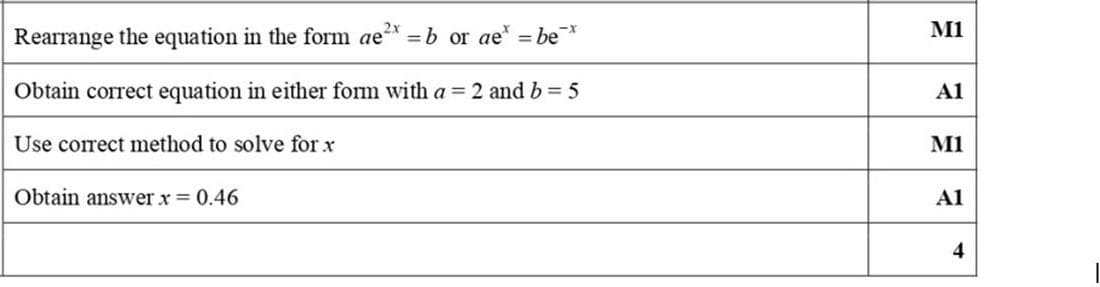
Showing all necessary working, solve the equation \(\frac{2e^x + e^{-x}}{e^x - e^{-x}} = 4\), giving your answer correct to 2 decimal places.
June 2017 p33 q3
Using the substitution \(u = e^x\), solve the equation \(4e^{-x} = 3e^x + 4\). Give your answer correct to 3 significant figures.