Exam-Style Problems
⬅ Back to SubchapterNov 2009 p11 q6
1399
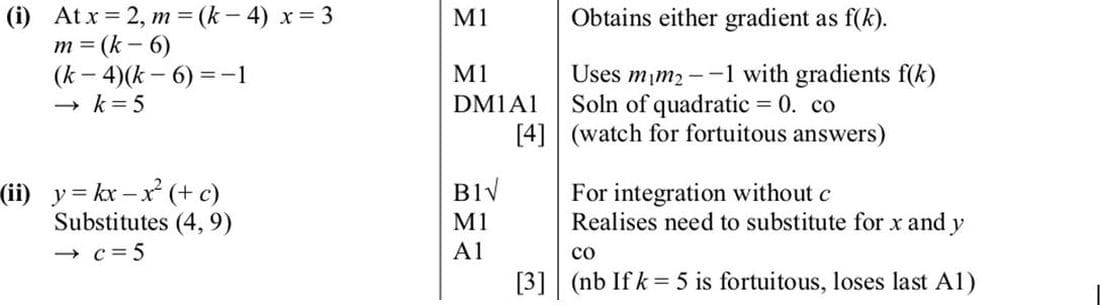
A curve is such that \(\frac{dy}{dx} = k - 2x\), where \(k\) is a constant.
(i) Given that the tangents to the curve at the points where \(x = 2\) and \(x = 3\) are perpendicular, find the value of \(k\). [4]
(ii) Given also that the curve passes through the point (4, 9), find the equation of the curve. [3]
Nov 2007 p1 q9
1400
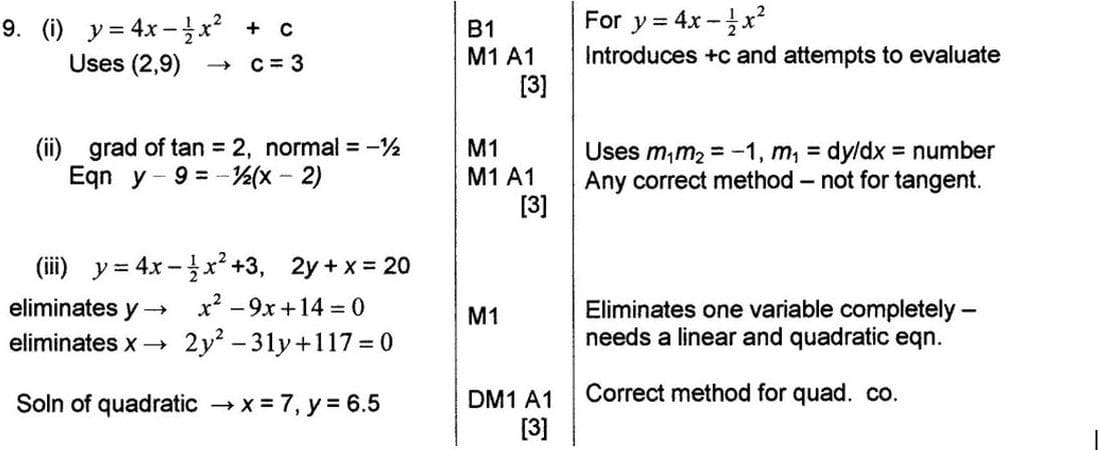
A curve is such that \(\frac{dy}{dx} = 4 - x\) and the point \(P(2, 9)\) lies on the curve. The normal to the curve at \(P\) meets the curve again at \(Q\). Find
- the equation of the curve,
- the equation of the normal to the curve at \(P\),
- the coordinates of \(Q\).
June 2006 p1 q9
1401
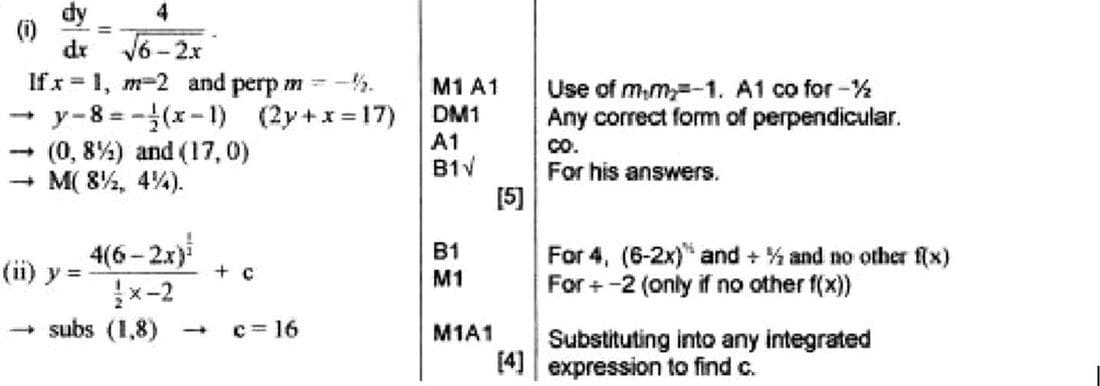
A curve is such that \(\frac{dy}{dx} = \frac{4}{\sqrt{6 - 2x}}\), and \(P(1, 8)\) is a point on the curve.
(i) The normal to the curve at the point \(P\) meets the coordinate axes at \(Q\) and at \(R\). Find the coordinates of the mid-point of \(QR\).
(ii) Find the equation of the curve.
Nov 2019 p13 q8
1402
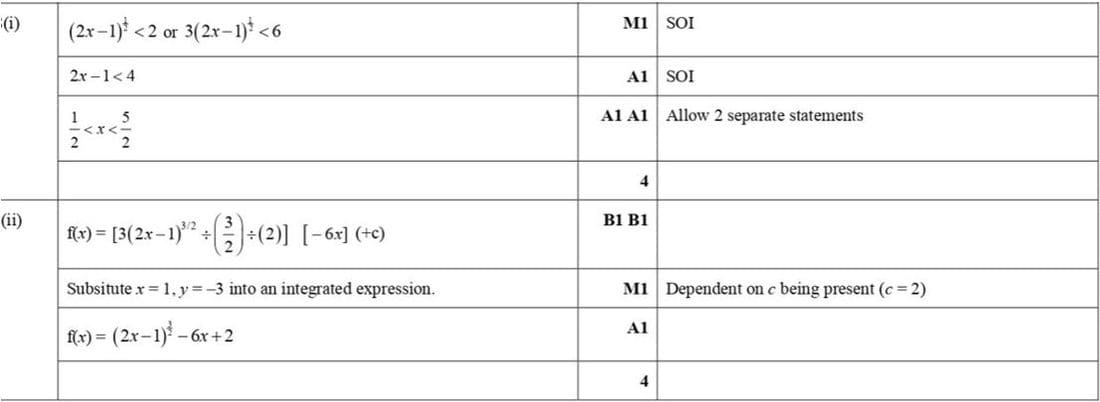
A function \(f\) is defined for \(x > \frac{1}{2}\) and is such that \(f'(x) = 3(2x-1)^{\frac{1}{2}} - 6\).
- Find the set of values of \(x\) for which \(f\) is decreasing.
- It is now given that \(f(1) = -3\). Find \(f(x)\).
Nov 2004 p1 q7
1403
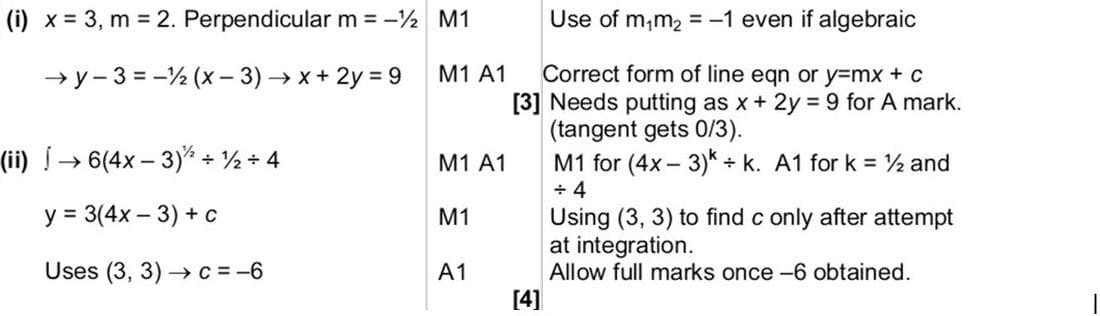
A curve is such that \(\frac{dy}{dx} = \frac{6}{\sqrt{4x - 3}}\) and \(P(3, 3)\) is a point on the curve.
(i) Find the equation of the normal to the curve at \(P\), giving your answer in the form \(ax + by = c\).
(ii) Find the equation of the curve.