Exam-Style Problems
⬅ Back to SubchapterNov 2010 p12 q11
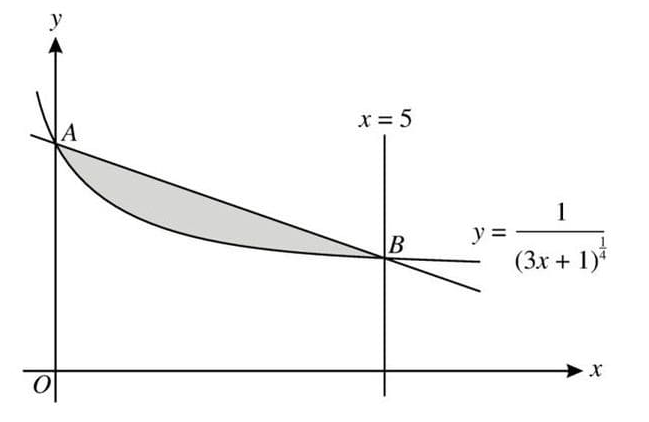
The diagram shows part of the curve \(y = \frac{1}{(3x+1)^{\frac{1}{4}}}\). The curve cuts the y-axis at \(A\) and the line \(x = 5\) at \(B\).
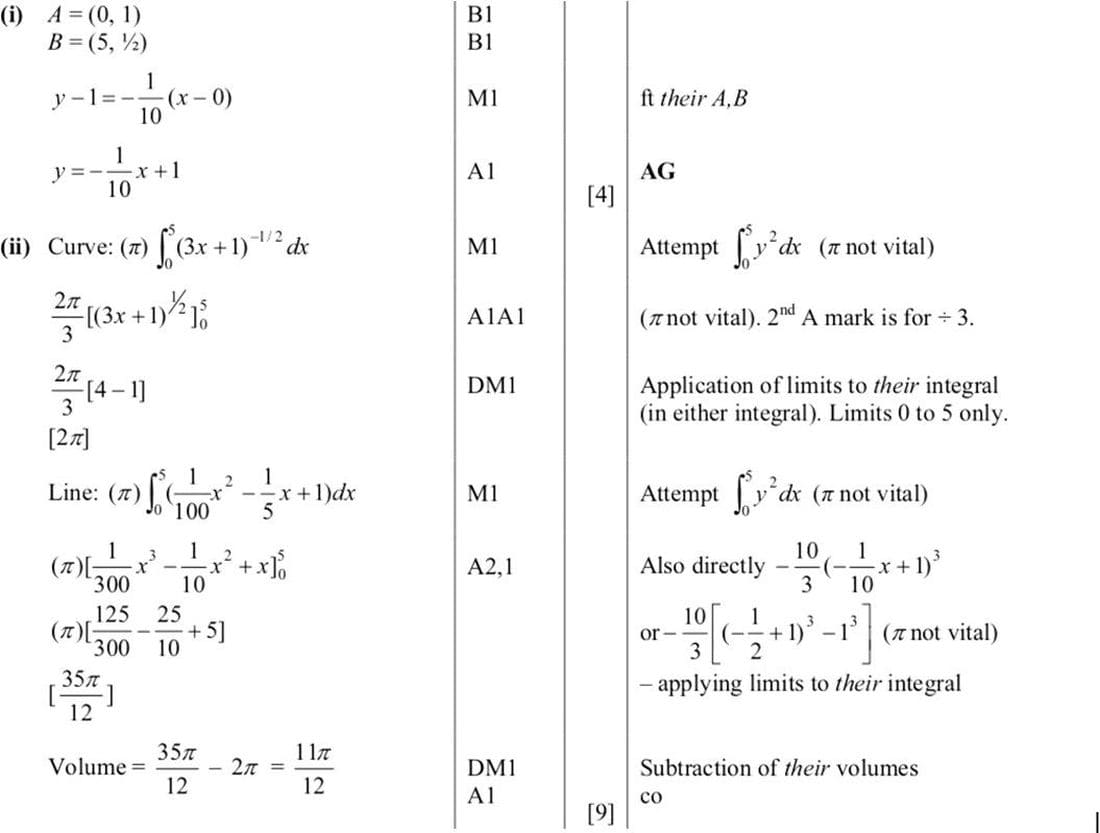
(i) Show that the equation of the line \(AB\) is \(y = -\frac{1}{10}x + 1\). [4]
(ii) Find the volume obtained when the shaded region is rotated through 360° about the x-axis. [9]
March 2022 p12 q8
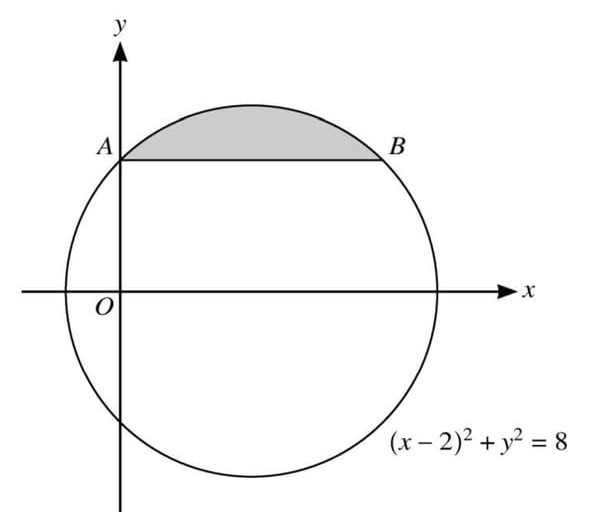
The diagram shows the circle with equation \((x-2)^2 + y^2 = 8\). The chord \(AB\) of the circle intersects the positive \(y\)-axis at \(A\) and is parallel to the \(x\)-axis.
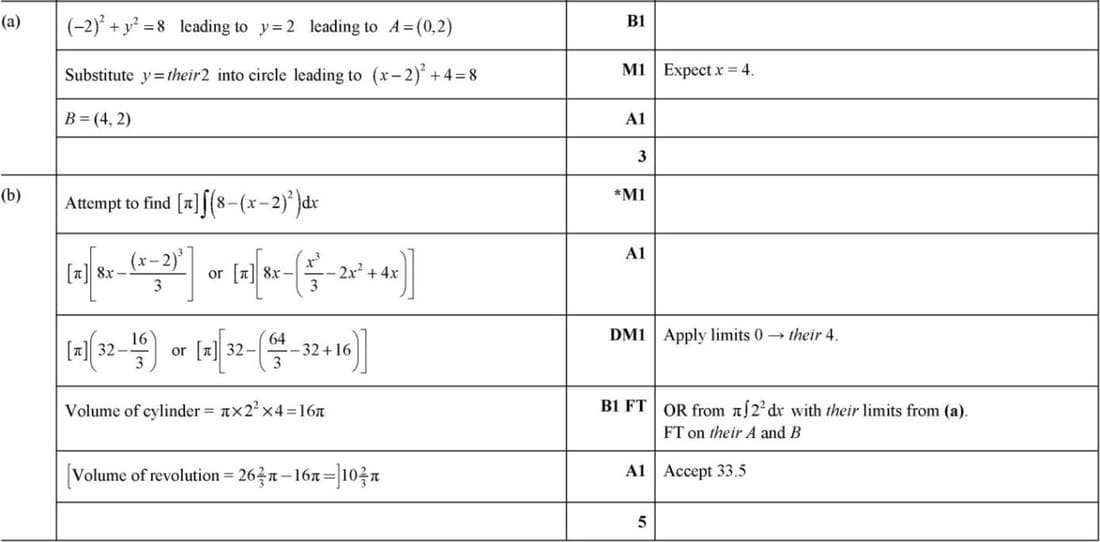
(a) Find, by calculation, the coordinates of \(A\) and \(B\).
(b) Find the volume of revolution when the shaded segment, bounded by the circle and the chord \(AB\), is rotated through 360° about the \(x\)-axis.
Nov 2010 p11 q11
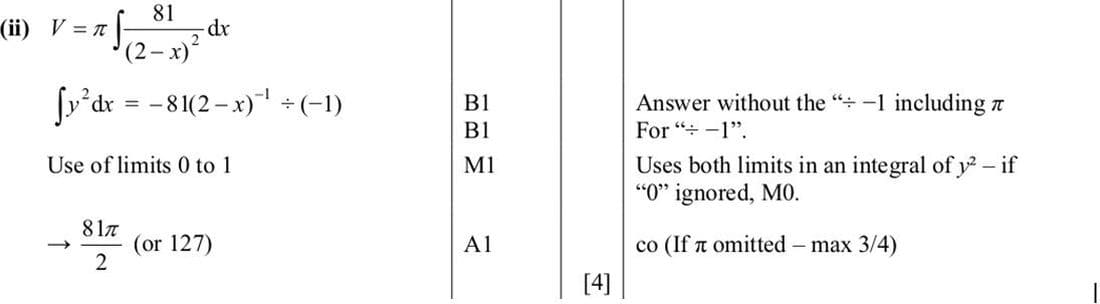
The equation of a curve is \(y = \frac{9}{2-x}\).
Find the volume obtained when the region bounded by the curve, the coordinate axes and the line \(x = 1\) is rotated through 360° about the x-axis.
June 2010 p13 q9
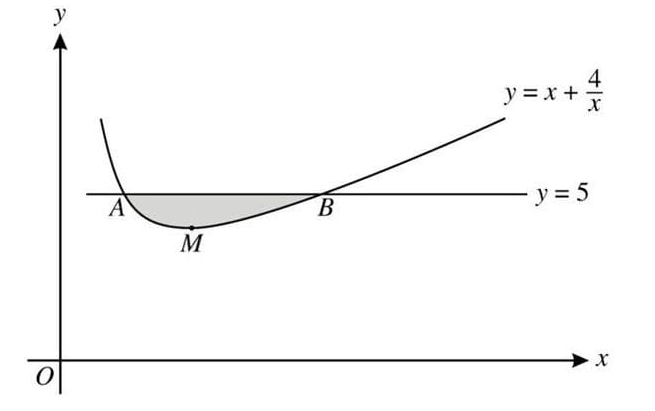
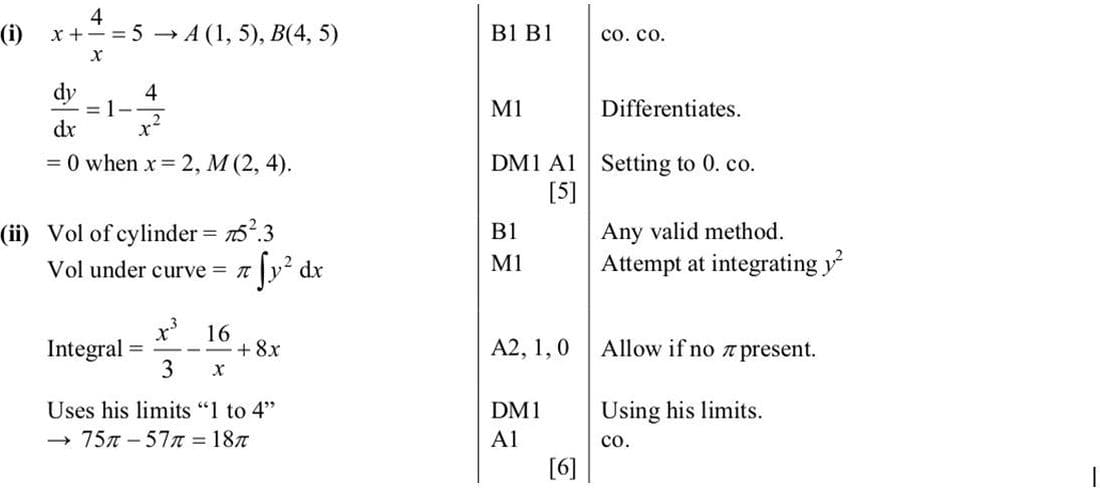
The diagram shows part of the curve \(y = x + \frac{4}{x}\) which has a minimum point at \(M\). The line \(y = 5\) intersects the curve at the points \(A\) and \(B\).
(i) Find the coordinates of \(A, B\) and \(M\).
(ii) Find the volume obtained when the shaded region is rotated through 360° about the x-axis.
June 2010 p12 q2
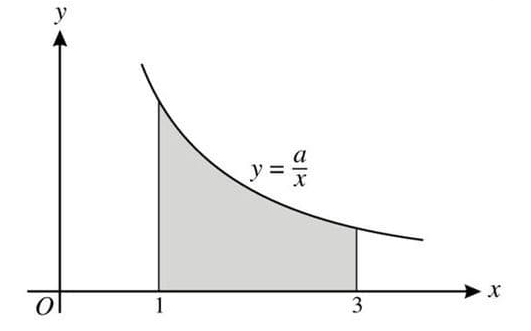
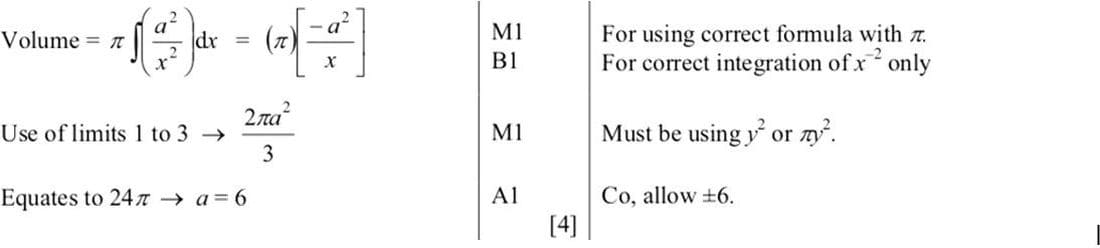
The diagram shows part of the curve \(y = \frac{a}{x}\), where \(a\) is a positive constant. Given that the volume obtained when the shaded region is rotated through 360° about the x-axis is \(24\pi\), find the value of \(a\).