Exam-Style Problems
⬅ Back to SubchapterJune 2013 p11 q9
1247
A curve has equation \(y = f(x)\) and is such that \(f'(x) = 3x^{\frac{1}{2}} + 3x^{-\frac{1}{2}} - 10\).
It is given that the curve \(y = f(x)\) passes through the point \((4, -7)\). Find \(f(x)\).

Nov 2012 p13 q8
1248
A curve is such that \(\frac{dy}{dx} = 2(3x + 4)^{\frac{3}{2}} - 6x - 8\).
It is now given that the stationary point on the curve has coordinates \((-1, 5)\). Find the equation of the curve.

Nov 2012 p11 q2
1249
A curve is such that \(\frac{dy}{dx} = -\frac{8}{x^3} - 1\) and the point (2, 4) lies on the curve. Find the equation of the curve.

June 2023 p13 q9
1250
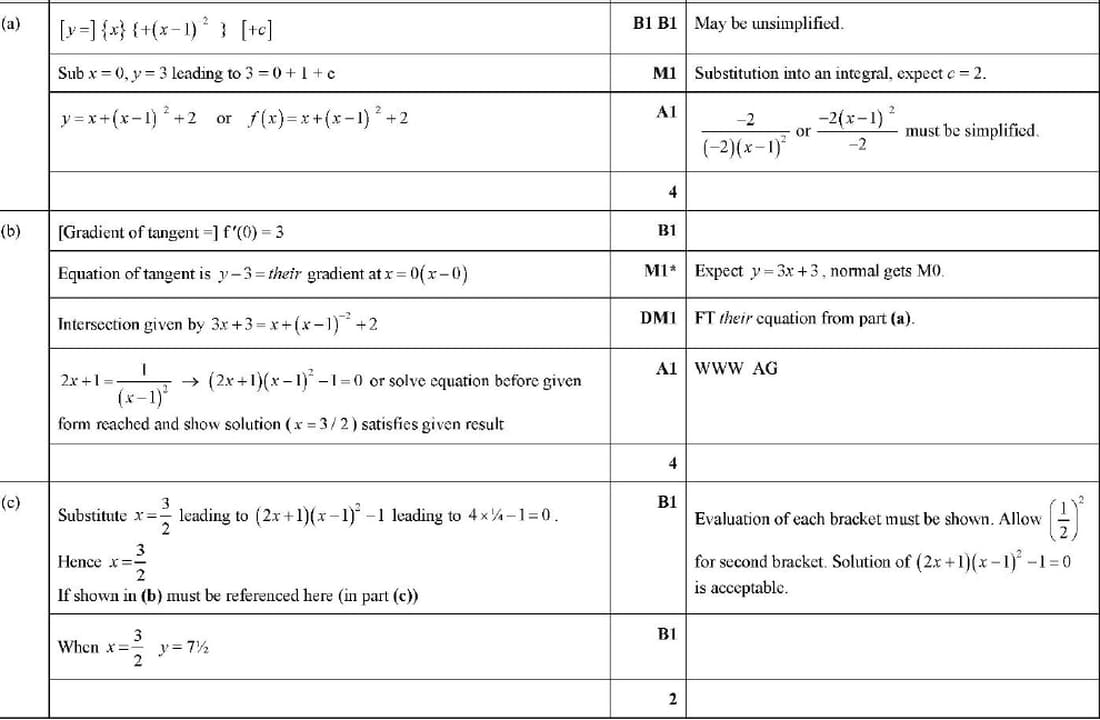
A curve which passes through (0, 3) has equation \(y = f(x)\). It is given that \(f'(x) = 1 - \frac{2}{(x-1)^3}\).
(a) Find the equation of the curve.
The tangent to the curve at (0, 3) intersects the curve again at one other point, \(P\).
(b) Show that the \(x\)-coordinate of \(P\) satisfies the equation \((2x + 1)(x - 1)^2 - 1 = 0\).
(c) Verify that \(x = \frac{3}{2}\) satisfies this equation and hence find the \(y\)-coordinate of \(P\).
June 2011 p13 q9
1251
A curve is such that \(\frac{dy}{dx} = \frac{2}{\sqrt{x}} - 1\) and \(P(9, 5)\) is a point on the curve.
Find the equation of the curve.
