Exam-Style Problems
⬅ Back to SubchapterJune 2011 p11 q6
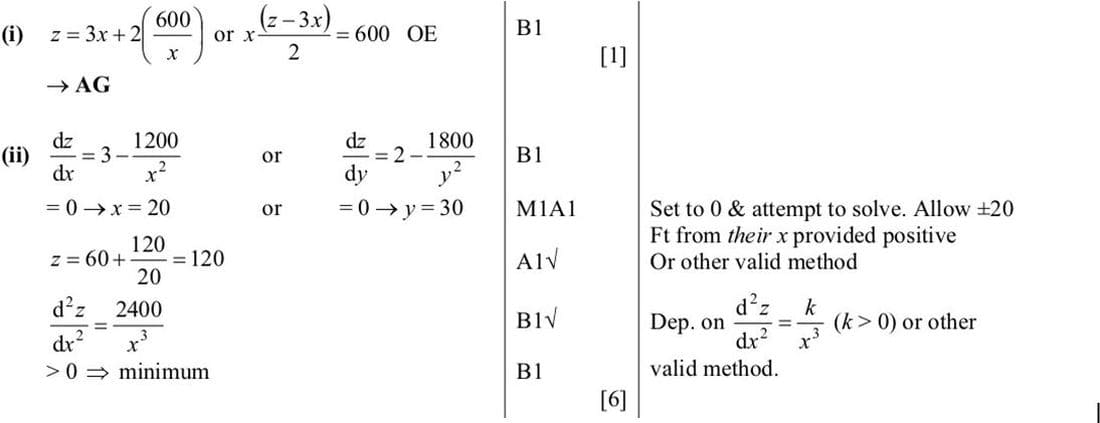
The variables x, y and z can take only positive values and are such that
\(z = 3x + 2y\) and \(xy = 600\).
(i) Show that \(z = 3x + \frac{1200}{x}\).
(ii) Find the stationary value of \(z\) and determine its nature.
Nov 2010 p13 q5
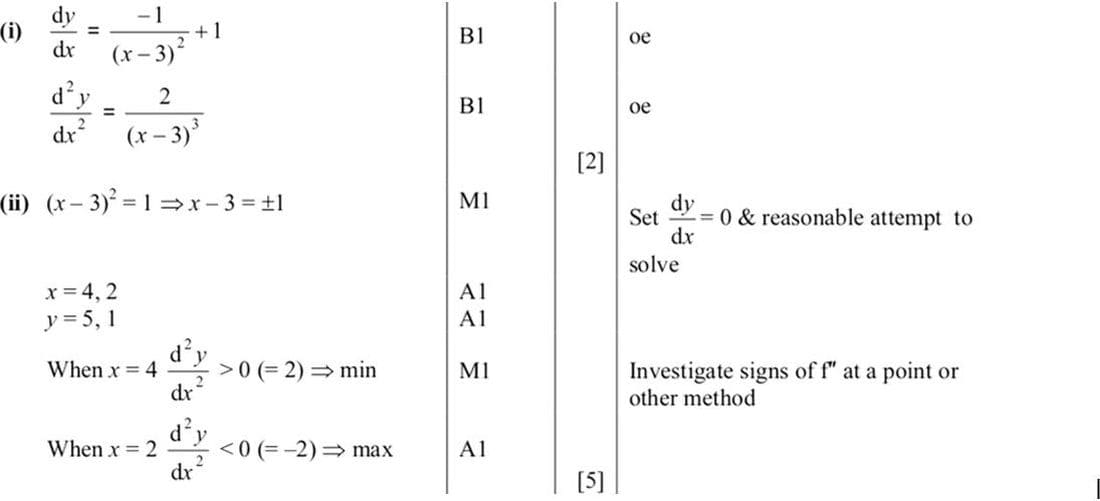
A curve has equation \(y = \frac{1}{x-3} + x\).
(i) Find \(\frac{dy}{dx}\) and \(\frac{d^2y}{dx^2}\).
(ii) Find the coordinates of the maximum point \(A\) and the minimum point \(B\) on the curve.
Nov 2010 p11 q11
The equation of a curve is \(y = \frac{9}{2-x}\).
Find an expression for \(\frac{dy}{dx}\) and determine, with a reason, whether the curve has any stationary points.

June 2022 p12 q9
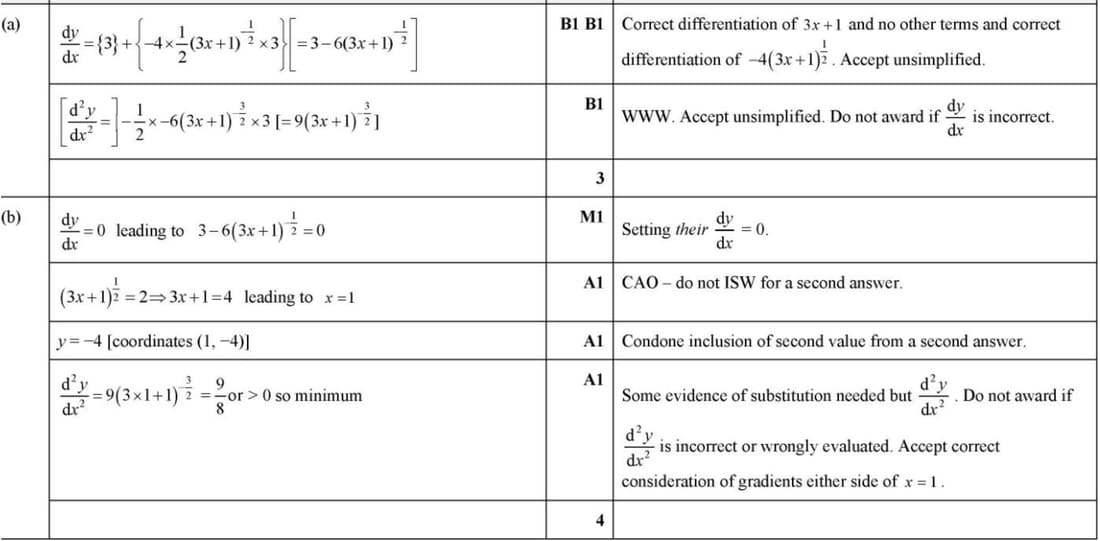
The equation of a curve is \(y = 3x + 1 - 4(3x + 1)^{\frac{1}{2}}\) for \(x > -\frac{1}{3}\).
(a) Find \(\frac{dy}{dx}\) and \(\frac{d^2y}{dx^2}\).
(b) Find the coordinates of the stationary point of the curve and determine its nature.
Nov 2007 p1 q8
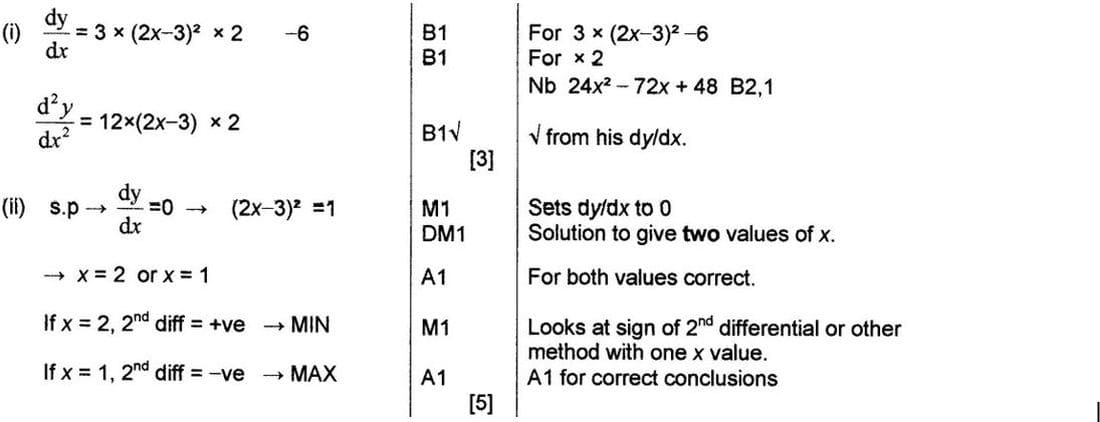
The equation of a curve is \(y = (2x - 3)^3 - 6x\).
(i) Express \(\frac{dy}{dx}\) and \(\frac{d^2y}{dx^2}\) in terms of \(x\).
(ii) Find the \(x\)-coordinates of the two stationary points and determine the nature of each stationary point.