Exam-Style Problems
⬅ Back to SubchapterJune 2019 p12 q6
596
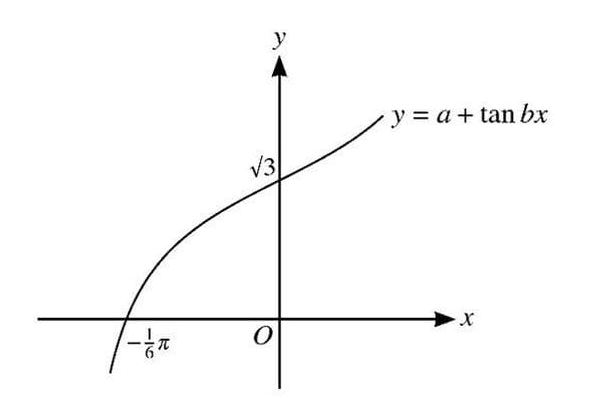
The equation of a curve is \(y = 3 \cos 2x\) and the equation of a line is \(2y + \frac{3x}{\pi} = 5\).
(i) State the smallest and largest values of \(y\) for both the curve and the line for \(0 \leq x \leq 2\pi\).
(ii) Sketch, on the same diagram, the graphs of \(y = 3 \cos 2x\) and \(2y + \frac{3x}{\pi} = 5\) for \(0 \leq x \leq 2\pi\).
(iii) State the number of solutions of the equation \(6 \cos 2x = 5 - \frac{3x}{\pi}\) for \(0 \leq x \leq 2\pi\).
June 2019 p12 q4
597
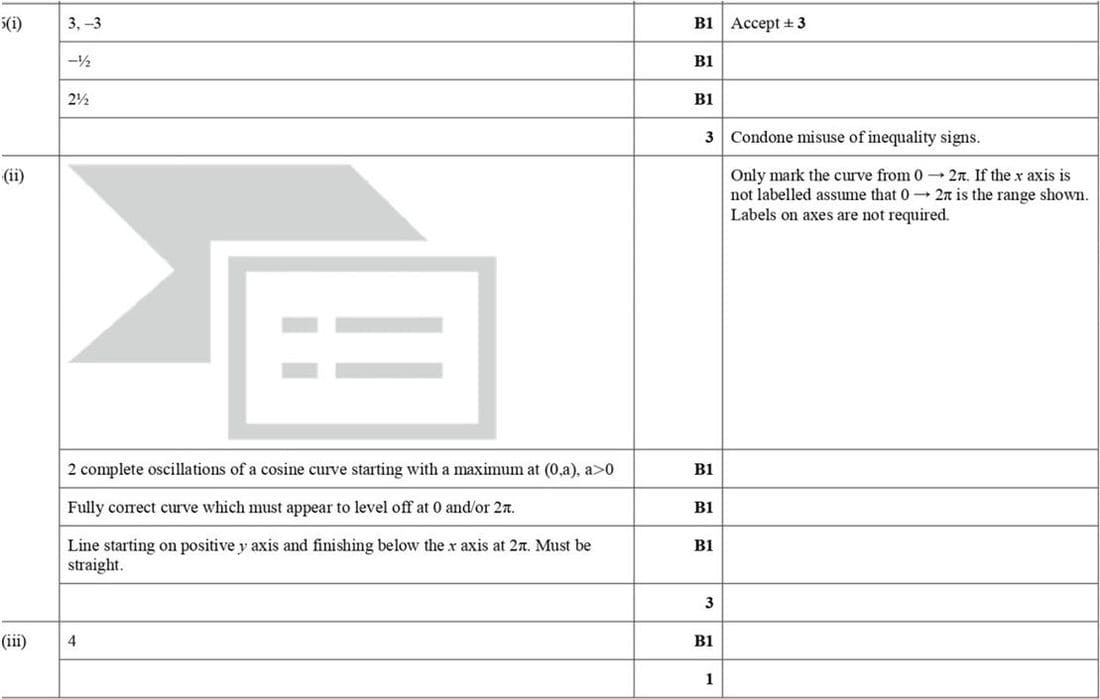
Angle x is such that \(\sin x = a + b\) and \(\cos x = a - b\), where a and b are constants.
(i) Show that \(a^2 + b^2\) has a constant value for all values of x.
(ii) In the case where \(\tan x = 2\), express a in terms of b.
Problem 598
598
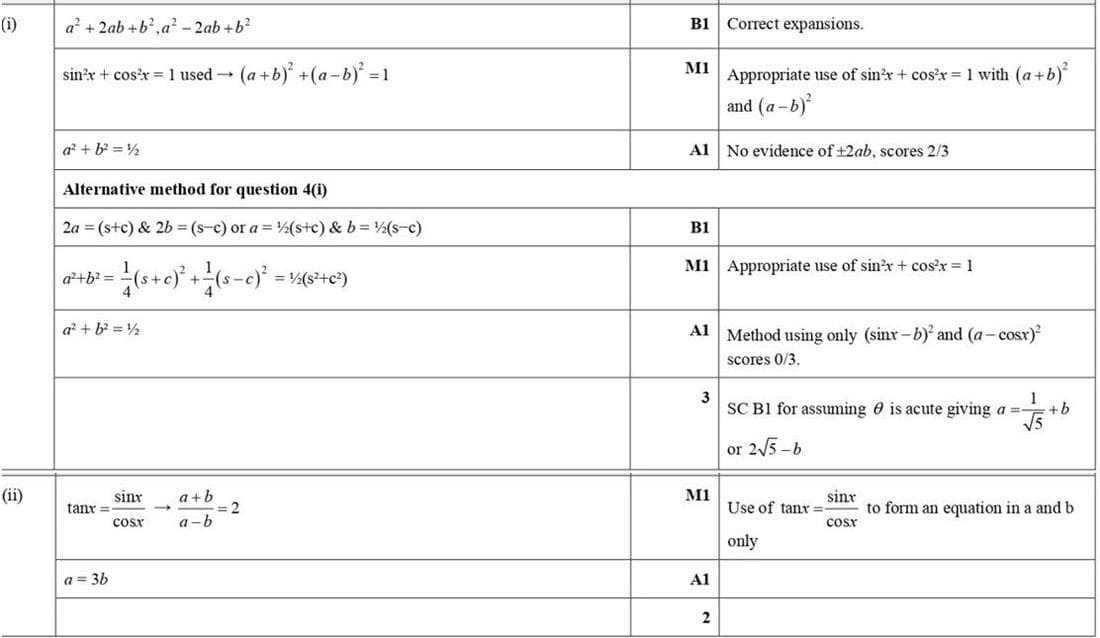
The diagram shows part of the graph of \(y = a + \tan bx\), where \(x\) is measured in radians and \(a\) and \(b\) are constants. The curve intersects the \(x\)-axis at \(\left(-\frac{1}{6}\pi, 0\right)\) and the \(y\)-axis at \((0, \sqrt{3})\). Find the values of \(a\) and \(b\).