Exam-Style Problems
⬅ Back to SubchapterFM Nov 2024 p11 q03
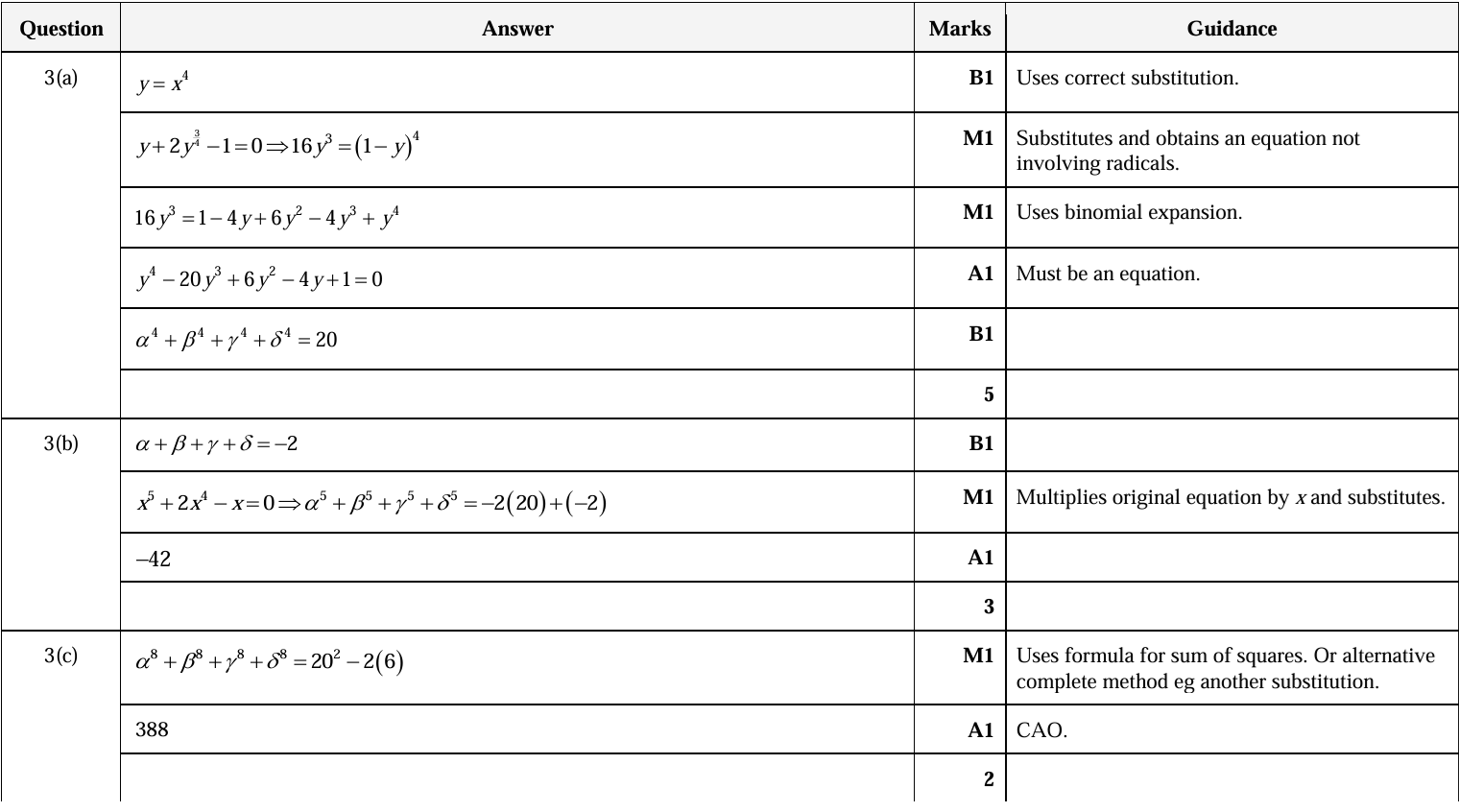
The quartic equation \(x^4 + 2x^3 - 1 = 0\) has roots \(\alpha, \beta, \gamma, \delta\).
(a) Find a quartic equation whose roots are \(\alpha^4, \beta^4, \gamma^4, \delta^4\) and state the value of \(\alpha^4 + \beta^4 + \gamma^4 + \delta^4\).
(b) Find the value of \(\alpha^5 + \beta^5 + \gamma^5 + \delta^5\).
(c) Find the value of \(\alpha^8 + \beta^8 + \gamma^8 + \delta^8\).
FM Nov 2024 p11 q04
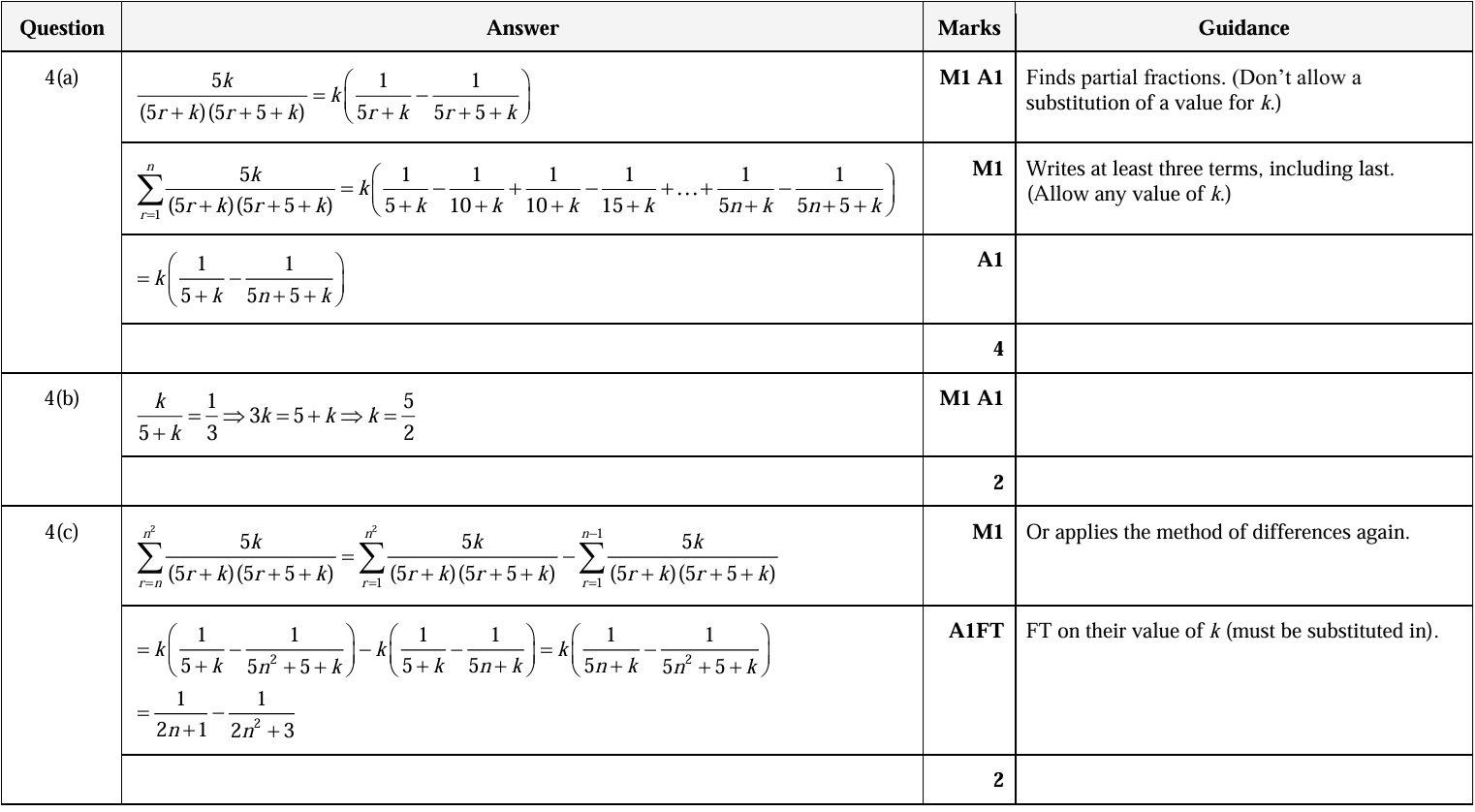
(a) Use the method of differences to find \(\sum_{r=1}^{n} \frac{5k}{(5r+k)(5r+5+k)}\) in terms of \(n\) and \(k\), where \(k\) is a positive constant.
It is given that \(\sum_{r=1}^{\infty} \frac{5k}{(5r+k)(5r+5+k)} = \frac{1}{3}\).
(b) Find the value of \(k\).
(c) Hence find \(\sum_{r=n}^{n^2} \frac{5k}{(5r+k)(5r+5+k)}\) in terms of \(n\).
FM Nov 2024 p11 q05
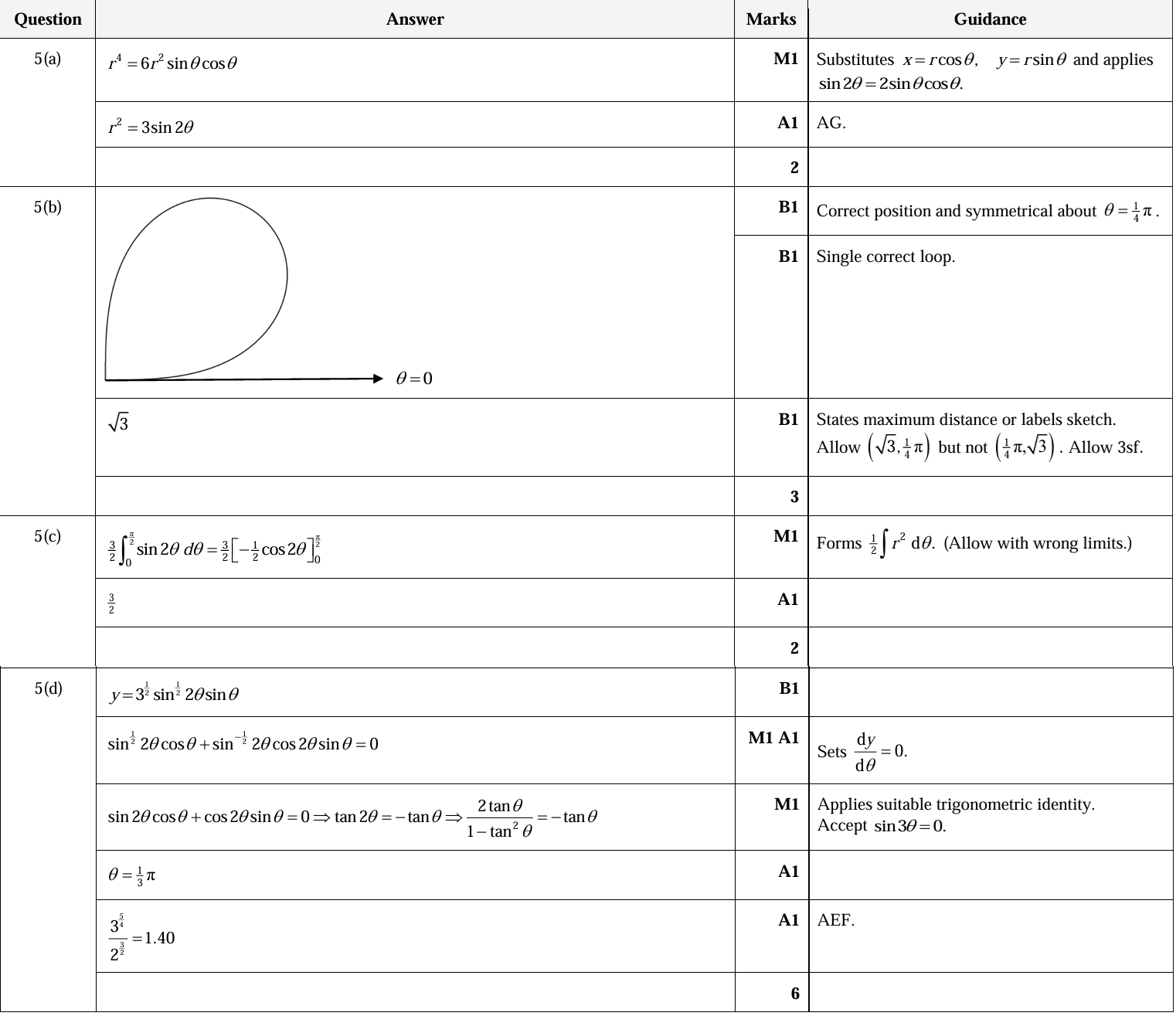
(a) Show that the curve with Cartesian equation \((x^2 + y^2)^2 = 6xy\) has polar equation \(r^2 = 3 \sin 2\theta\).
The curve \(C\) has polar equation \(r^2 = 3 \sin 2\theta\), for \(0 \leq \theta \leq \frac{1}{2}\pi\).
(b) Sketch \(C\) and state the maximum distance of a point on \(C\) from the pole.
(c) Find the area of the region enclosed by \(C\).
(d) Find the maximum distance of a point on \(C\) from the initial line.
FM Nov 2024 p11 q06
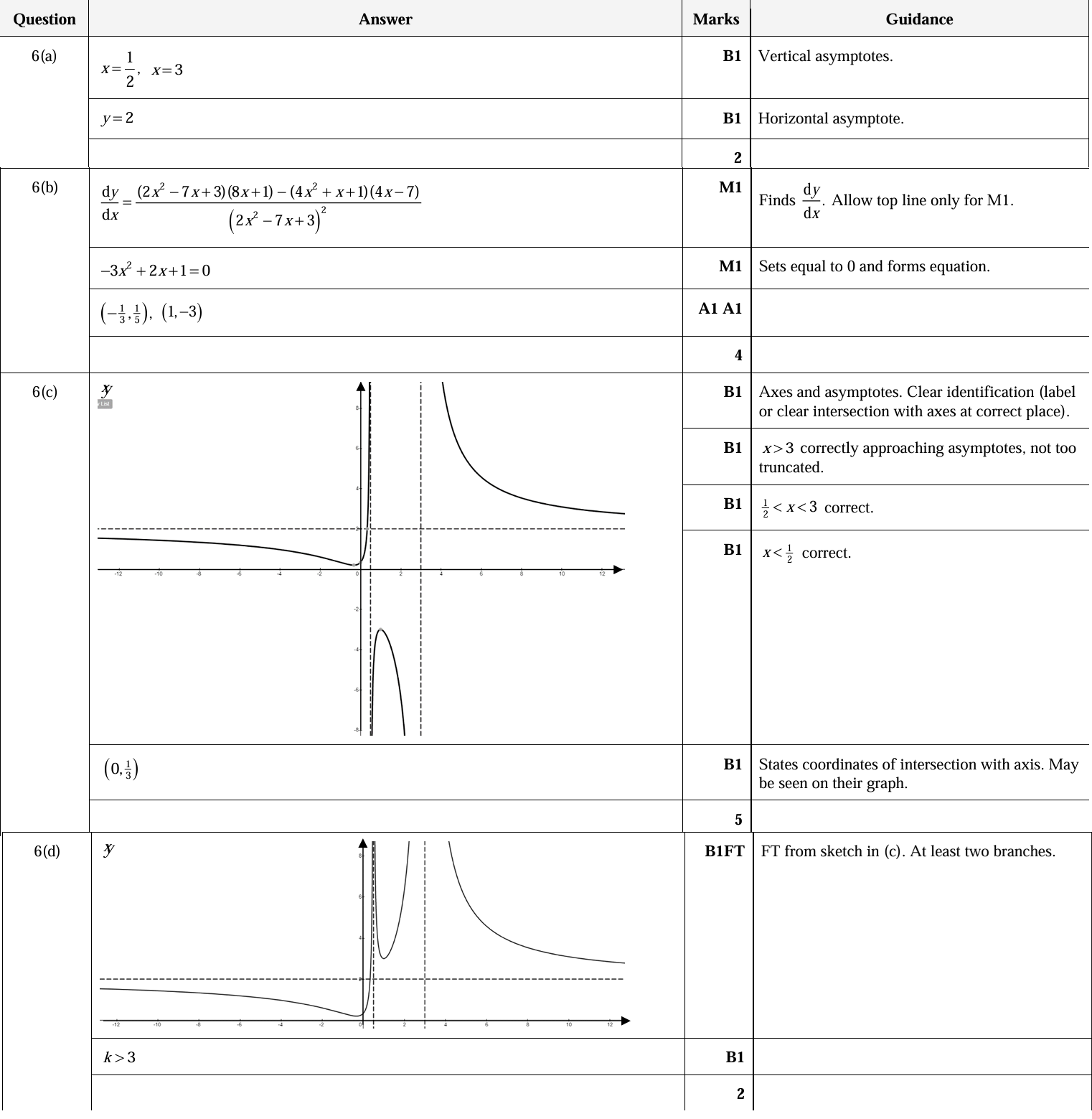
The curve C has equation \(y = \frac{4x^2 + x + 1}{2x^2 - 7x + 3}\).
- (a) Find the equations of the asymptotes of C.
- (b) Find the coordinates of any stationary points on C.
- (c) Sketch C, stating the coordinates of any intersections with the axes.
- (d) Sketch the curve with equation \(y = \left| \frac{4x^2 + x + 1}{2x^2 - 7x + 3} \right|\) and state the set of values of \(k\) for which \(\left| \frac{4x^2 + x + 1}{2x^2 - 7x + 3} \right| = k\) has 4 distinct real solutions.
FM Nov 2024 p11 q07
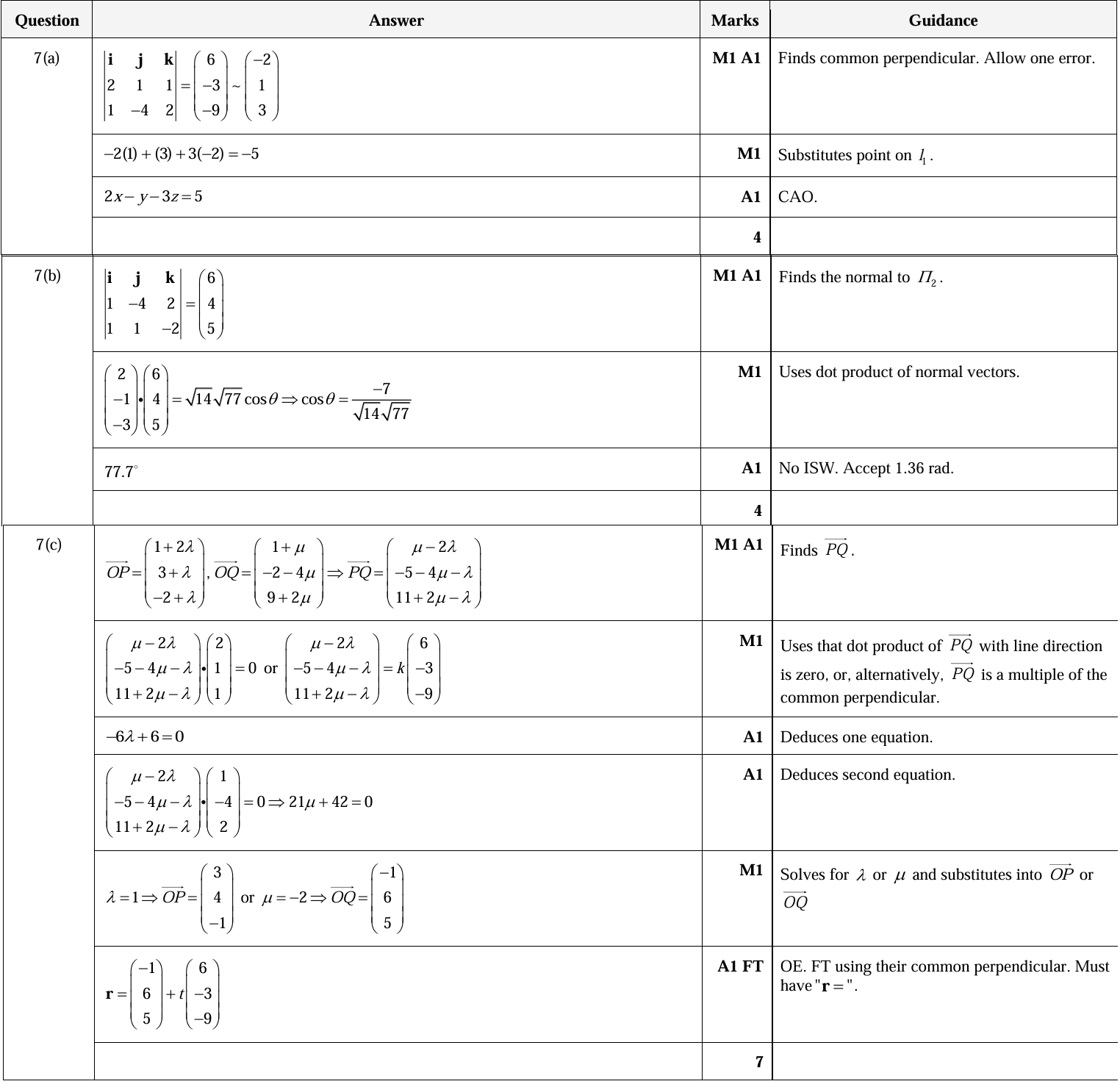
The lines \(l_1\) and \(l_2\) have equations \(\mathbf{r} = \mathbf{i} + 3\mathbf{j} - 2\mathbf{k} + \lambda(2\mathbf{i} + \mathbf{j} + \mathbf{k})\) and \(\mathbf{r} = \mathbf{i} - 2\mathbf{j} + 9\mathbf{k} + \mu(\mathbf{i} - 4\mathbf{j} + 2\mathbf{k})\) respectively. The plane \(\Pi_1\) contains \(l_1\) and is parallel to \(l_2\).
(a) Find the equation of \(\Pi_1\), giving your answer in the form \(ax + by + cz = d\).
The plane \(\Pi_2\) contains \(l_2\) and the point with coordinates \((2, -1, 7)\).
(b) Find the acute angle between \(\Pi_1\) and \(\Pi_2\).
The point \(P\) on \(l_1\) and the point \(Q\) on \(l_2\) are such that \(PQ\) is perpendicular to both \(l_1\) and \(l_2\).
(c) Find a vector equation for \(PQ\).