Exam-Style Problems
⬅ Back to SubchapterJune 2012 p42 q4
4085
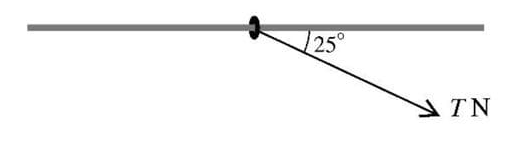
A ring of mass 4 kg is attached to one end of a light string. The ring is threaded on a fixed horizontal rod and the string is pulled at an angle of 25° below the horizontal (see diagram). With a tension in the string of \(T\) N the ring is in equilibrium.
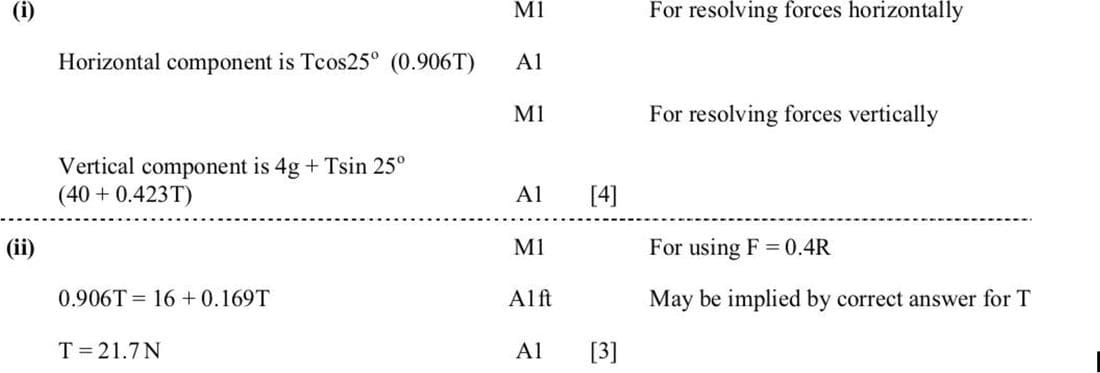
(i) Find, in terms of \(T\), the horizontal and vertical components of the force exerted on the ring by the rod.
The coefficient of friction between the ring and the rod is 0.4.
(ii) Given that the equilibrium is limiting, find the value of \(T\).
June 2010 p41 q3
4086
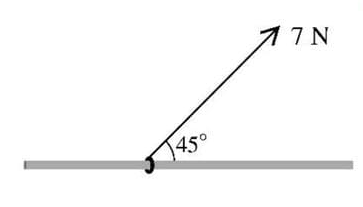
A small ring of mass 0.8 kg is threaded on a rough rod which is fixed horizontally. The ring is in equilibrium, acted on by a force of magnitude 7 N pulling upwards at 45° to the horizontal (see diagram).
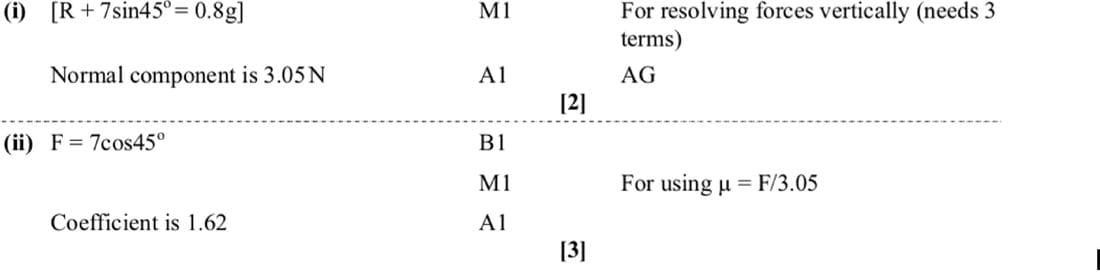
(i) Show that the normal component of the contact force acting on the ring has magnitude 3.05 N, correct to 3 significant figures.
(ii) The ring is in limiting equilibrium. Find the coefficient of friction between the ring and the rod.
June 2004 p4 q1
4087
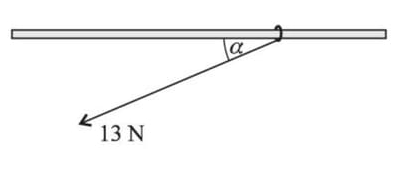
A ring of mass 1.1 kg is threaded on a fixed rough horizontal rod. A light string is attached to the ring and the string is pulled with a force of magnitude 13 N at an angle \(\alpha\) below the horizontal, where \(\tan \alpha = \frac{5}{12}\) (see diagram). The ring is in equilibrium.
(i) Find the frictional component of the contact force on the ring.
(ii) Find the normal component of the contact force on the ring.
(iii) Given that the equilibrium of the ring is limiting, find the coefficient of friction between the ring and the rod.

June 2021 p42 q3
4088
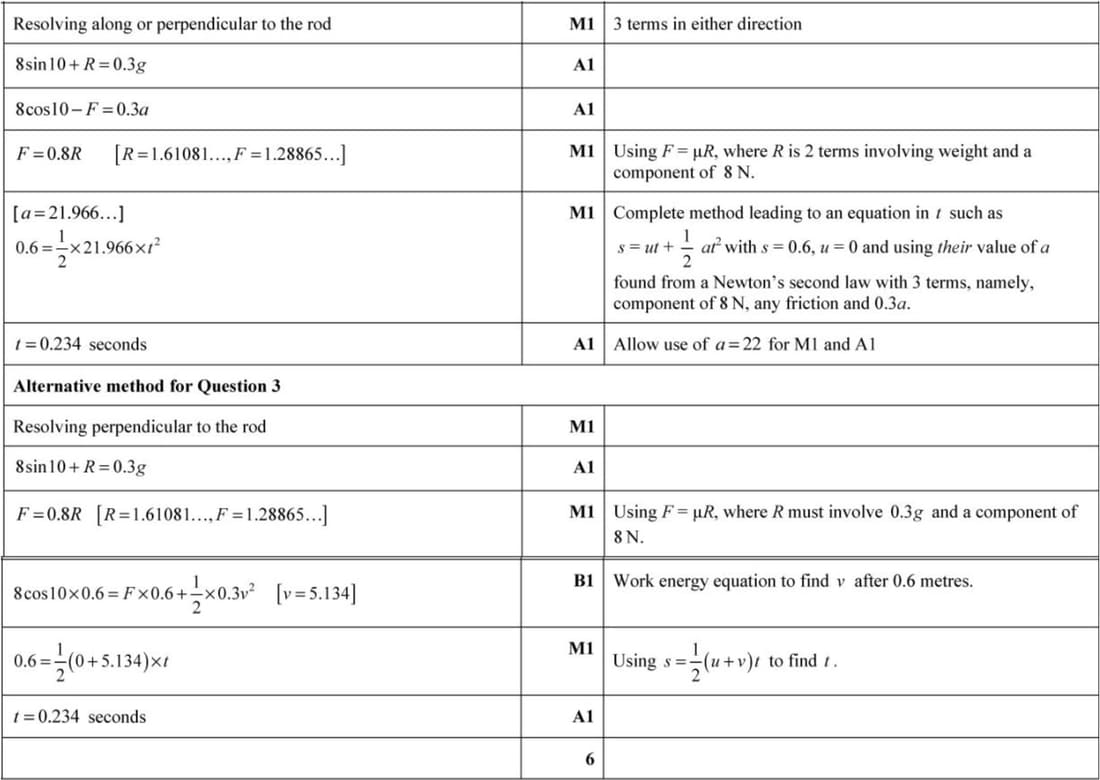
A ring of mass 0.3 kg is threaded on a horizontal rough rod. The coefficient of friction between the ring and the rod is 0.8. A force of magnitude 8 N acts on the ring. This force acts at an angle of 10° above the horizontal in the vertical plane containing the rod.
Find the time taken for the ring to move, from rest, 0.6 m along the rod.
June 2020 p41 q4
4089
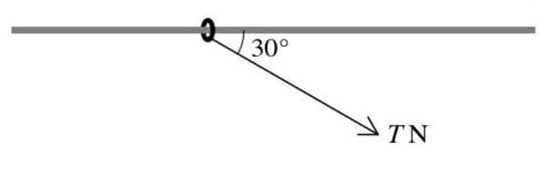
The diagram shows a ring of mass 0.1 kg threaded on a fixed horizontal rod. The rod is rough and the coefficient of friction between the ring and the rod is 0.8. A force of magnitude \(T \text{ N}\) acts on the ring in a direction at \(30^\circ\) to the rod, downwards in the vertical plane containing the rod. Initially the ring is at rest.
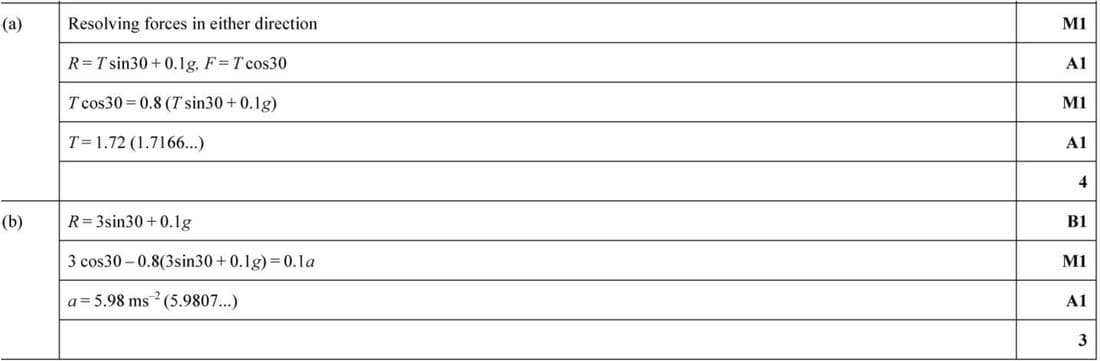
(a) Find the greatest value of \(T\) for which the ring remains at rest. [4]
(b) Find the acceleration of the ring when \(T = 3\). [3]