Exam-Style Problems
⬅ Back to SubchapterProblem 3437
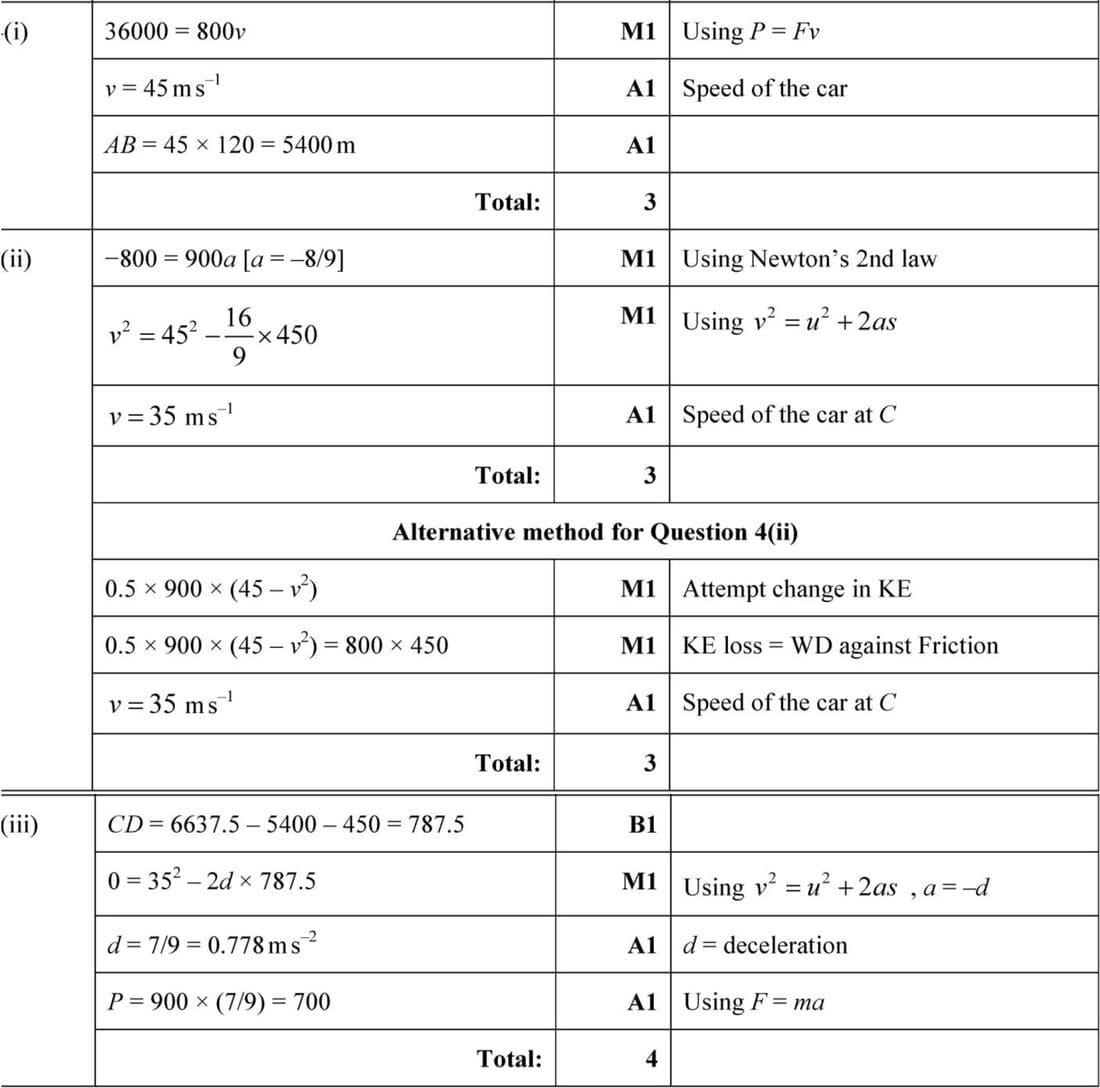
A car of mass 900 kg is moving on a straight horizontal road ABCD. There is a constant resistance of magnitude 800 N in the sections AB and BC, and a constant resistance of magnitude R N in the section CD. The power of the car’s engine is a constant 36 kW.
- The car moves from A to B at a constant speed in 120 s. Find the speed of the car and the distance AB.
- The car’s engine is switched off at B.
- The distance BC is 450 m. Find the speed of the car at C.
- The car comes to rest at D. The distance AD is 6637.5 m. Find the deceleration of the car and the value of R.
Nov 2016 p43 q6
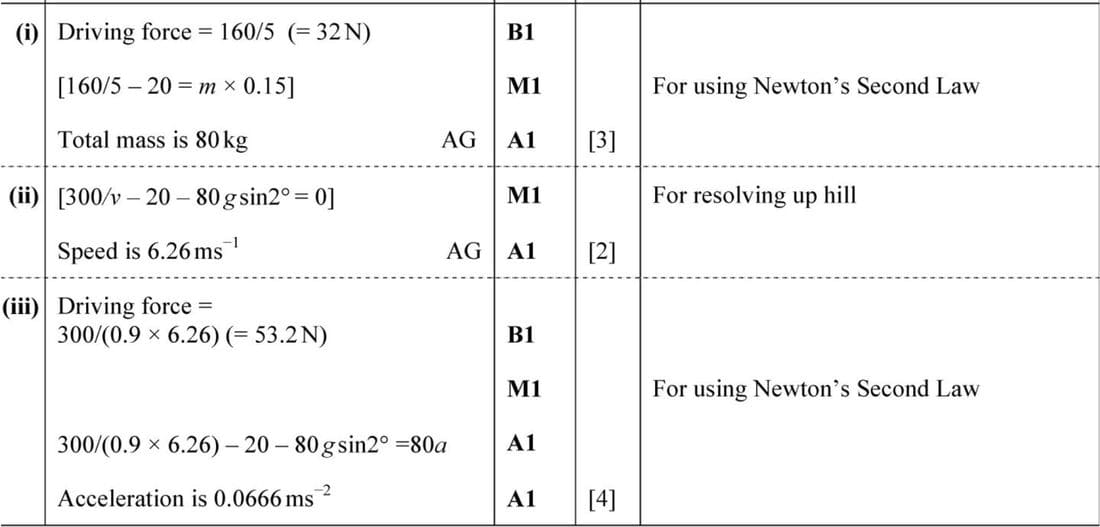
A cyclist is cycling with constant power of 160 W along a horizontal straight road. There is a constant resistance to motion of 20 N. At an instant when the cyclist’s speed is 5 m s-1, his acceleration is 0.15 m s-2.
(i) Show that the total mass of the cyclist and bicycle is 80 kg.
The cyclist comes to a hill inclined at 2° to the horizontal. When the cyclist starts climbing the hill, he increases his power to a constant 300 W. The resistance to motion remains 20 N.
(ii) Show that the steady speed up the hill which the cyclist can maintain when working at this power is 6.26 m s-1, correct to 3 significant figures.
(iii) Find the acceleration at an instant when the cyclist is travelling at 90% of the speed in part (ii).
Nov 2016 p43 q1
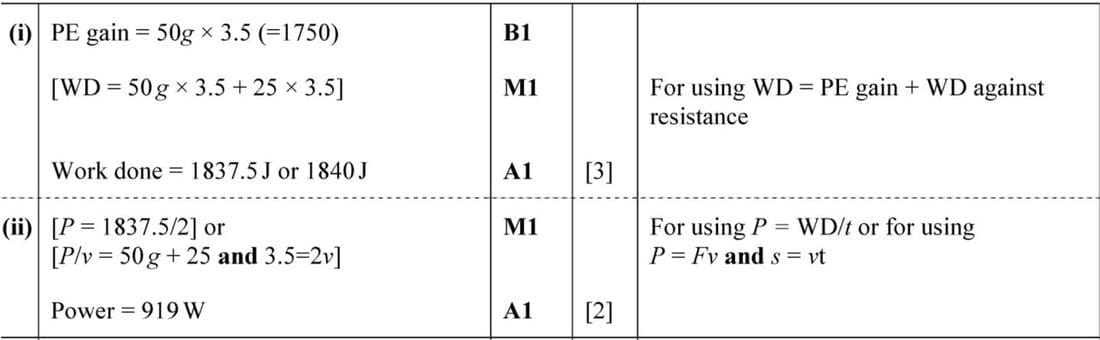
A crane is used to raise a block of mass 50 kg vertically upwards at constant speed through a height of 3.5 m. There is a constant resistance to motion of 25 N.
- Find the work done by the crane.
- Given that the time taken to raise the block is 2 s, find the power of the crane.
Feb/Mar 2023 p42 q4
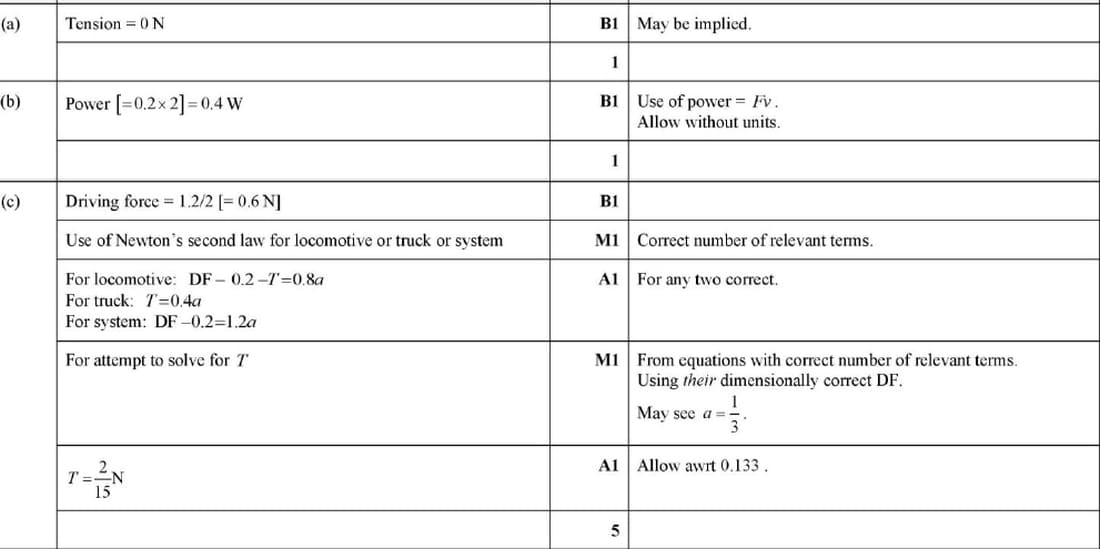
A toy railway locomotive of mass 0.8 kg is towing a truck of mass 0.4 kg on a straight horizontal track at a constant speed of 2 m s-1. There is a constant resistance force of magnitude 0.2 N on the locomotive, but no resistance force on the truck. There is a light rigid horizontal coupling connecting the locomotive and the truck.
(a) State the tension in the coupling.
(b) Find the power produced by the locomotive’s engine.
The power produced by the locomotive’s engine is now changed to 1.2 W.
(c) Find the magnitude of the tension in the coupling at the instant that the locomotive begins to accelerate.
Nov 2016 p42 q6
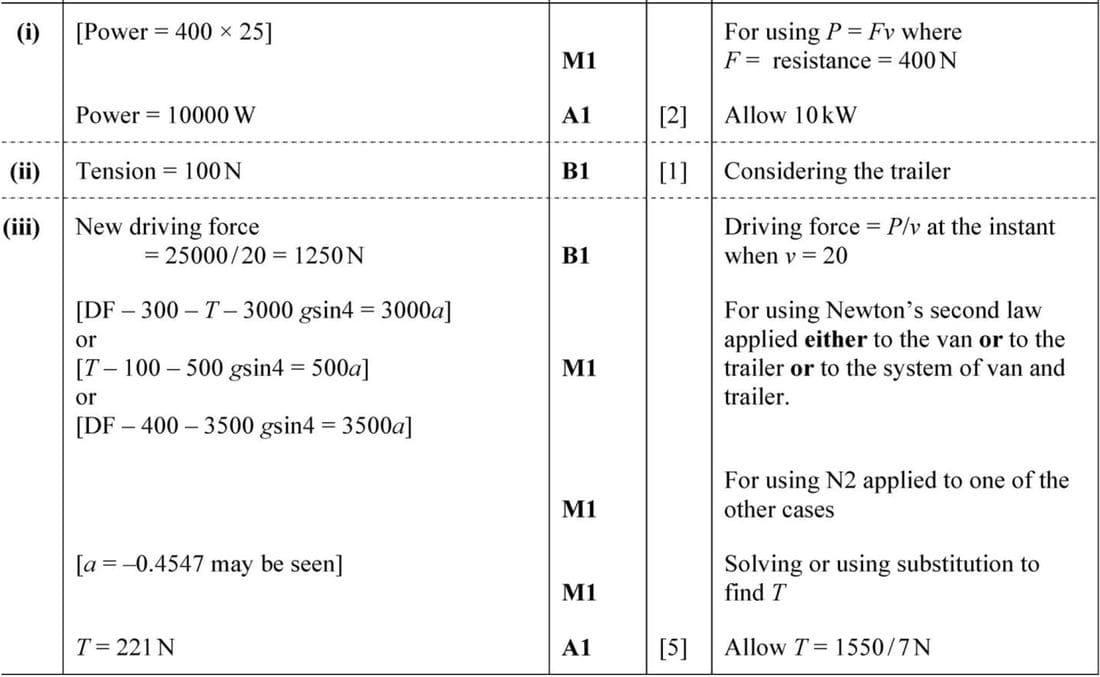
A van of mass 3000 kg is pulling a trailer of mass 500 kg along a straight horizontal road at a constant speed of 25 m s-1. The system of the van and the trailer is modelled as two particles connected by a light inextensible cable. There is a constant resistance to motion of 300 N on the van and 100 N on the trailer.
(i) Find the power of the van’s engine.
(ii) Write down the tension in the cable.
The van reaches the bottom of a hill inclined at 4° to the horizontal with speed 25 m s-1. The power of the van’s engine is increased to 25 000 W.
(iii) Assuming that the resistance forces remain the same, find the new tension in the cable at the instant when the speed of the van up the hill is 20 m s-1.