Exam-Style Problems
⬅ Back to SubchapterJune 2019 p42 q3
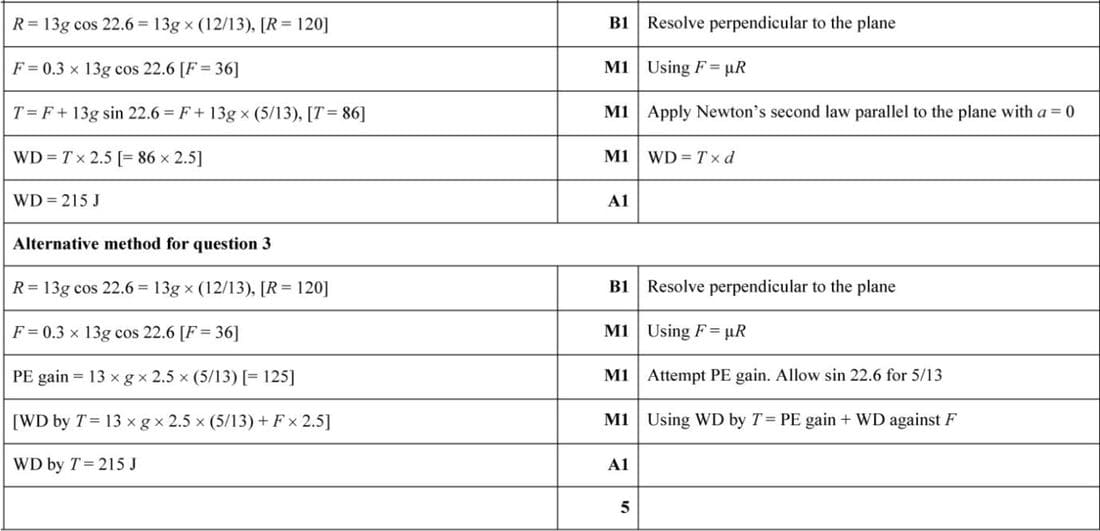
A particle of mass 13 kg is on a rough plane inclined at an angle of \(\theta\) to the horizontal, where \(\tan \theta = \frac{5}{12}\). The coefficient of friction between the particle and the plane is 0.3. A force of magnitude \(T\) N, acting parallel to a line of greatest slope, moves the particle a distance of 2.5 m up the plane at a constant speed. Find the work done by this force.
June 2019 p41 q4
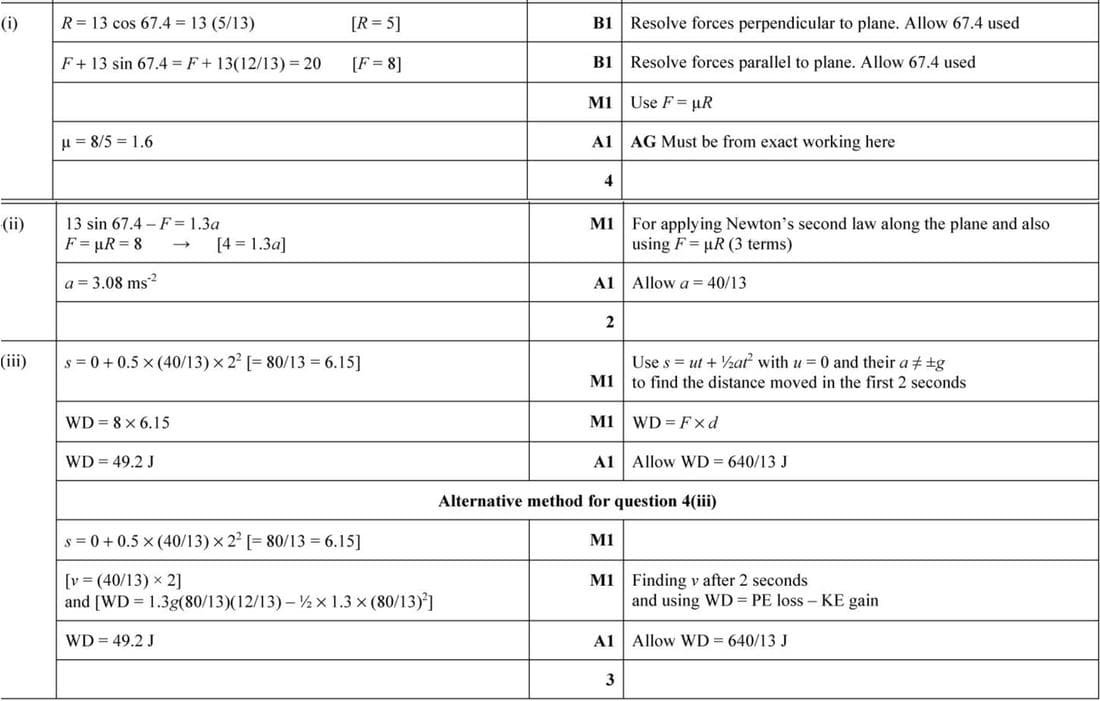
A particle of mass 1.3 kg rests on a rough plane inclined at an angle \(\theta\) to the horizontal, where \(\tan \theta = \frac{12}{5}\). The coefficient of friction between the particle and the plane is \(\mu\).
(i) A force of magnitude 20 N parallel to a line of greatest slope of the plane is applied to the particle and the particle is on the point of moving up the plane. Show that \(\mu = 1.6\). [4]
The force of magnitude 20 N is now removed.
(ii) Find the acceleration of the particle. [2]
(iii) Find the work done against friction during the first 2 s of motion. [3]
Nov 2018 p43 q3
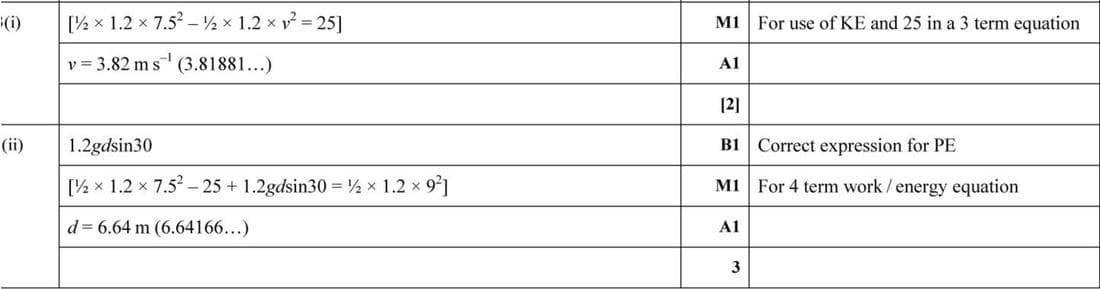
A particle of mass 1.2 kg moves in a straight line AB. It is projected with speed 7.5 m s-1 from A towards B and experiences a resistance force. The work done against this resistance force in moving from A to B is 25 J.
- Given that AB is horizontal, find the speed of the particle at B.
- It is given instead that AB is inclined at 30° below the horizontal and that the speed of the particle at B is 9 m s-1. The work done against the resistance force remains the same. Find the distance AB.
Nov 2018 p41 q3
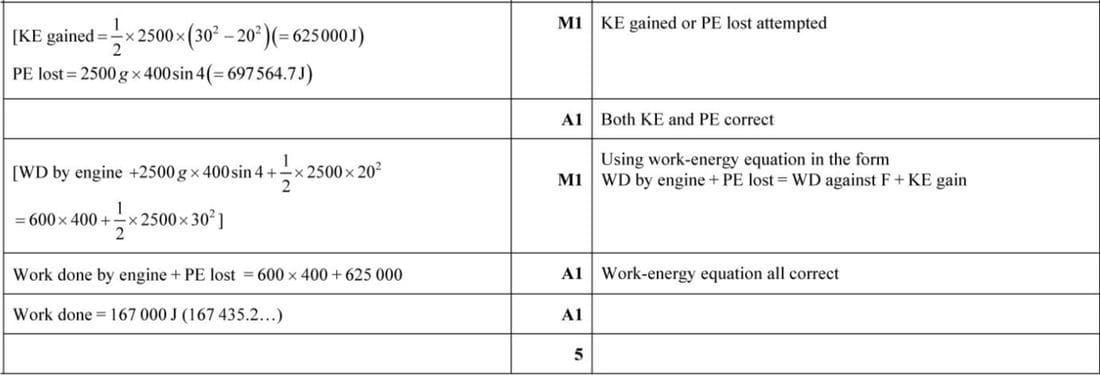
A van of mass 2500 kg descends a hill of length 0.4 km inclined at 4° to the horizontal. There is a constant resistance to motion of 600 N and the speed of the van increases from 20 m/s to 30 m/s as it descends the hill. Find the work done by the van’s engine as it descends the hill.