Exam-Style Problems
⬅ Back to SubchapterJune 2018 p41 q6
3523
A car has mass 1250 kg.
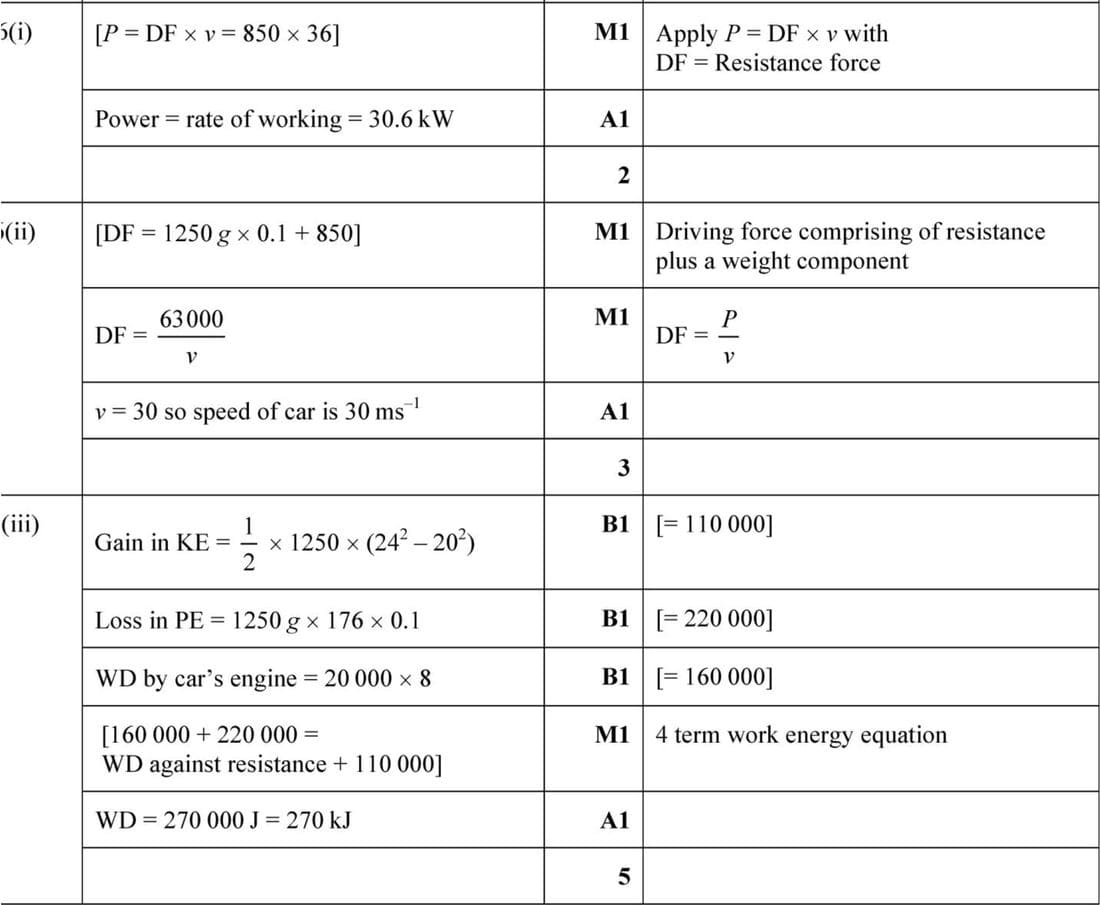
- The car is moving along a straight level road at a constant speed of 36 m s-1 and is subject to a constant resistance of magnitude 850 N. Find, in kW, the rate at which the engine of the car is working.
- The car travels at a constant speed up a hill and is subject to the same resistance as in part (i). The hill is inclined at an angle of θ° to the horizontal, where sin θ° = 0.1, and the engine is working at 63 kW. Find the speed of the car.
- The car descends the same hill with the engine of the car working at a constant rate of 20 kW. The resistance is not constant. The initial speed of the car is 20 m s-1. Eight seconds later the car has speed 24 m s-1 and has moved 176 m down the hill. Use an energy method to find the total work done against the resistance during the eight seconds.
Feb/Mar 2018 p42 q3
3524
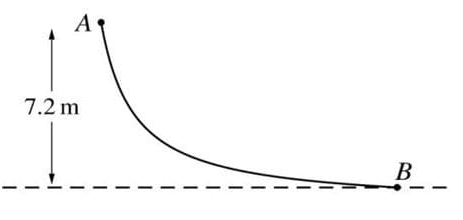
A girl, of mass 40 kg, slides down a slide in a water park. The girl starts at the point A and slides to the point B which is 7.2 metres vertically below the level of A, as shown in the diagram.
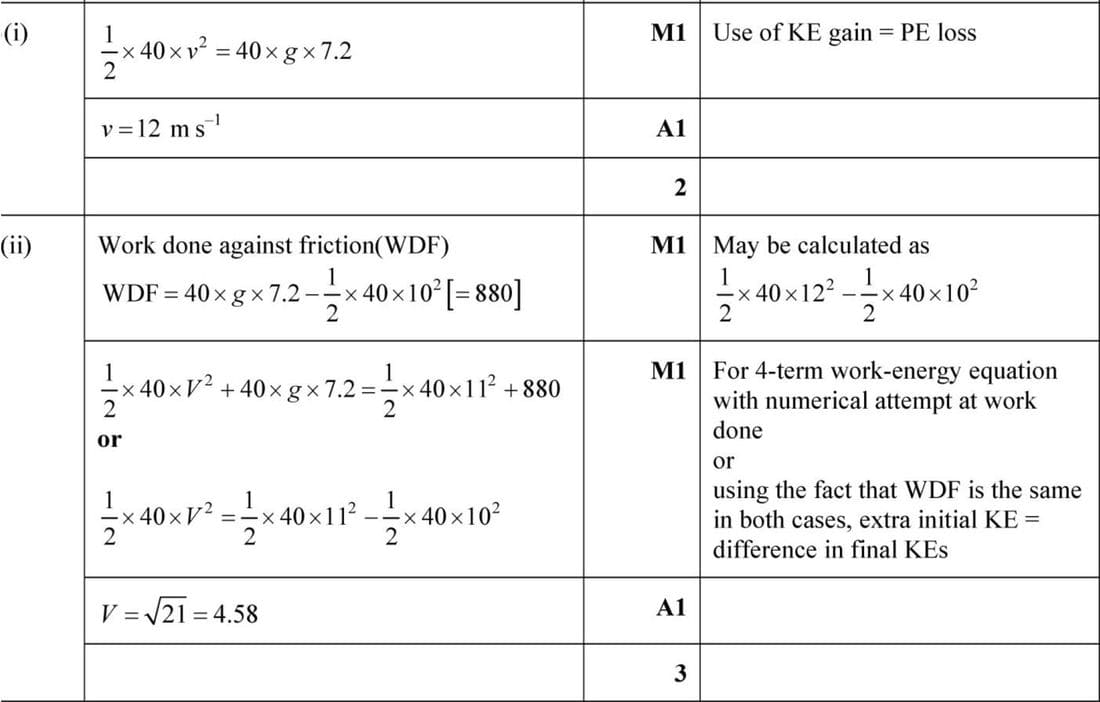
(i) Given that the slide is smooth and that the girl starts from rest at A, find the speed of the girl at B. [2]
(ii) It is given instead that the slide is rough. On one occasion the girl starts from rest at A and reaches B with a speed of 10 m s-1. On another occasion the girl is pushed from A with an initial speed V m s-1 and reaches B with speed 11 m s-1. Given that the work done against friction is the same on both occasions, find V. [3]
Nov 2017 p43 q7
3525
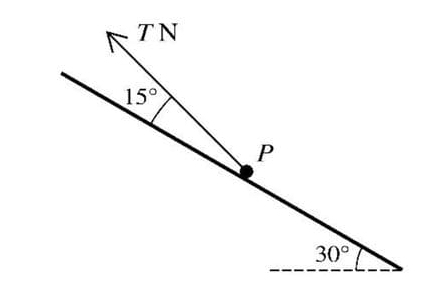
A particle P of mass 0.2 kg rests on a rough plane inclined at 30° to the horizontal. The coefficient of friction between the particle and the plane is 0.3. A force of magnitude T N acts upwards on P at 15° above a line of greatest slope of the plane (see diagram).
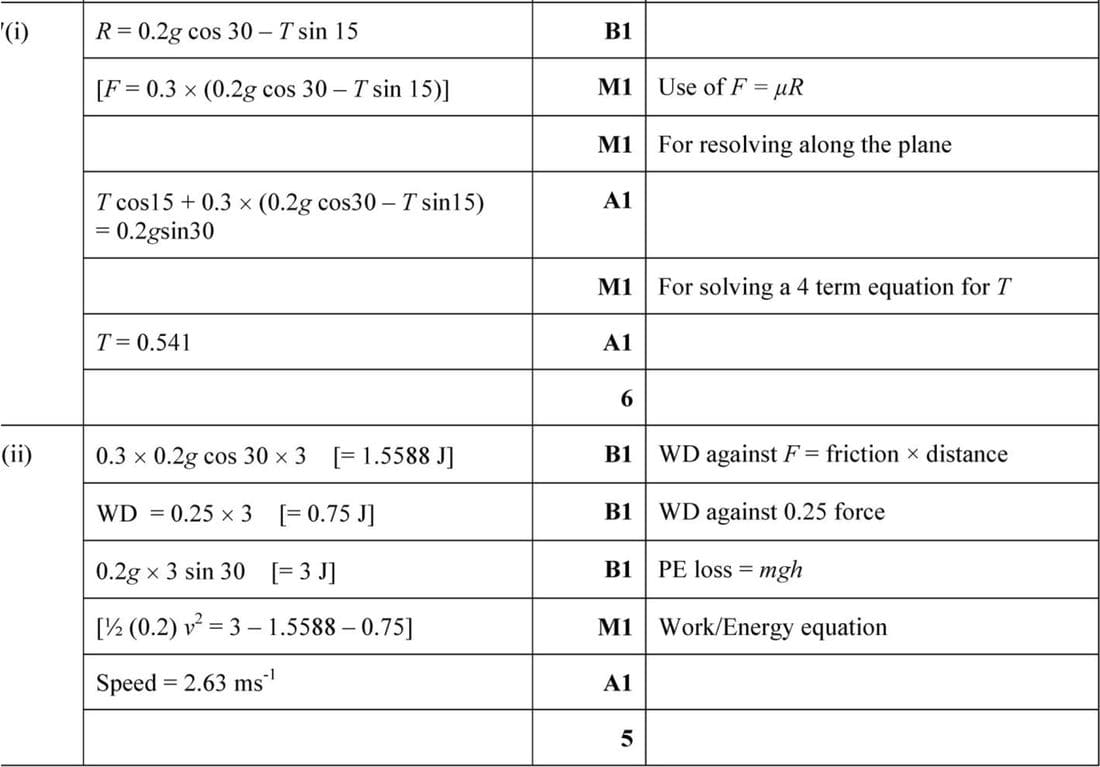
- Find the least value of T for which the particle remains at rest.
The force of magnitude T N is now removed. A new force of magnitude 0.25 N acts on P up the plane, parallel to a line of greatest slope of the plane. Starting from rest, P slides down the plane. After moving a distance of 3 m, P passes through the point A.
- Use an energy method to find the speed of P at A.
June 2023 p42 q4
3526
An athlete of mass 84 kg is running along a straight road.
(a) Initially the road is horizontal and he runs at a constant speed of 3 m s-1. The athlete produces a constant power of 60 W.
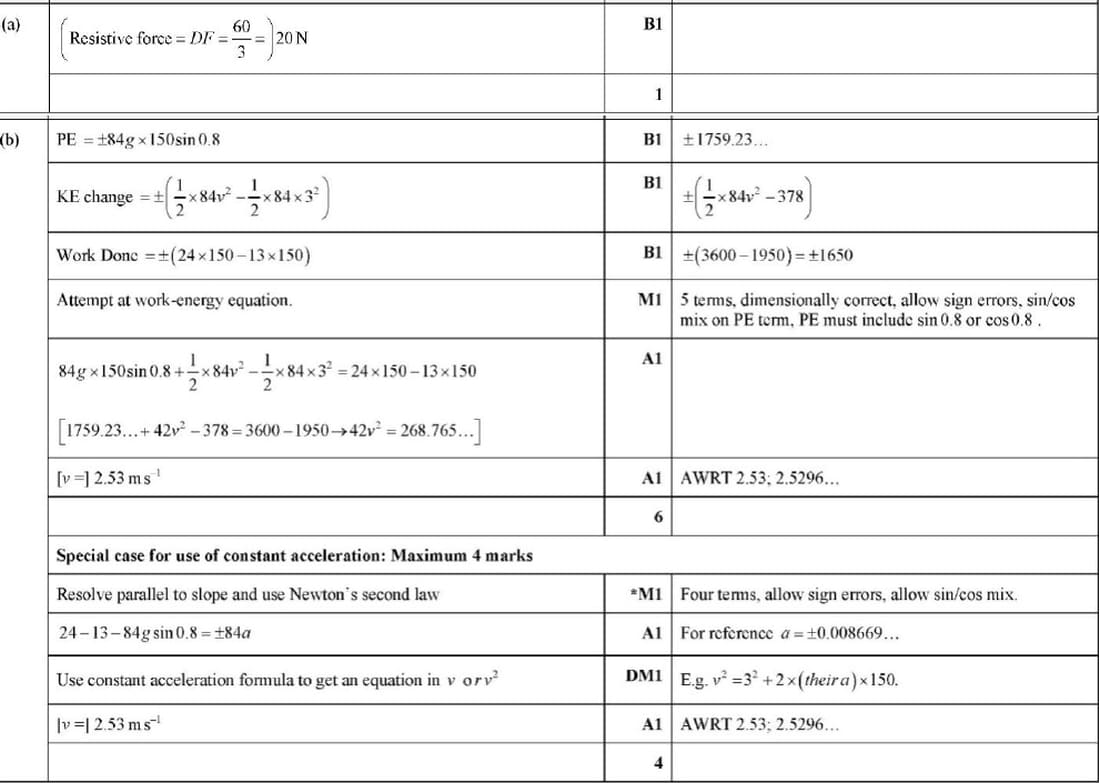
Find the resistive force which acts on the athlete.
(b) The athlete then runs up a 150 m section of the road which is inclined at 0.8° to the horizontal. The speed of the athlete at the start of this section of road is 3 m s-1 and he now produces a constant driving force of 24 N. The total resistive force which acts on the athlete along this section of road has constant magnitude 13 N.
Use an energy method to find the speed of the athlete at the end of the 150 m section of road.
Nov 2017 p41 q3
3527
A roller-coaster car (including passengers) has a mass of 840 kg. The roller-coaster ride includes a section where the car climbs a straight ramp of length 8 m inclined at 30° above the horizontal. The car then immediately descends another ramp of length 10 m inclined at 20° below the horizontal. The resistance to motion acting on the car is 640 N throughout the motion.
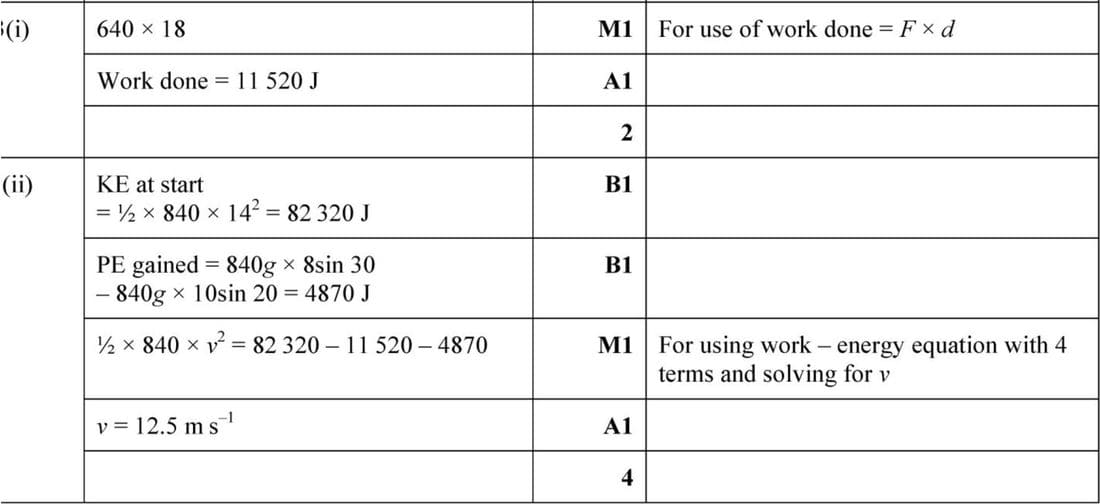
- Find the total work done against the resistance force as the car ascends the first ramp and descends the second ramp.
- The speed of the car at the bottom of the first ramp is 14 m s-1. Use an energy method to find the speed of the car when it reaches the bottom of the second ramp.