Exam-Style Problems
⬅ Back to SubchapterJune 2003 p4 q2
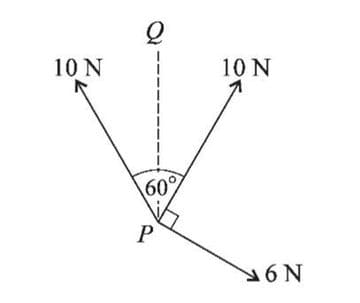
Three coplanar forces of magnitudes 10 N, 10 N, and 6 N act at a point P in the directions shown in the diagram. PQ is the bisector of the angle between the two forces of magnitude 10 N.
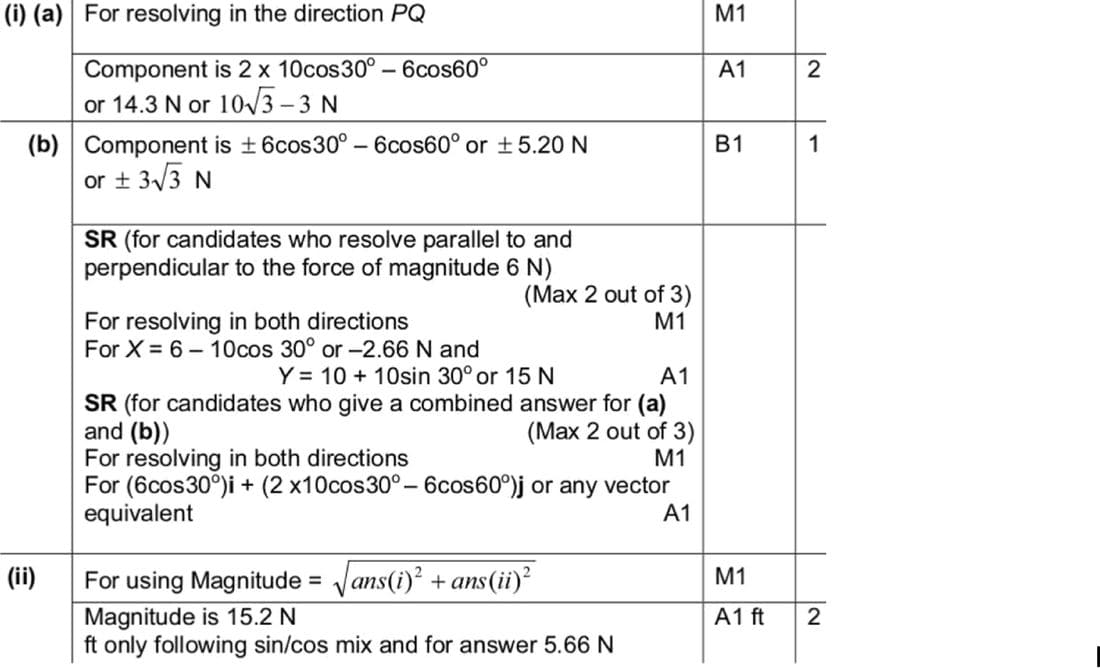
(i) Find the component of the resultant of the three forces
- in the direction of PQ,
- in the direction perpendicular to PQ.
(ii) Find the magnitude of the resultant of the three forces.
June 2021 p42 q2
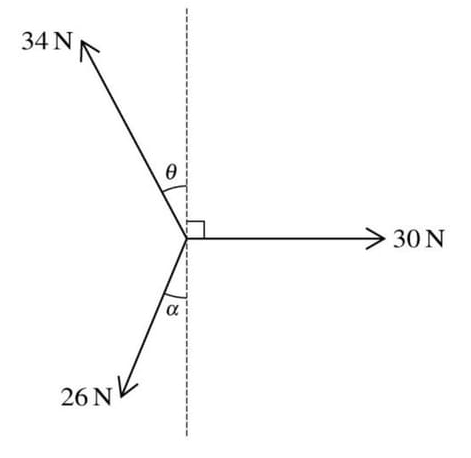
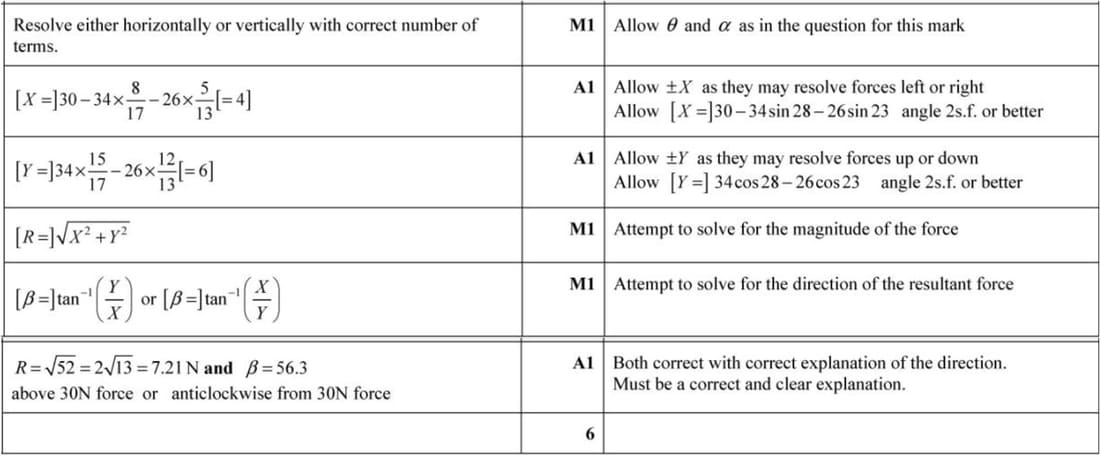
Coplanar forces of magnitudes 34 N, 30 N, and 26 N act at a point in the directions shown in the diagram. Given that \(\sin \alpha = \frac{5}{13}\) and \(\sin \theta = \frac{8}{17}\), find the magnitude and direction of the resultant of the three forces.
June 2021 p41 q6
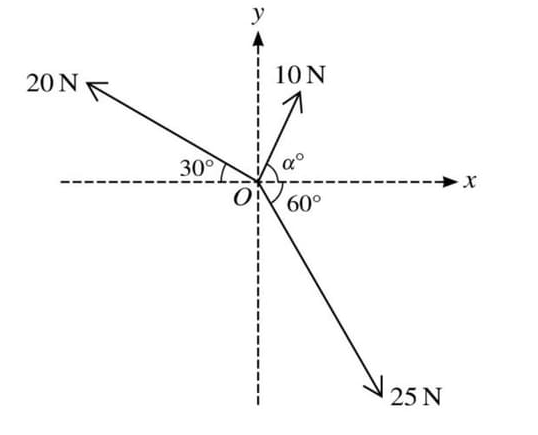
Three coplanar forces of magnitudes 10 N, 25 N, and 20 N act at a point O in the directions shown in the diagram.
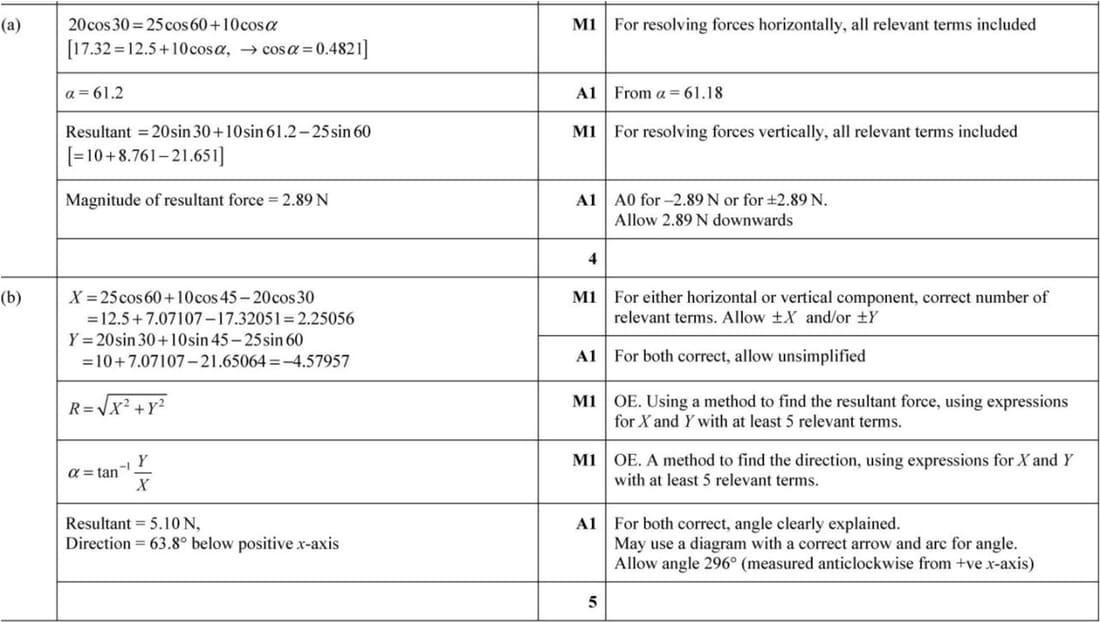
(a) Given that the component of the resultant force in the x-direction is zero, find \(\alpha\), and hence find the magnitude of the resultant force.
(b) Given instead that \(\alpha = 45\), find the magnitude and direction of the resultant of the three forces.
June 2020 p41 q1
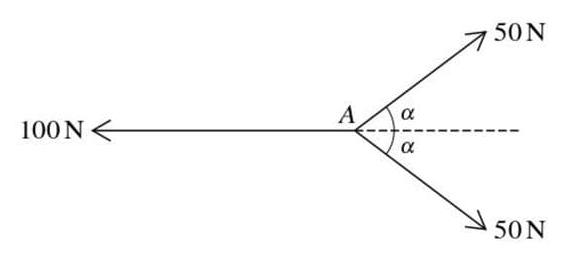
Three coplanar forces of magnitudes 100 N, 50 N, and 50 N act at a point A, as shown in the diagram. The value of \(\cos \alpha\) is \(\frac{4}{5}\).
Find the magnitude of the resultant of the three forces and state its direction.

Feb/Mar 2020 p42 q5
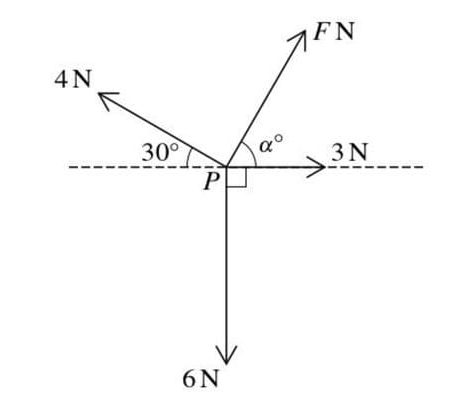
Coplanar forces, of magnitudes F N, 3 N, 6 N, and 4 N, act at a point P, as shown in the diagram.
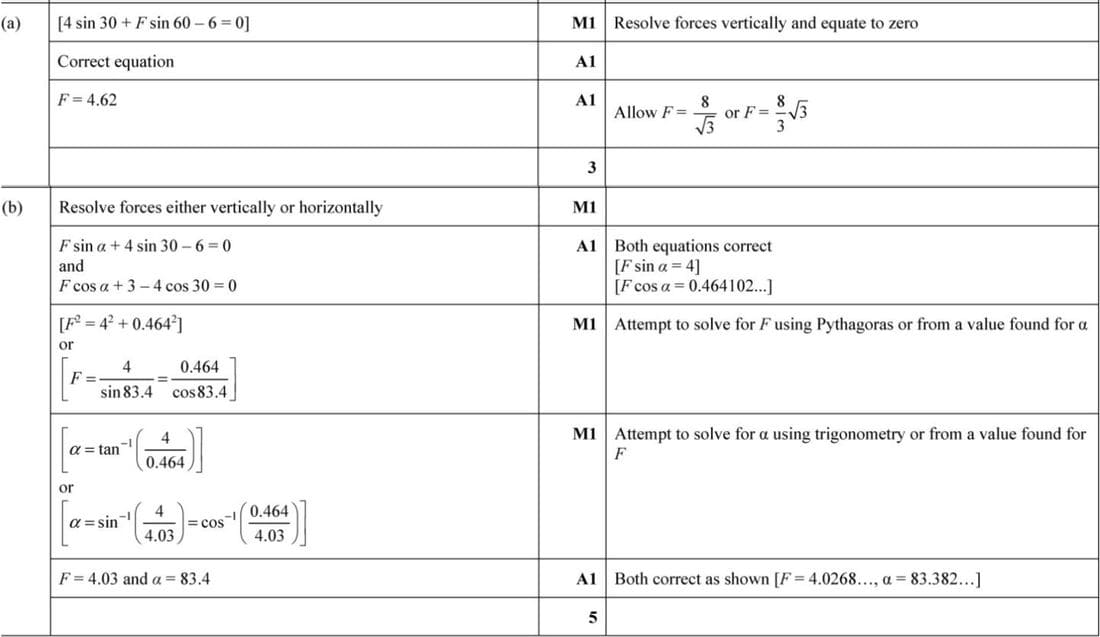
(a) Given that \(\alpha = 60\), and that the resultant of the four forces is in the direction of the 3 N force, find \(F\).
(b) Given instead that the four forces are in equilibrium, find the values of \(F\) and \(\alpha\).