Exam-Style Problems
⬅ Back to SubchapterJune 2011 p62 q4
(i) Find the number of different ways that the 9 letters of the word HAPPINESS can be arranged in a line.
(ii) The 9 letters of the word HAPPINESS are arranged in random order in a line. Find the probability that the 3 vowels (A, E, I) are not all next to each other.

Nov 2010 p63 q6
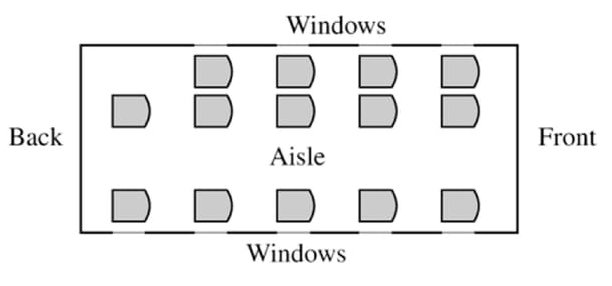
A small aeroplane has 14 seats for passengers. The seats are arranged in 4 rows of 3 seats and a back row of 2 seats (see diagram). 12 passengers board the aeroplane.
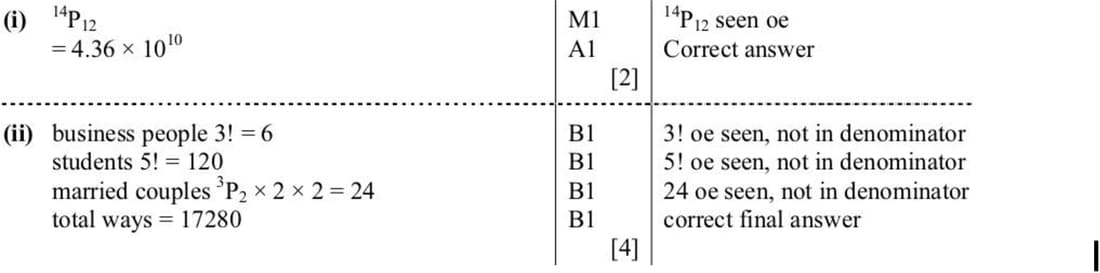
(i) How many possible seating arrangements are there for the 12 passengers? Give your answer correct to 3 significant figures.
These 12 passengers consist of 2 married couples (Mr and Mrs Lin and Mr and Mrs Brown), 5 students and 3 business people.
(ii) The 3 business people sit in the front row. The 5 students each sit at a window seat. Mr and Mrs Lin sit in the same row on the same side of the aisle. Mr and Mrs Brown sit in another row on the same side of the aisle. How many possible seating arrangements are there?
Nov 2010 p61 q6
Pegs are to be placed in the four holes shown, one in each hole. The pegs come in different colours and pegs of the same colour are identical. Calculate how many different arrangements of coloured pegs in the four holes can be made using
- 6 pegs, all of different colours,
- 4 pegs consisting of 2 blue pegs, 1 orange peg and 1 yellow peg.


Nov 2022 p51 q6
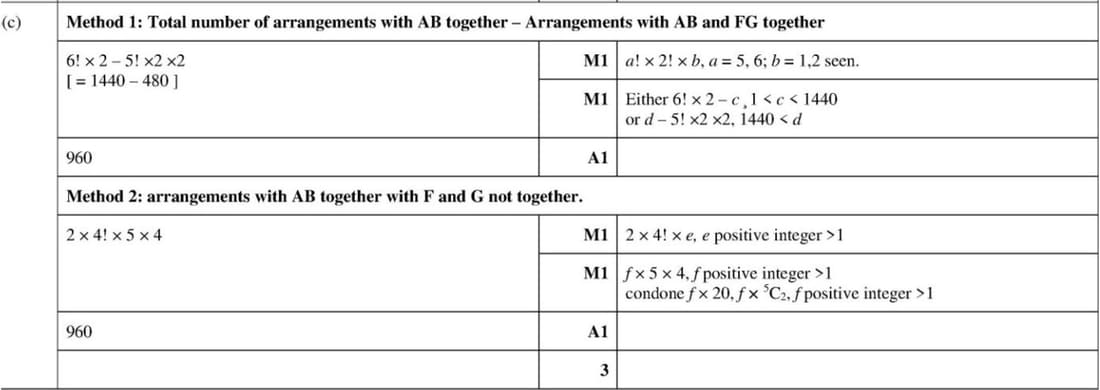
In one photograph Abel, Betty, Cally, Doug, Eve, Freya and Gino are the 7 members in the back row.
In how many different ways can these 7 members be arranged so that Abel and Betty are next to each other and Freya and Gino are not next to each other?
June 2010 p63 q4
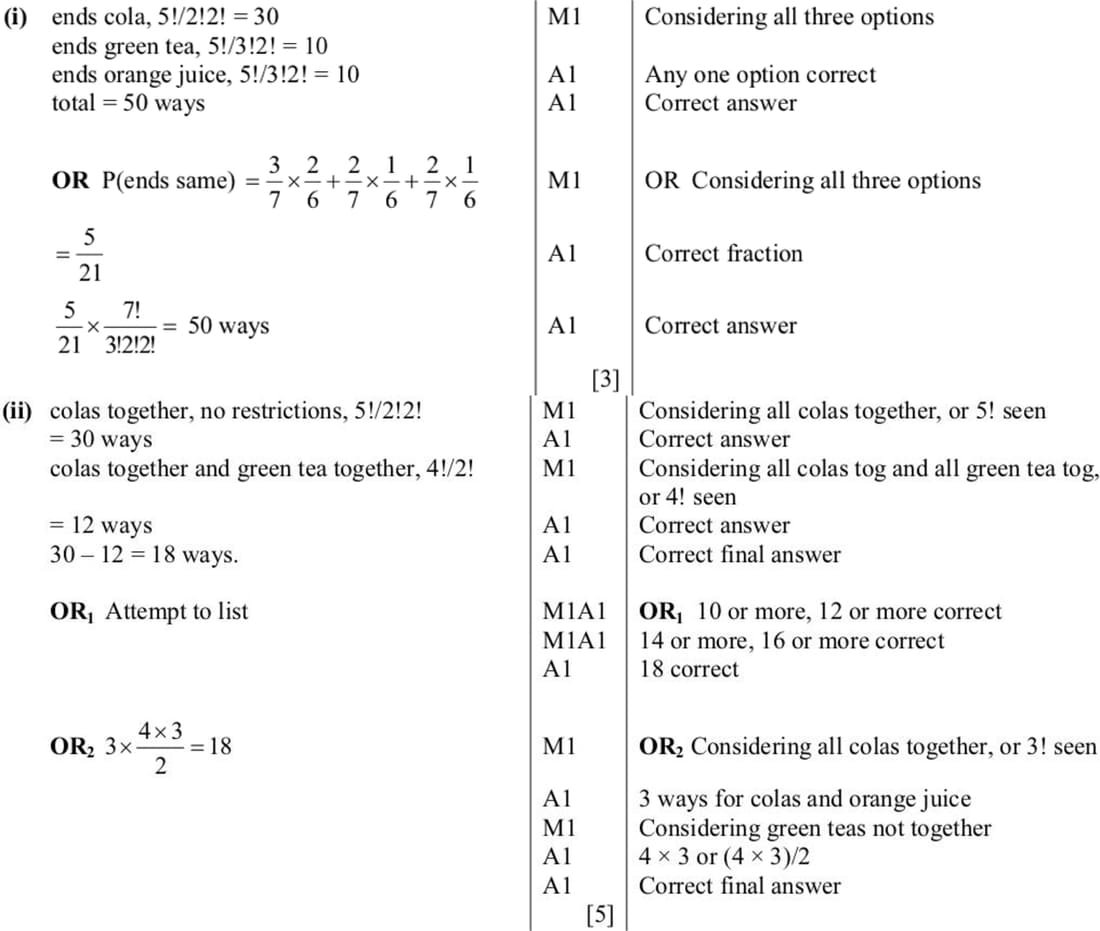
Three identical cans of cola, 2 identical cans of green tea, and 2 identical cans of orange juice are arranged in a row. Calculate the number of arrangements if:
- the first and last cans in the row are the same type of drink,
- the 3 cans of cola are all next to each other and the 2 cans of green tea are not next to each other.