Exam-Style Problems
⬅ Back to SubchapterNov 2011 p31 q4
2354
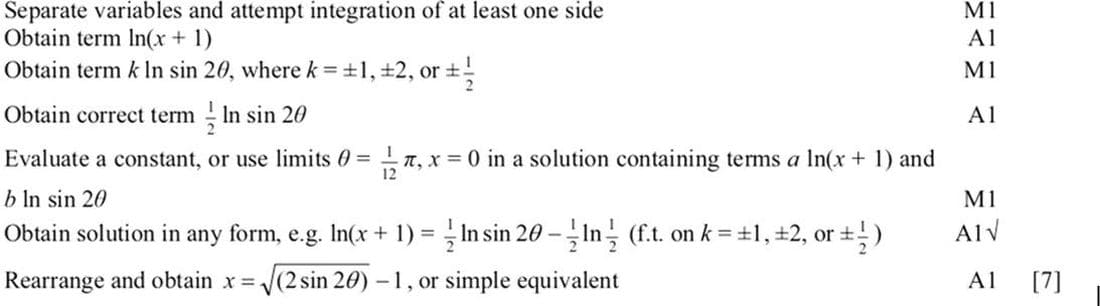
The variables x and θ are related by the differential equation
\(\sin 2θ \frac{dx}{dθ} = (x + 1) \cos 2θ\),
where \(0 < θ < \frac{1}{2}π\). When \(θ = \frac{1}{12}π\), \(x = 0\). Solve the differential equation, obtaining an expression for \(x\) in terms of \(θ\), and simplifying your answer as far as possible.
June 2010 p32 q7
2355
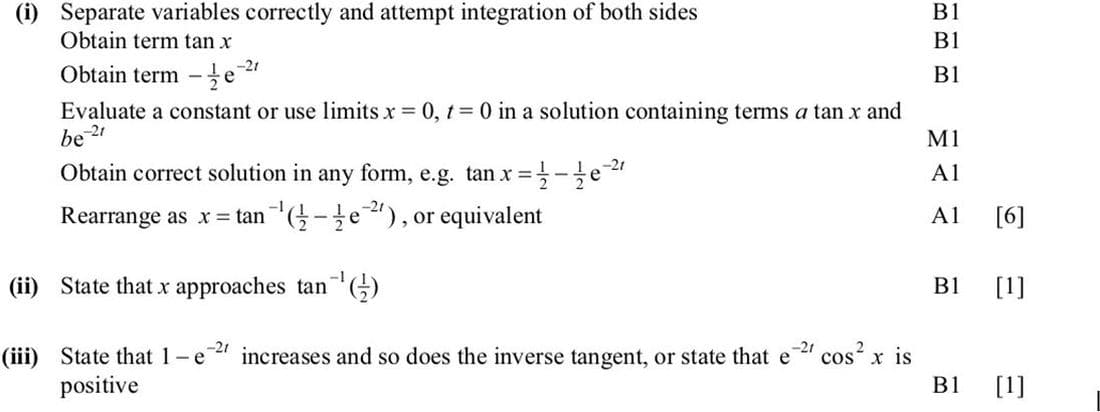
The variables x and t are related by the differential equation
\(e^{2t} \frac{dx}{dt} = \cos^2 x\),
where \(t \geq 0\). When \(t = 0\), \(x = 0\).
(i) Solve the differential equation, obtaining an expression for \(x\) in terms of \(t\). [6]
(ii) State what happens to the value of \(x\) when \(t\) becomes very large. [1]
(iii) Explain why \(x\) increases as \(t\) increases. [1]
June 2023 p32 q8
2356
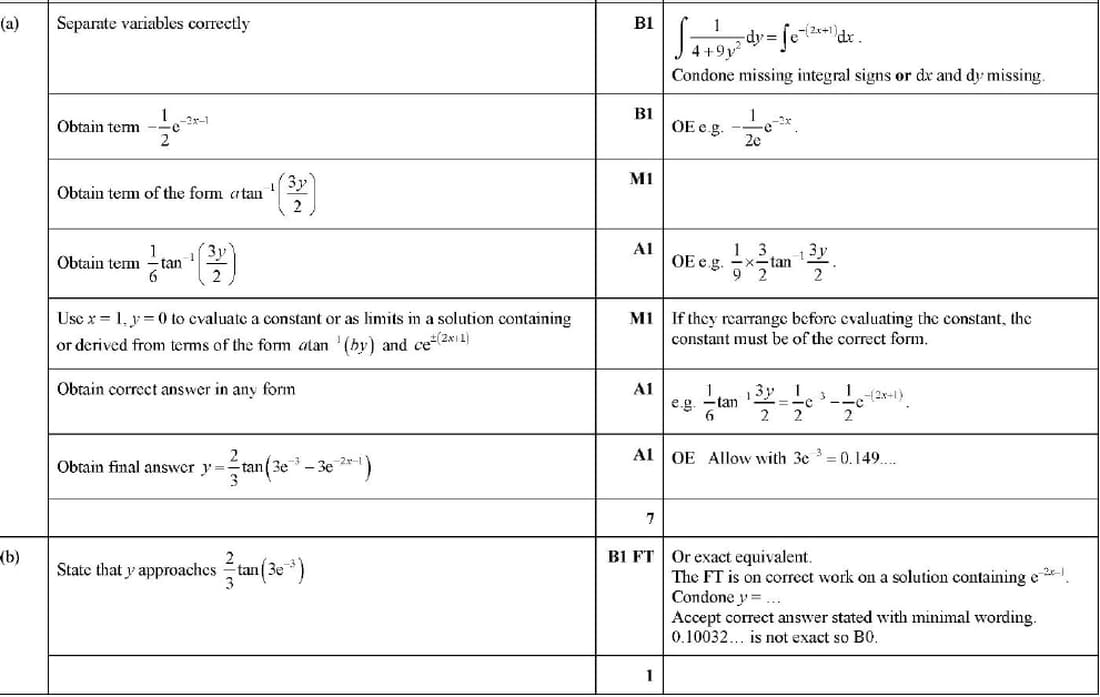
(a) The variables x and y satisfy the differential equation \(\frac{dy}{dx} = \frac{4 + 9y^2}{e^{2x+1}}\).
It is given that \(y = 0\) when \(x = 1\).
Solve the differential equation, obtaining an expression for y in terms of x.
(b) State what happens to the value of y as x tends to infinity. Give your answer in an exact form.
June 2023 p31 q7
2357
The variables x and y satisfy the differential equation
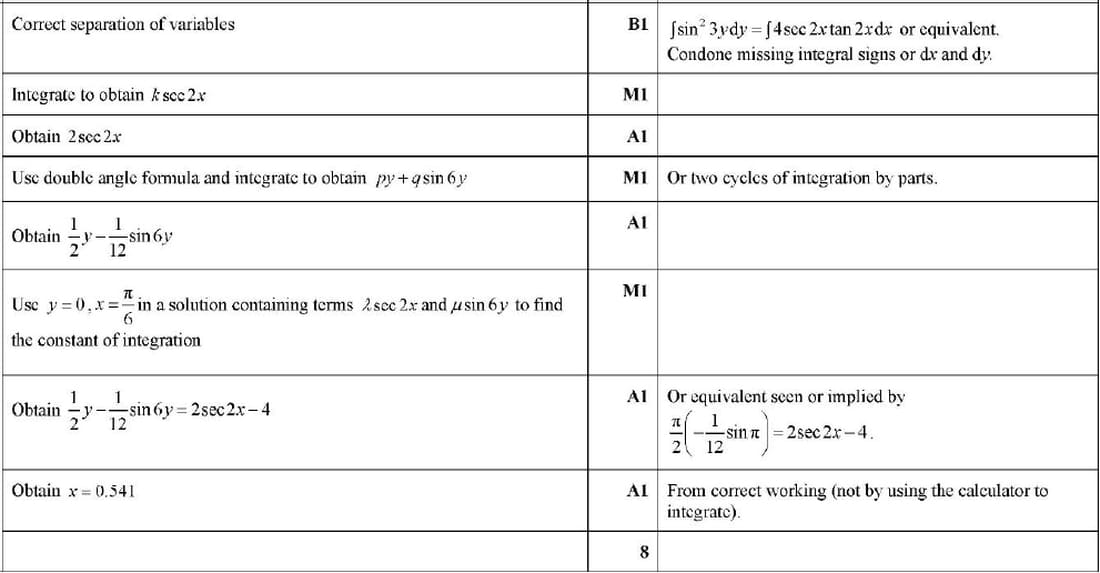
\(\cos 2x \frac{dy}{dx} = \frac{4 \tan 2x}{\sin^2 3y}\),
where \(0 \leq x < \frac{1}{4}\pi\). It is given that \(y = 0\) when \(x = \frac{1}{6}\pi\).
Solve the differential equation to obtain the value of x when \(y = \frac{1}{6}\pi\). Give your answer correct to 3 decimal places.
Feb/Mar 2023 p32 q9
2358
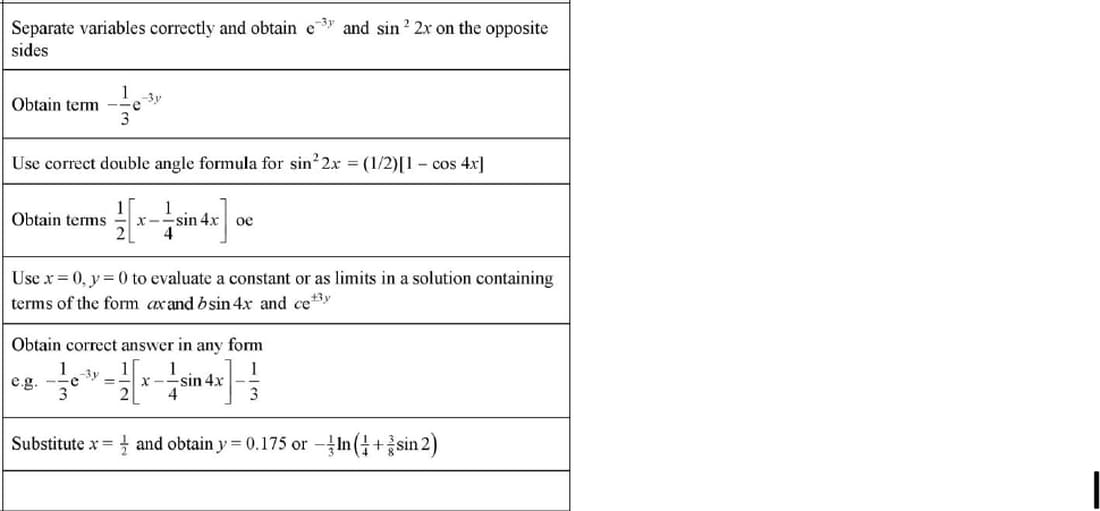
The variables x and y satisfy the differential equation
\(\frac{dy}{dx} = e^{3y} \sin^2 2x\).
It is given that \(y = 0\) when \(x = 0\).
Solve the differential equation and find the value of \(y\) when \(x = \frac{1}{2}\).