Exam-Style Problems
⬅ Back to SubchapterNov 2008 p3 q8
2309
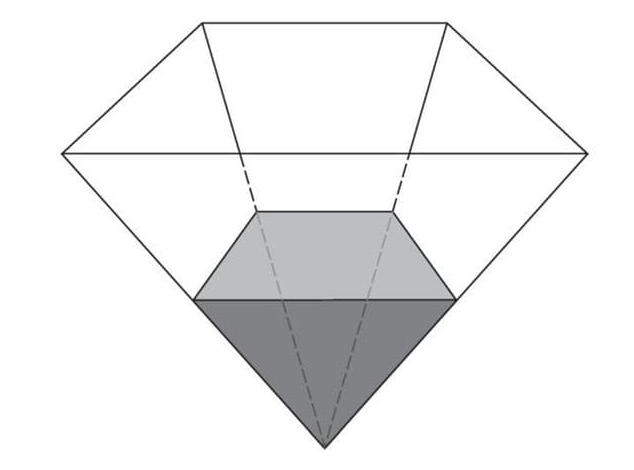
An underground storage tank is being filled with liquid as shown in the diagram. Initially the tank is empty. At time \(t\) hours after filling begins, the volume of liquid is \(V\) m\(^3\) and the depth of liquid is \(h\) m. It is given that \(V = \frac{4}{3}h^3\).
The liquid is poured in at a rate of 20 m\(^3\) per hour, but owing to leakage, liquid is lost at a rate proportional to \(h^2\). When \(h = 1\), \(\frac{dh}{dt} = 4.95\).
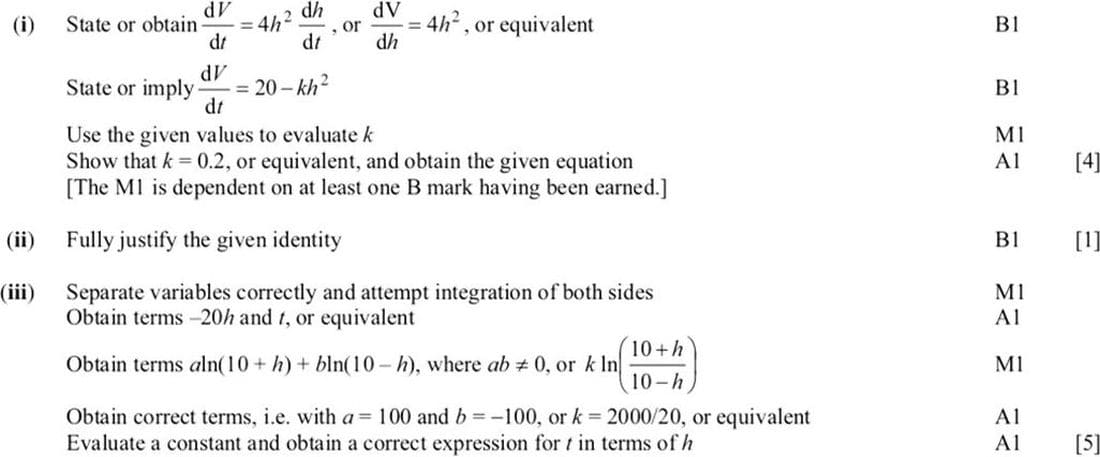
- Show that \(h\) satisfies the differential equation \(\frac{dh}{dt} = \frac{5}{h^2} - \frac{1}{20}\).
- Verify that \(\frac{20h^2}{100-h^2} = -20 + \frac{2000}{(10-h)(10+h)}\).
- Hence solve the differential equation in part (i), obtaining an expression for \(t\) in terms of \(h\).
June 2008 p3 q8
2310
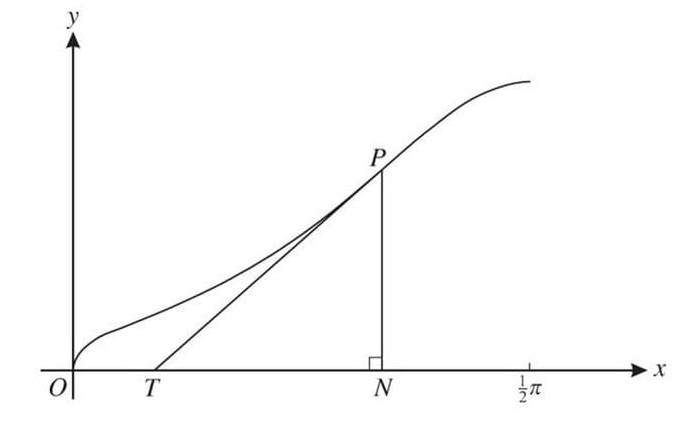
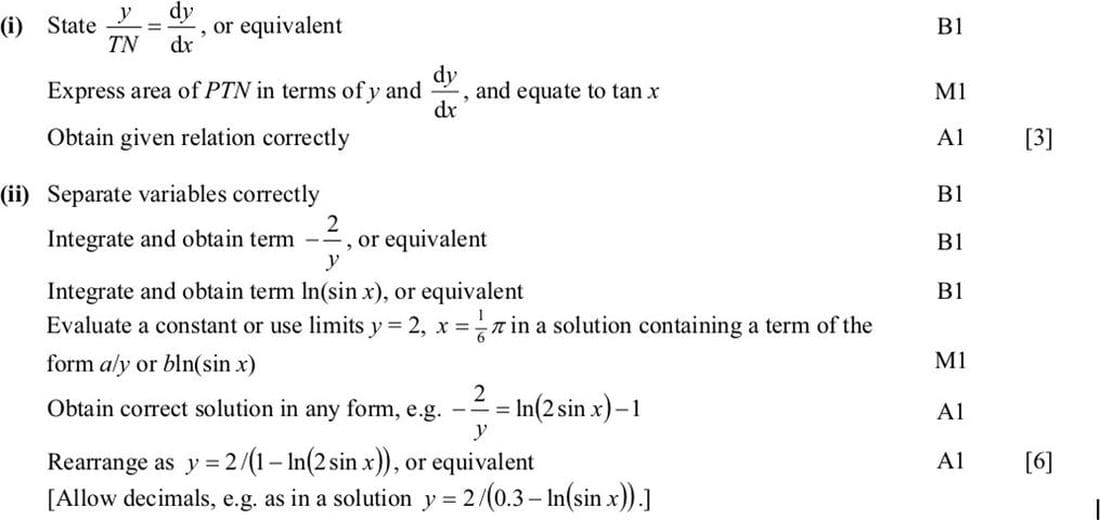
In the diagram the tangent to a curve at a general point \(P\) with coordinates \((x, y)\) meets the \(x\)-axis at \(T\). The point \(N\) on the \(x\)-axis is such that \(PN\) is perpendicular to the \(x\)-axis. The curve is such that, for all values of \(x\) in the interval \(0 < x < \frac{1}{2}\pi\), the area of triangle \(PTN\) is equal to \(\tan x\), where \(x\) is in radians.
(i) Using the fact that the gradient of the curve at \(P\) is \(\frac{PN}{TN}\), show that \(\frac{dy}{dx} = \frac{1}{2}y^2 \cot x\).
(ii) Given that \(y = 2\) when \(x = \frac{1}{6}\pi\), solve this differential equation to find the equation of the curve, expressing \(y\) in terms of \(x\).
June 2007 p3 q10
2311
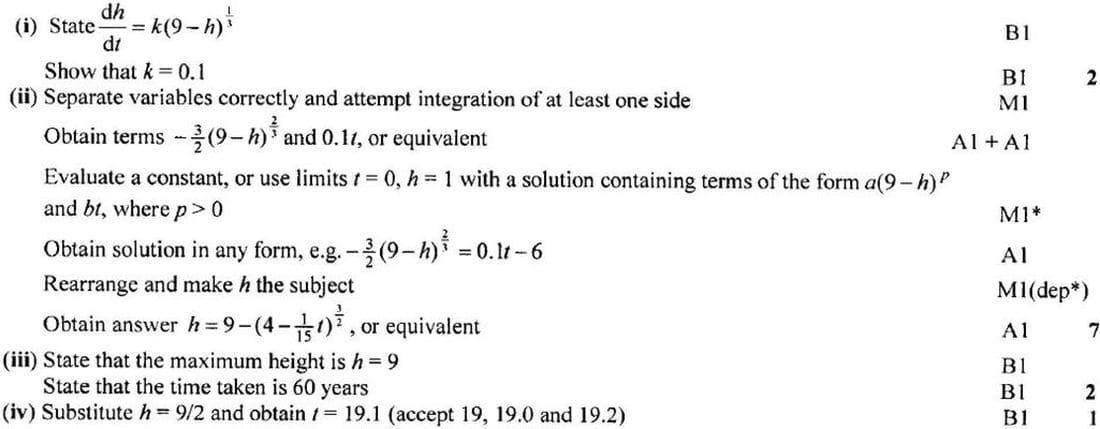
A model for the height, h metres, of a certain type of tree at time t years after being planted assumes that, while the tree is growing, the rate of increase in height is proportional to \((9 - h)^{\frac{1}{3}}\). It is given that, when t = 0, h = 1 and \(\frac{dh}{dt} = 0.2\).
(i) Show that h and t satisfy the differential equation \(\frac{dh}{dt} = 0.1(9 - h)^{\frac{1}{3}}\).
(ii) Solve this differential equation, and obtain an expression for h in terms of t.
(iii) Find the maximum height of the tree and the time taken to reach this height after planting.
(iv) Calculate the time taken to reach half the maximum height.
June 2006 p3 q5
2312
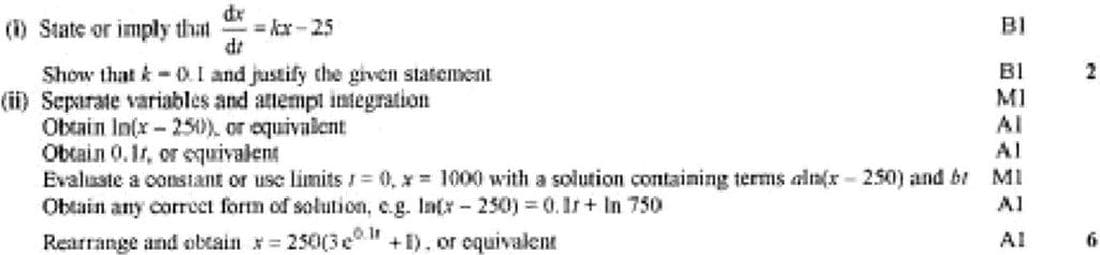
In a certain industrial process, a substance is being produced in a container. The mass of the substance in the container t minutes after the start of the process is x grams. At any time, the rate of formation of the substance is proportional to its mass. Also, throughout the process, the substance is removed from the container at a constant rate of 25 grams per minute. When t = 0, x = 1000 and \(\frac{dx}{dt} = 75\).
(i) Show that x and t satisfy the differential equation \(\frac{dx}{dt} = 0.1(x - 250)\).
(ii) Solve this differential equation, obtaining an expression for x in terms of t.
Nov 2004 p3 q10
2313
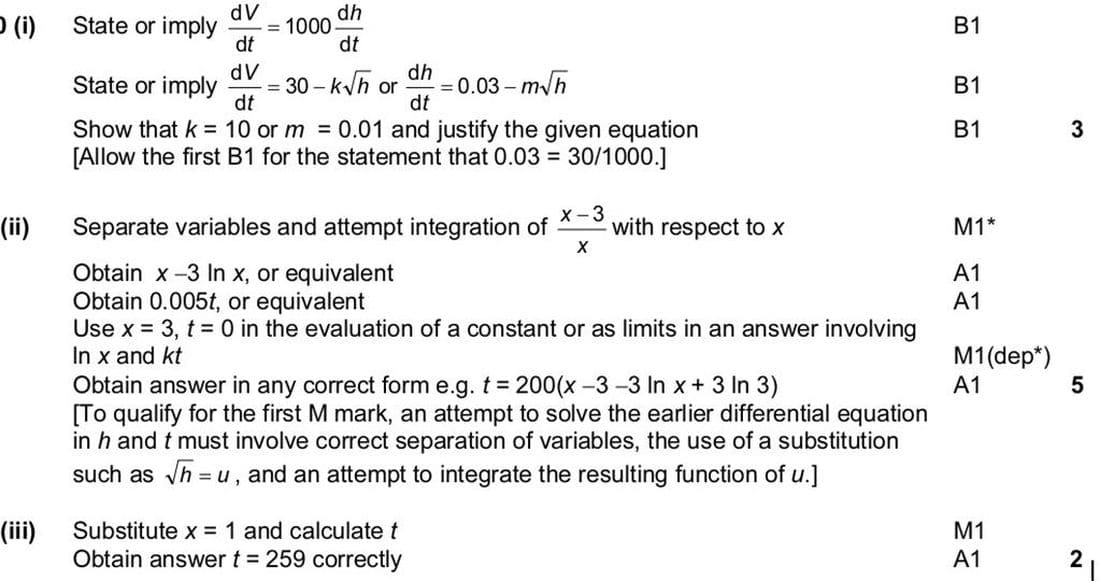
A rectangular reservoir has a horizontal base of area 1000 m2. At time \(t = 0\), it is empty and water begins to flow into it at a constant rate of 30 m3s-1. At the same time, water begins to flow out at a rate proportional to \(\sqrt{h}\), where \(h\) m is the depth of the water at time \(t\) s. When \(h = 1\), \(\frac{dh}{dt} = 0.02\).
(i) Show that \(h\) satisfies the differential equation \(\frac{dh}{dt} = 0.01(3 - \sqrt{h})\).
It is given that, after making the substitution \(x = 3 - \sqrt{h}\), the equation in part (i) becomes \((x - 3) \frac{dx}{dt} = 0.005x\).
(ii) Using the fact that \(x = 3\) when \(t = 0\), solve this differential equation, obtaining an expression for \(t\) in terms of \(x\).
(iii) Find the time at which the depth of water reaches 4 m.