Exam-Style Problems
⬅ Back to SubchapterJune 2019 p11 q7
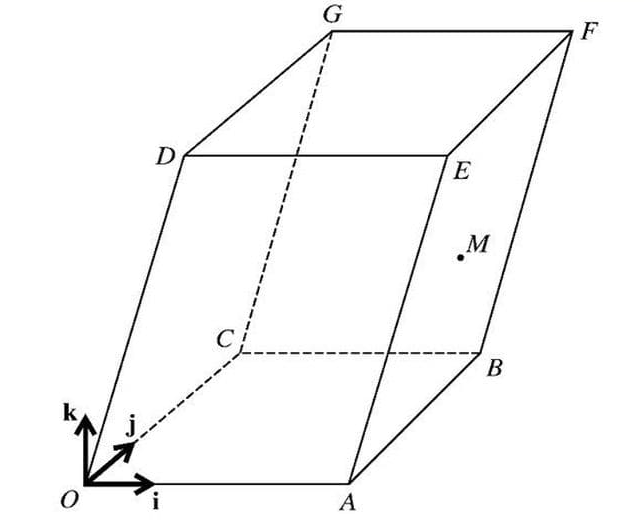
The diagram shows a three-dimensional shape in which the base OABC and the upper surface DEFG are identical horizontal squares. The parallelograms OAED and CBFG both lie in vertical planes. The point M is the mid-point of AF.
Unit vectors i and j are parallel to OA and OC respectively and the unit vector k is vertically upwards. The position vectors of A and D are given by \(\overrightarrow{OA} = 8\mathbf{i}\) and \(\overrightarrow{OD} = 3\mathbf{i} + 10\mathbf{k}\).
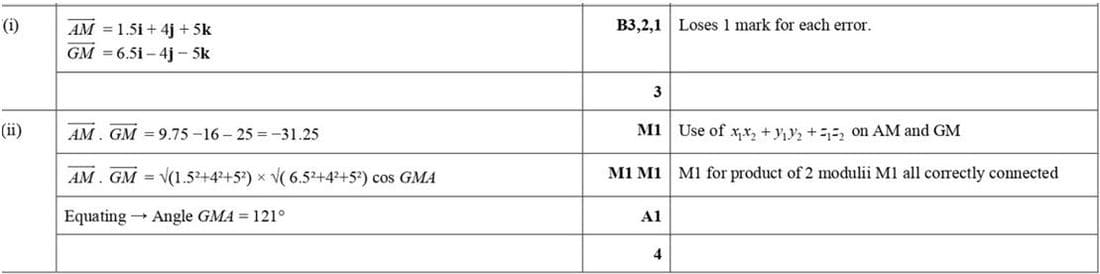
(i) Express each of the vectors \(\overrightarrow{AM}\) and \(\overrightarrow{GM}\) in terms of i, j and k. [3]
(ii) Use a scalar product to find angle GMA correct to the nearest degree. [4]
Nov 2018 p13 q6
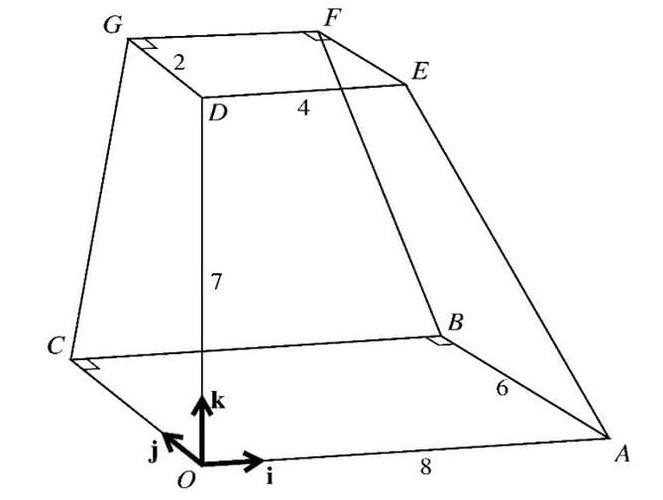
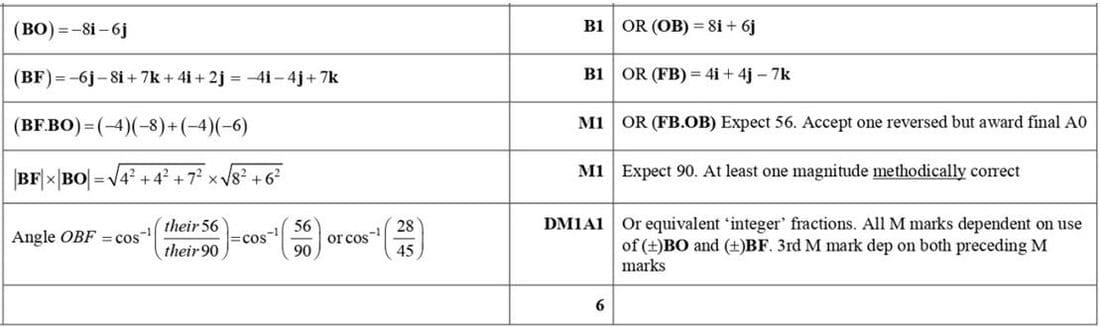
The diagram shows a solid figure OABCDEFG with a horizontal rectangular base OABC in which OA = 8 units and AB = 6 units. The rectangle DEFG lies in a horizontal plane and is such that D is 7 units vertically above O and DE is parallel to OA. The sides DE and DG have lengths 4 units and 2 units respectively. Unit vectors i, j and k are parallel to OA, OC and OD respectively. Use a scalar product to find angle OBF, giving your answer in the form cos-1(\frac{a}{b}), where a and b are integers.
Nov 2018 p12 q7
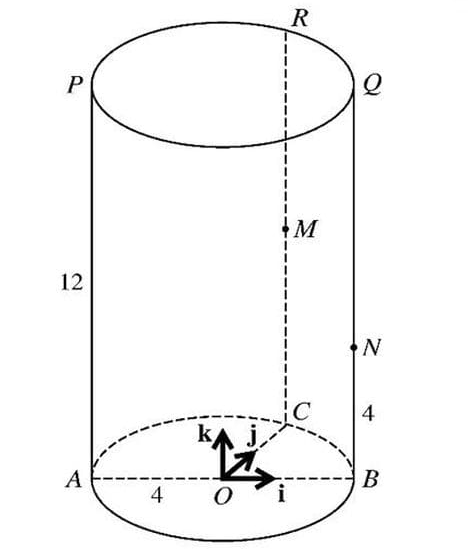
The diagram shows a solid cylinder standing on a horizontal circular base with centre O and radius 4 units. Points A, B and C lie on the circumference of the base such that AB is a diameter and angle BOC = 90^ ext{o}. Points P, Q and R lie on the upper surface of the cylinder vertically above A, B and C respectively. The height of the cylinder is 12 units. The mid-point of CR is M and N lies on BQ with BN = 4 units.
Unit vectors i and j are parallel to OB and OC respectively and the unit vector k is vertically upwards.
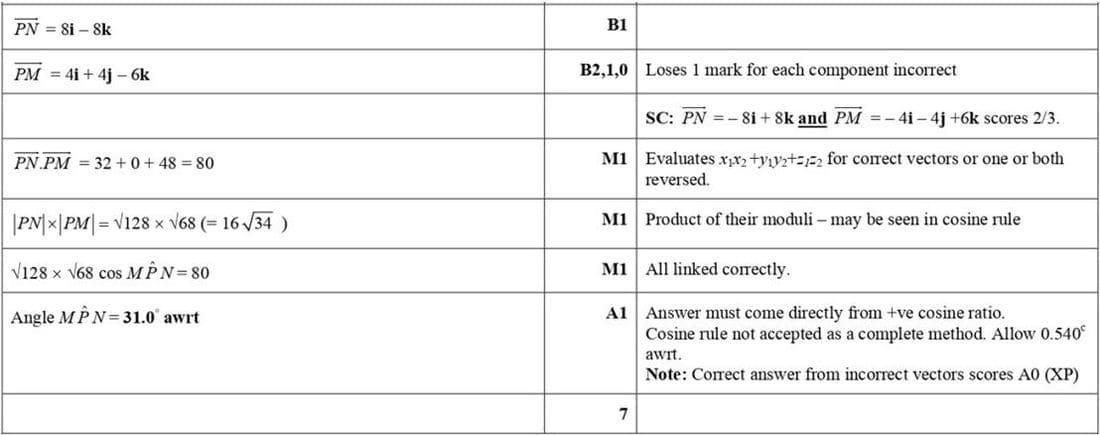
Evaluate \(\overrightarrow{PN} \cdot \overrightarrow{PM}\) and hence find angle MPN.
Nov 2018 p11 q8
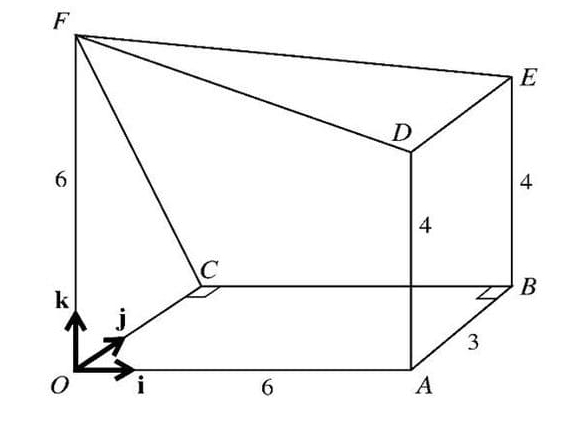
The diagram shows a solid figure OABCDEF having a horizontal rectangular base OABC with OA = 6 units and AB = 3 units. The vertical edges OF, AD and BE have lengths 6 units, 4 units and 4 units respectively. Unit vectors i, j and k are parallel to OA, OC and OF respectively.
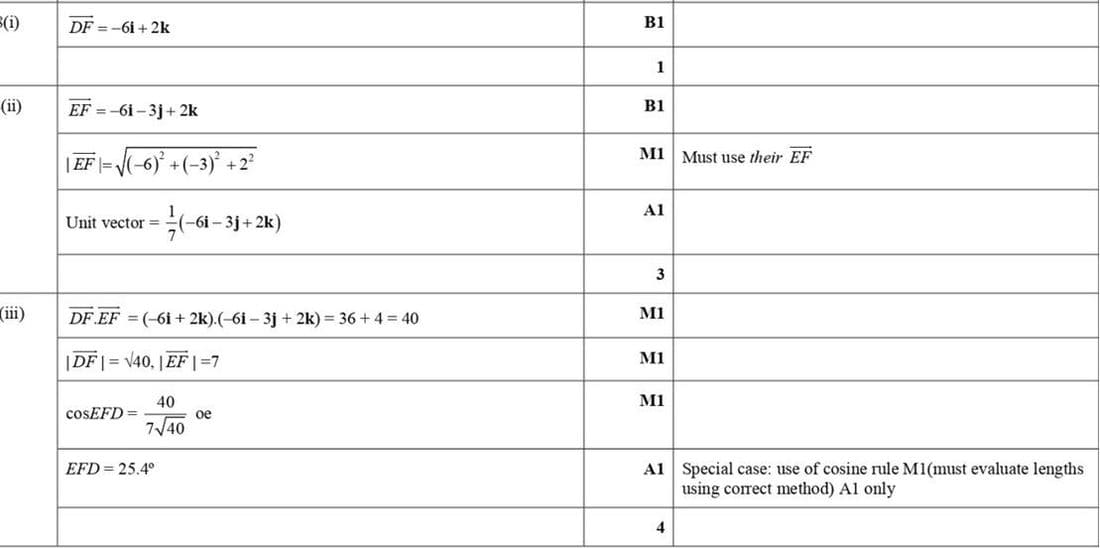
- Find \(\overrightarrow{DF}\).
- Find the unit vector in the direction of \(\overrightarrow{EF}\).
- Use a scalar product to find angle EFD.