Exam-Style Problems
⬅ Back to SubchapterNov 2011 p13 q6
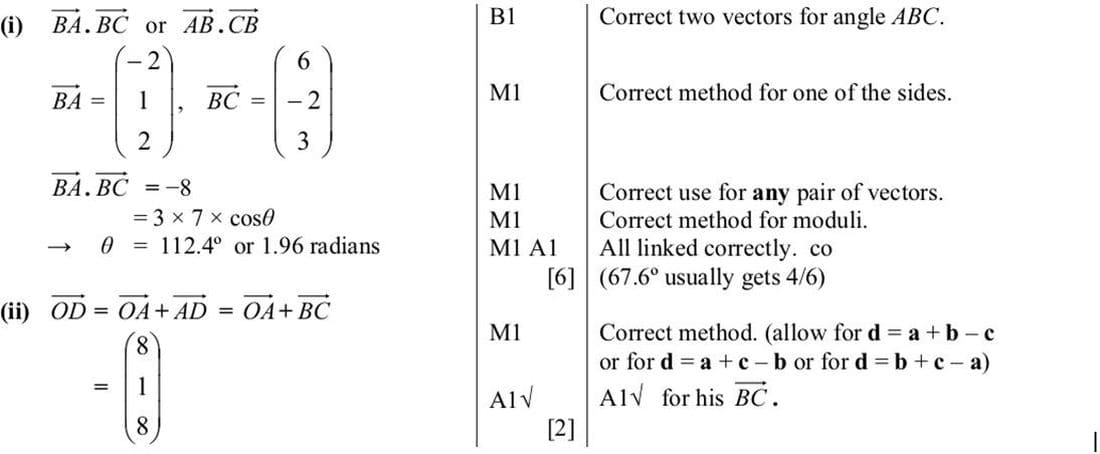
Relative to an origin O, the position vectors of points A and B are 3i + 4j - k and 5i - 2j - 3k respectively.
(i) Use a scalar product to find angle BOA.
The point C is the mid-point of AB. The point D is such that \(\overrightarrow{OD} = 2\overrightarrow{OB}\).
(ii) Find \(\overrightarrow{DC}\).
Nov 2011 p12 q3
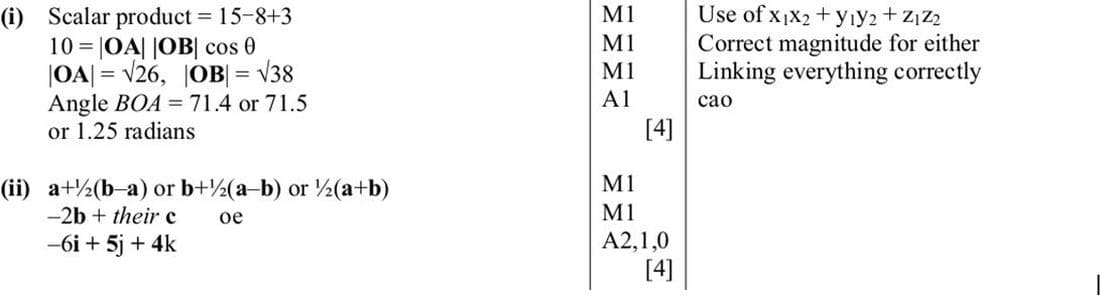
Relative to an origin O, the position vectors of points A and B are given by \(\overrightarrow{OA} = 5\mathbf{i} + \mathbf{j} + 2\mathbf{k}\) and \(\overrightarrow{OB} = 2\mathbf{i} + 7\mathbf{j} + p\mathbf{k}\), where \(p\) is a constant.
(i) Find the value of \(p\) for which angle \(AOB\) is \(90^\circ\).
(ii) In the case where \(p = 4\), find the vector which has magnitude 28 and is in the same direction as \(\overrightarrow{AB}\).
Nov 2011 p11 q8
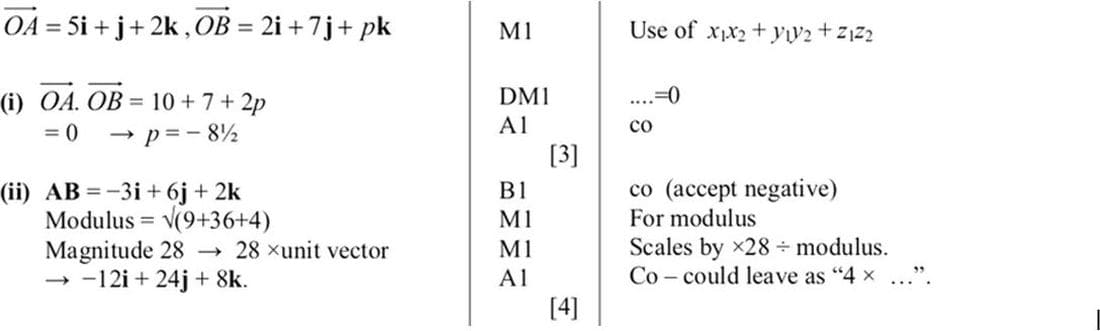
Relative to an origin O, the point A has position vector \(4\mathbf{i} + 7\mathbf{j} - p\mathbf{k}\) and the point B has position vector \(8\mathbf{i} - \mathbf{j} - p\mathbf{k}\), where \(p\) is a constant.
- Find \(\overrightarrow{OA} \cdot \overrightarrow{OB}\).
- Hence show that there are no real values of \(p\) for which OA and OB are perpendicular to each other.
- Find the values of \(p\) for which angle AOB = 60°.
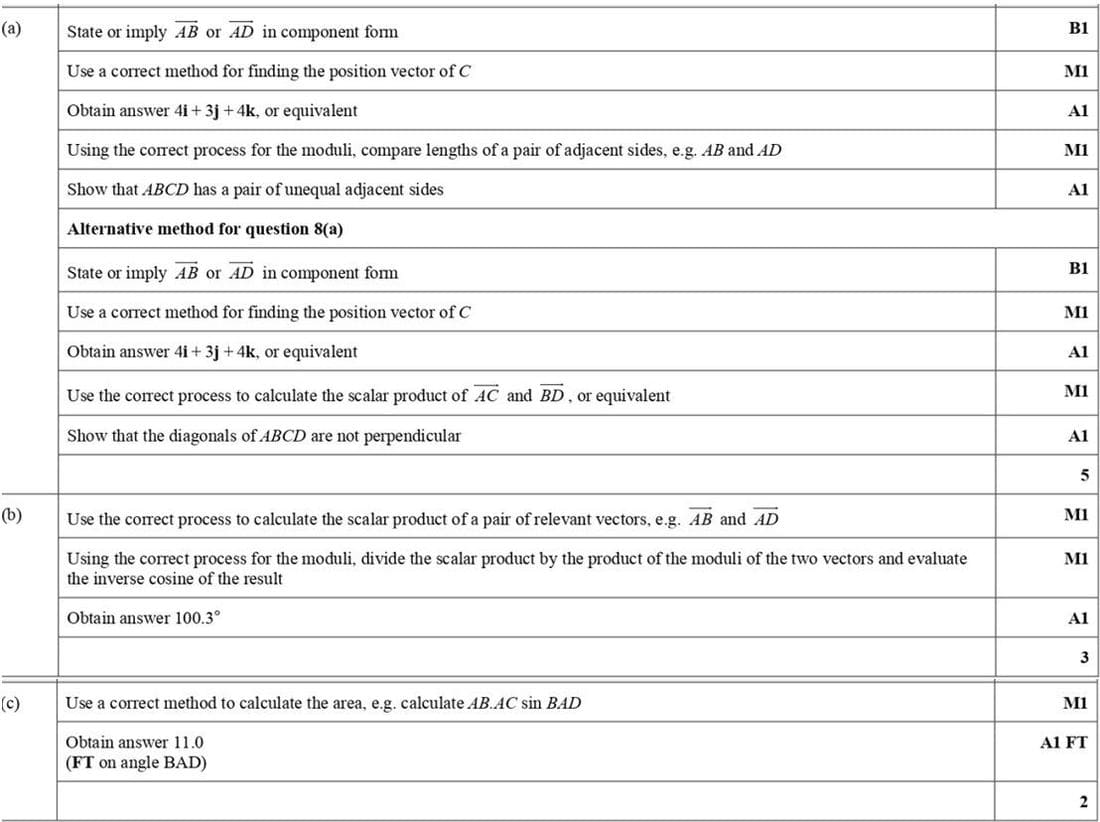
June 2020 p33 q8
Relative to the origin \(O\), the points \(A, B\) and \(D\) have position vectors given by
\(\overrightarrow{OA} = \mathbf{i} + 2\mathbf{j} + \mathbf{k}, \quad \overrightarrow{OB} = 2\mathbf{i} + 5\mathbf{j} + 3\mathbf{k} \quad \text{and} \quad \overrightarrow{OD} = 3\mathbf{i} + 2\mathbf{k}.\)
A fourth point \(C\) is such that \(ABCD\) is a parallelogram.
(a) Find the position vector of \(C\) and verify that the parallelogram is not a rhombus. [5]
(b) Find angle \(BAD\), giving your answer in degrees. [3]
(c) Find the area of the parallelogram correct to 3 significant figures. [2]
June 2011 p12 q8
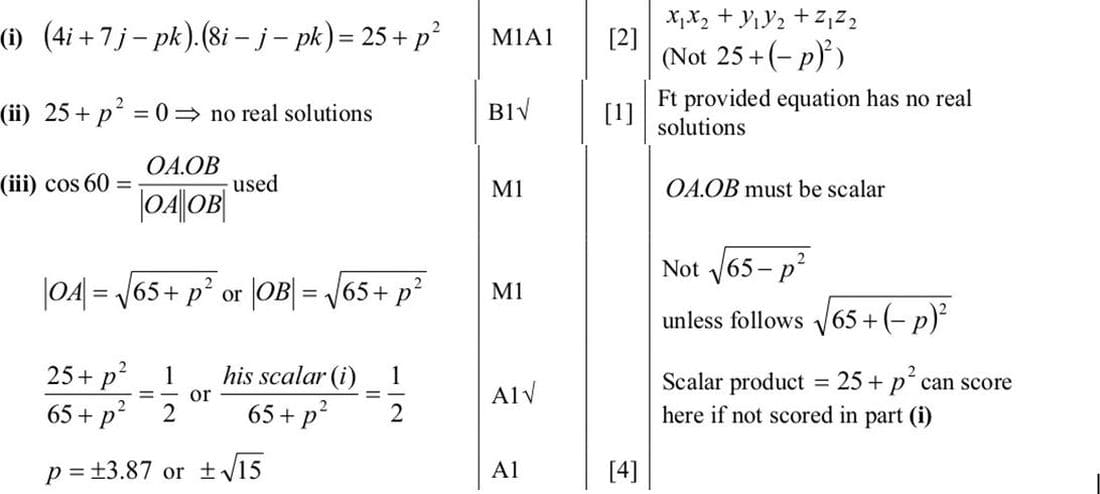
Relative to the origin O, the position vectors of the points A, B and C are given by
\(\overrightarrow{OA} = \begin{pmatrix} 2 \\ 3 \\ 5 \end{pmatrix}, \quad \overrightarrow{OB} = \begin{pmatrix} 4 \\ 2 \\ 3 \end{pmatrix} \quad \text{and} \quad \overrightarrow{OC} = \begin{pmatrix} 10 \\ 0 \\ 6 \end{pmatrix}.\)
(i) Find angle \(ABC\).
The point D is such that ABCD is a parallelogram.
(ii) Find the position vector of D.