Exam-Style Problems
⬅ Back to SubchapterNov 2006 p3 q8
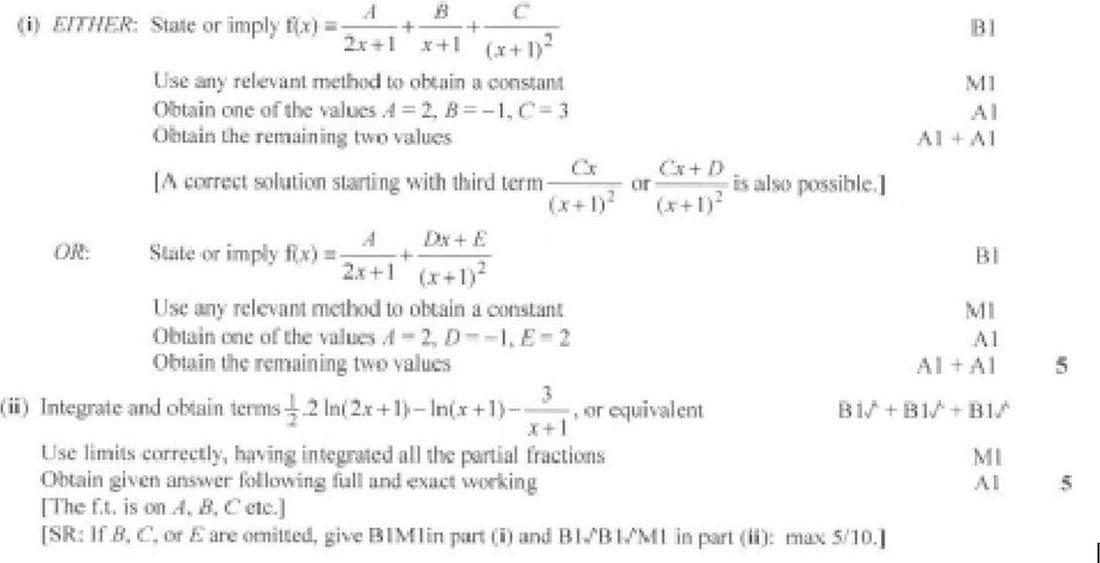
Let \(f(x) = \frac{7x + 4}{(2x + 1)(x + 1)^2}\).
(i) Express \(f(x)\) in partial fractions.
(ii) Hence show that \(\int_0^2 f(x) \, dx = 2 + \ln \frac{5}{3}\).
Nov 2004 p3 q8
An appropriate form for expressing \(\frac{3x}{(x+1)(x-2)}\) in partial fractions is \(\frac{A}{x+1} + \frac{B}{x-2}\), where \(A\) and \(B\) are constants.
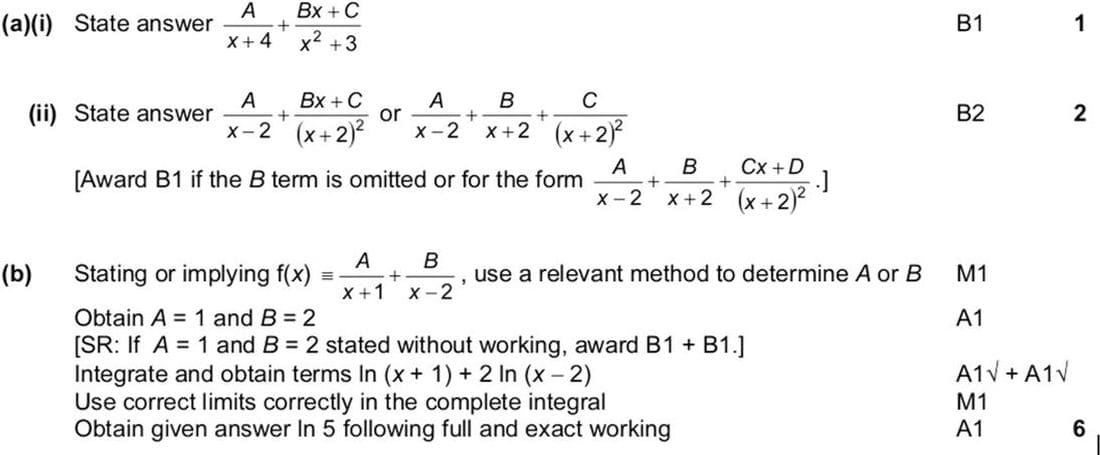
(a) Without evaluating any constants, state appropriate forms for expressing the following in partial fractions:
(i) \(\frac{4x}{(x+4)(x^2+3)}\)
(ii) \(\frac{2x+1}{(x-2)(x+2)^2}\)
(b) Show that \(\int_3^4 \frac{3x}{(x+1)(x-2)} \, dx = \ln 5\).
June 2002 p3 q6
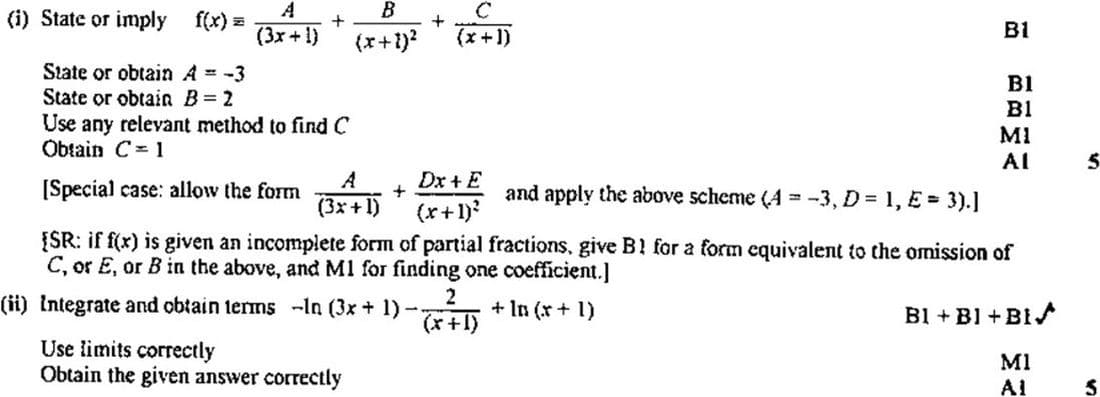
Let \(f(x) = \frac{4x}{(3x+1)(x+1)^2}\).
(i) Express \(f(x)\) in partial fractions.
(ii) Hence show that \(\int_0^1 f(x) \, dx = 1 - \ln 2\).
Feb/Mar 2023 p32 q11
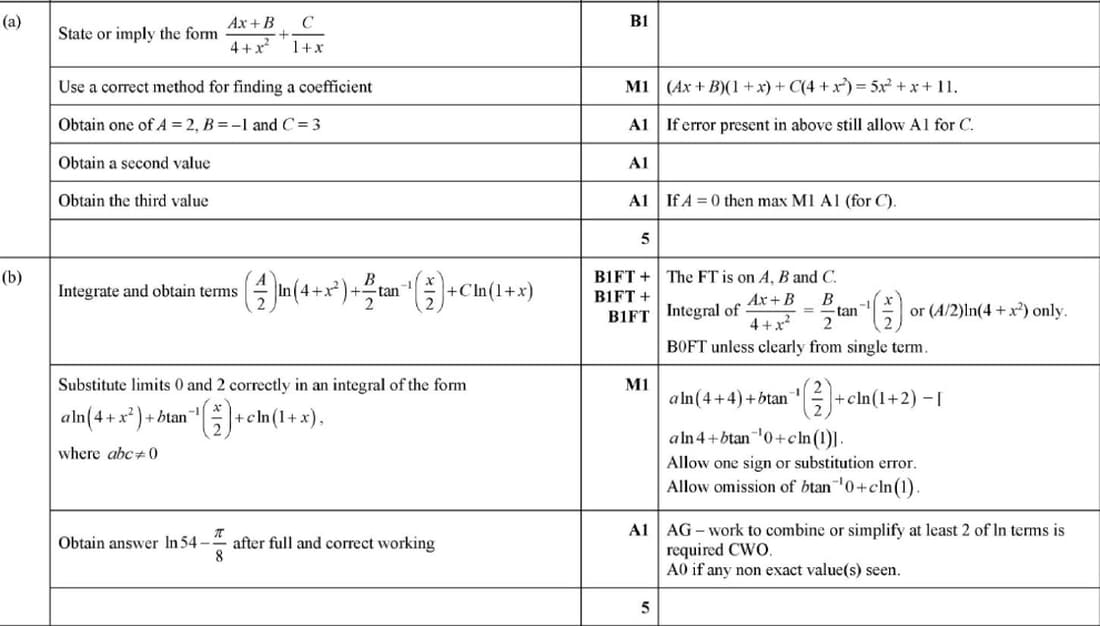
Let \(f(x) = \frac{5x^2 + x + 11}{(4 + x^2)(1 + x)}\).
(a) Express \(f(x)\) in partial fractions.
(b) Hence show that \(\int_0^2 f(x) \, dx = \ln 54 - \frac{1}{8}\pi\).
Nov 2022 p33 q11
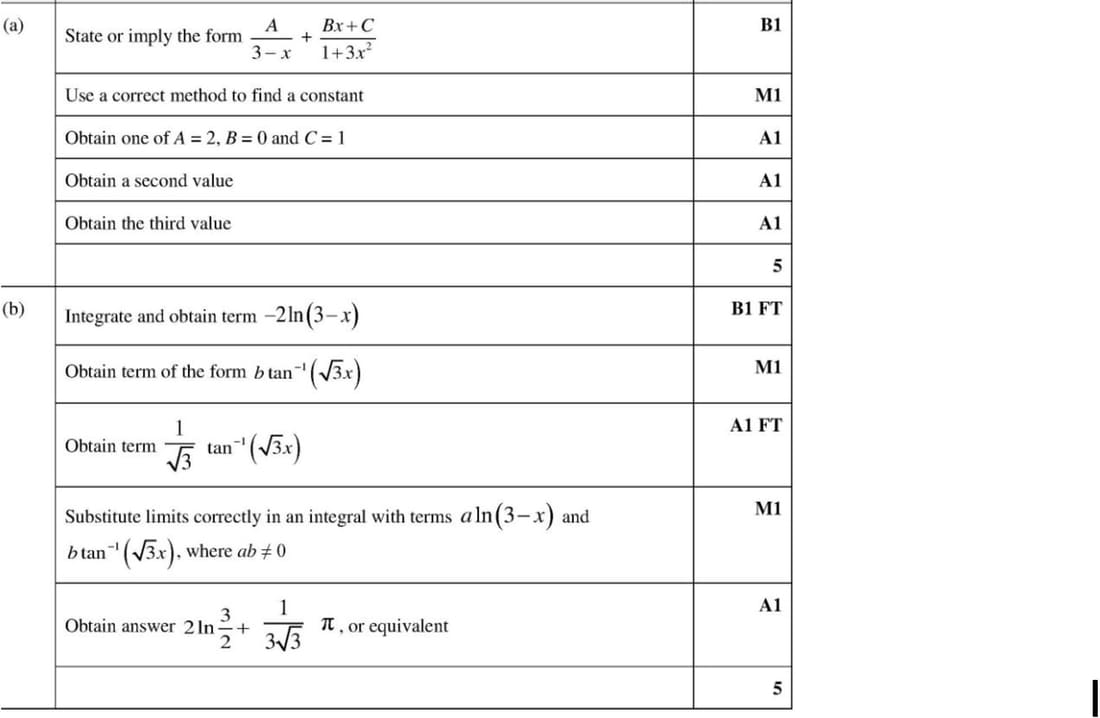
Let \(f(x) = \frac{5-x+6x^2}{(3-x)(1+3x^2)}\).
(a) Express \(f(x)\) in partial fractions.
(b) Find the exact value of \(\int_0^1 f(x) \, dx\), simplifying your answer.