Exam-Style Problems
⬅ Back to SubchapterNov 2009 p31 q9
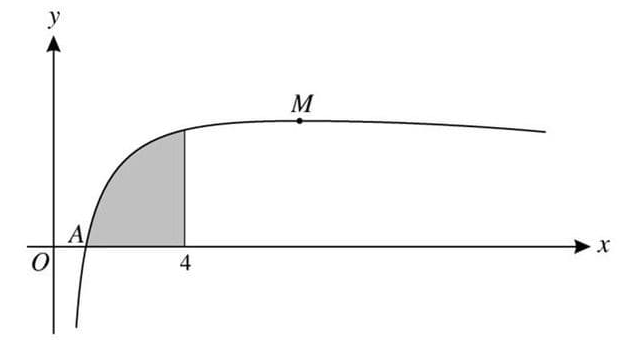
The diagram shows the curve \(y = \frac{\ln x}{\sqrt{x}}\) and its maximum point \(M\). The curve cuts the \(x\)-axis at the point \(A\).
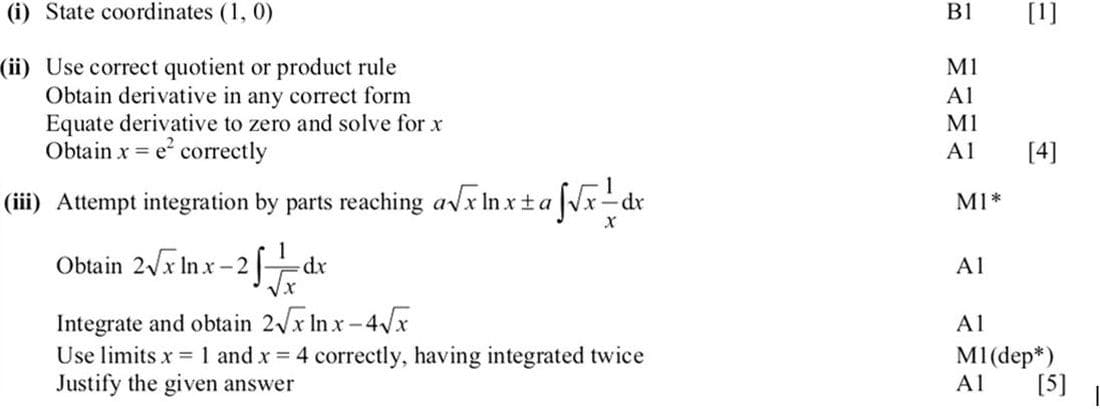
(i) State the coordinates of \(A\).
(ii) Find the exact value of the \(x\)-coordinate of \(M\).
(iii) Using integration by parts, show that the area of the shaded region bounded by the curve, the \(x\)-axis and the line \(x = 4\) is equal to \(8 \ln 2 - 4\).
June 2006 p3 q8
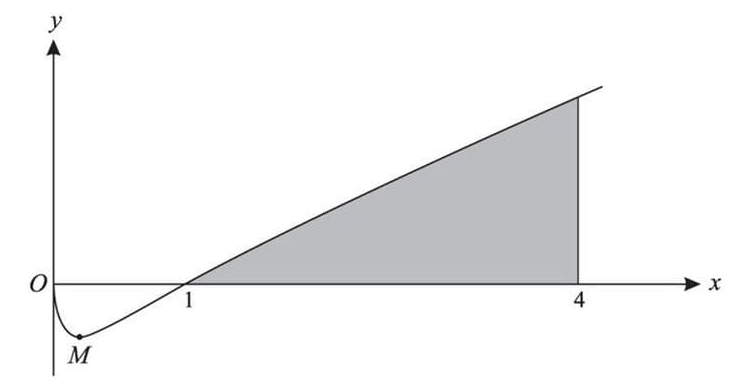
The diagram shows a sketch of the curve \(y = x^{\frac{1}{2}} \ln x\) and its minimum point \(M\). The curve cuts the \(x\)-axis at the point \((1, 0)\).
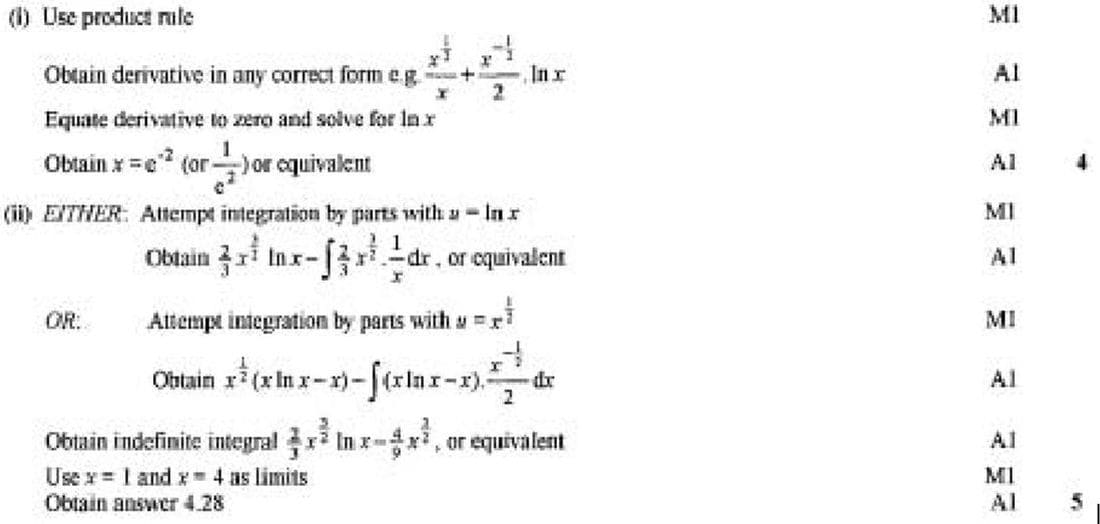
(i) Find the exact value of the \(x\)-coordinate of \(M\).
(ii) Use integration by parts to find the area of the shaded region enclosed by the curve, the \(x\)-axis and the line \(x = 4\). Give your answer correct to 2 decimal places.
Nov 2004 p3 q7
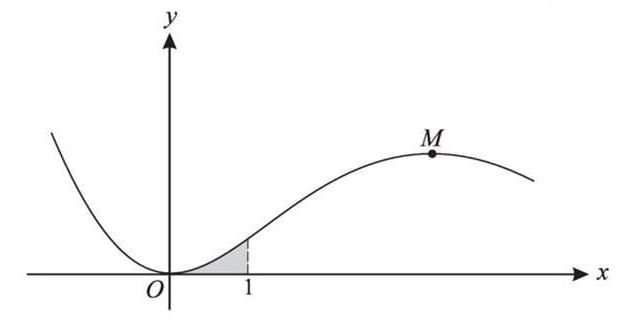
The diagram shows the curve \(y = x^2 e^{-\frac{1}{2}x}\).
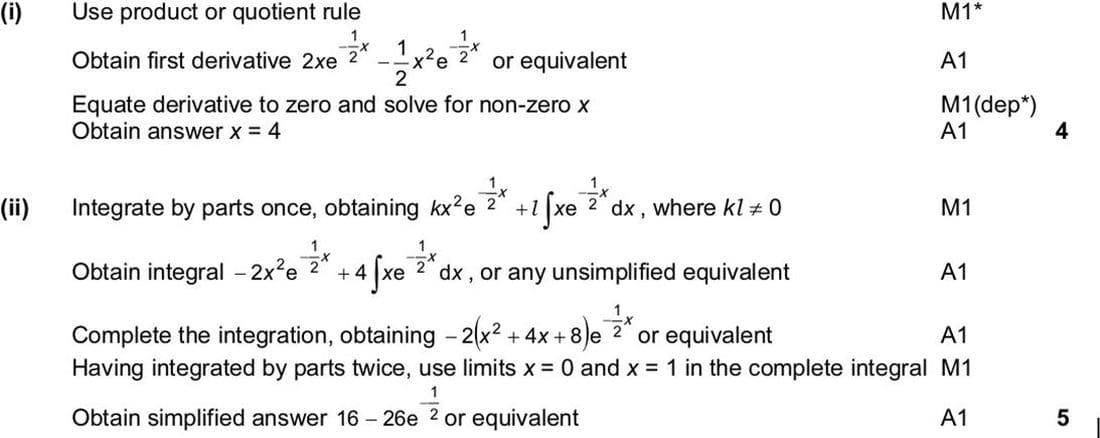
(i) Find the \(x\)-coordinate of \(M\), the maximum point of the curve.
(ii) Find the area of the shaded region enclosed by the curve, the \(x\)-axis and the line \(x = 1\), giving your answer in terms of \(e\).
June 2004 p3 q10
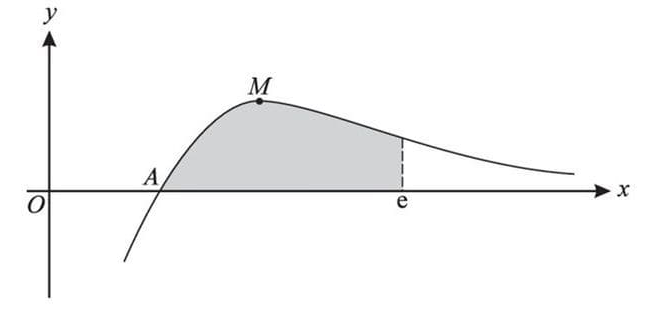
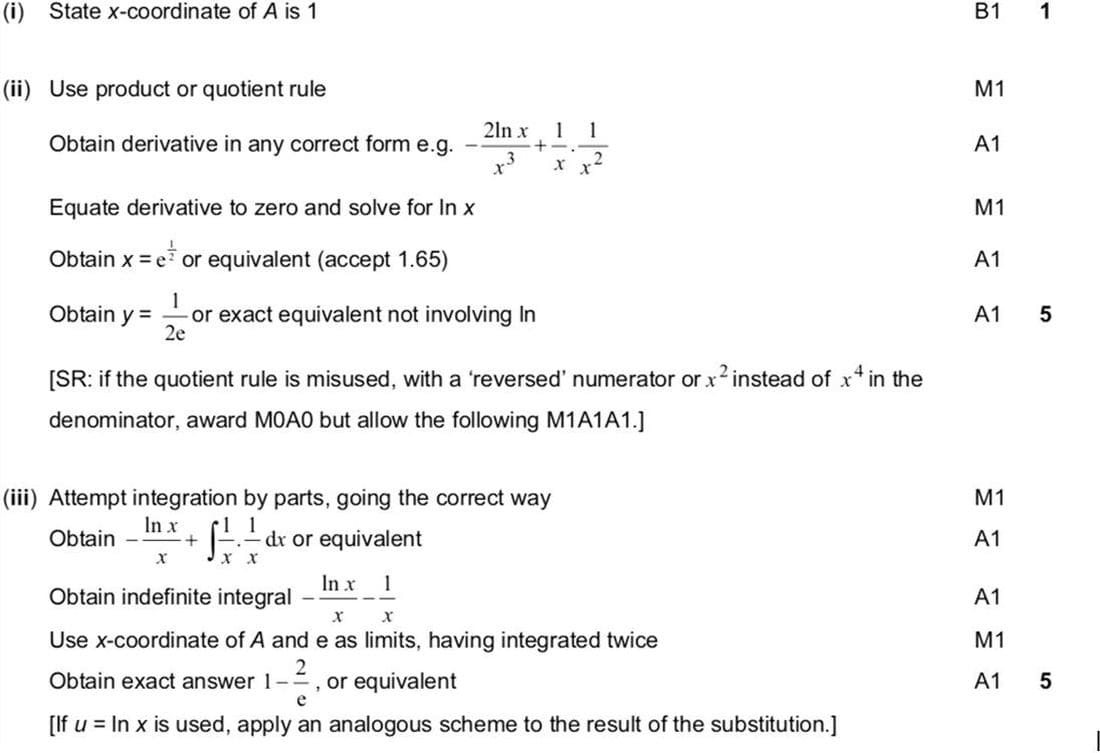
The diagram shows the curve \(y = \frac{\ln x}{x^2}\) and its maximum point \(M\). The curve cuts the \(x\)-axis at \(A\).
(i) Write down the \(x\)-coordinate of \(A\).
(ii) Find the exact coordinates of \(M\).
(iii) Use integration by parts to find the exact area of the shaded region enclosed by the curve, the \(x\)-axis and the line \(x = e\).
Nov 2003 p3 q6
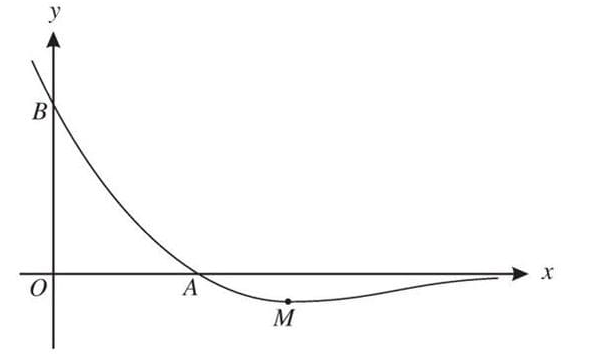
The diagram shows the curve \(y = (3 - x)e^{-2x}\) and its minimum point \(M\). The curve intersects the x-axis at \(A\) and the y-axis at \(B\).
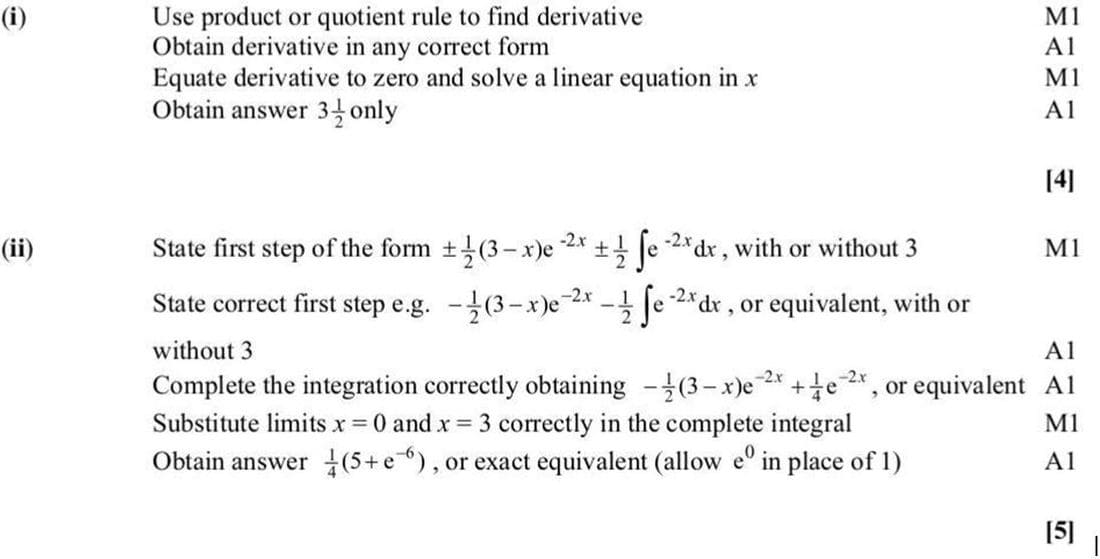
(i) Calculate the x-coordinate of \(M\).
(ii) Find the area of the region bounded by \(OA, OB\) and the curve, giving your answer in terms of \(e\).