Exam-Style Problems
⬅ Back to SubchapterJune 2010 p32 q5
1437
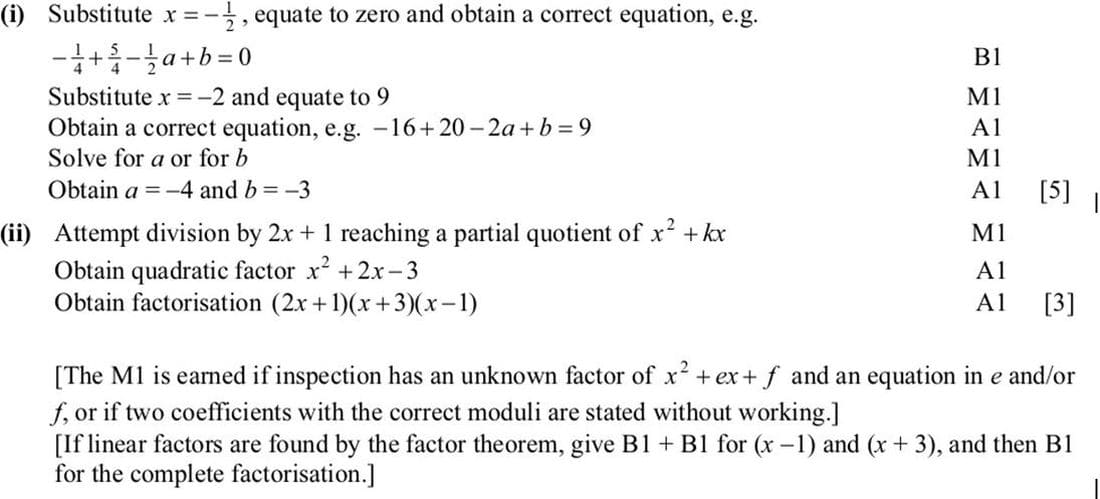
The polynomial \(2x^3 + 5x^2 + ax + b\), where \(a\) and \(b\) are constants, is denoted by \(p(x)\). It is given that \((2x + 1)\) is a factor of \(p(x)\) and that when \(p(x)\) is divided by \((x + 2)\) the remainder is 9.
(i) Find the values of \(a\) and \(b\).
(ii) When \(a\) and \(b\) have these values, factorise \(p(x)\) completely.
Nov 2008 p3 q5
1438
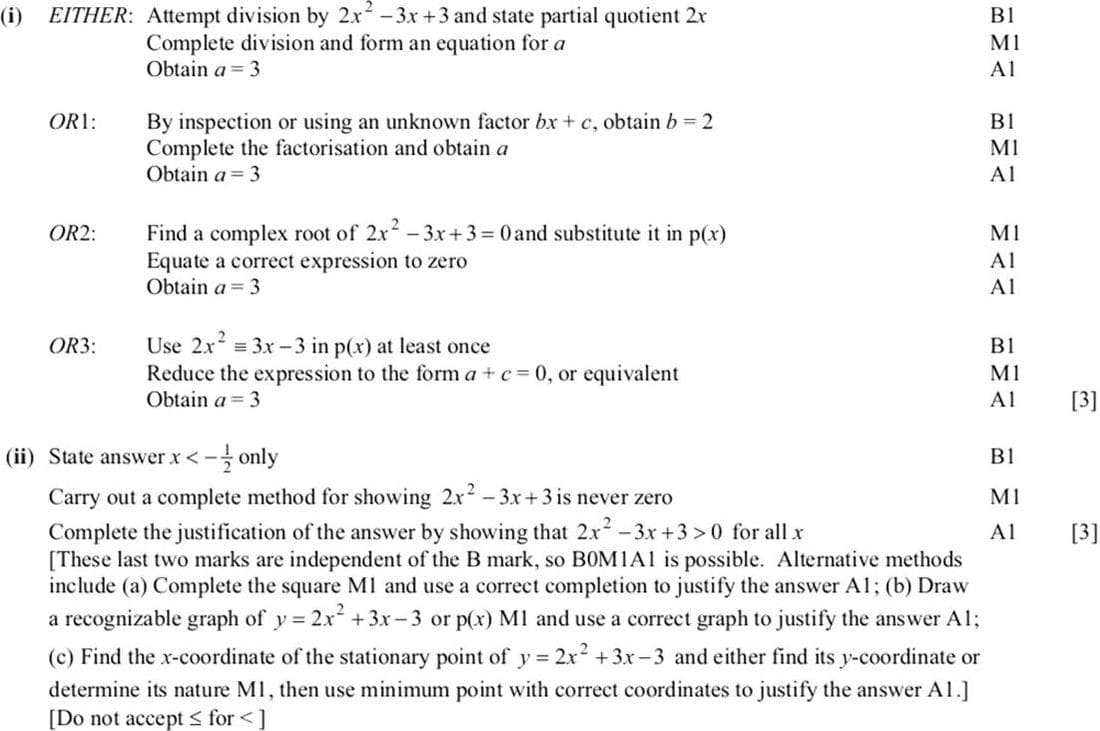
The polynomial \(4x^3 - 4x^2 + 3x + a\), where \(a\) is a constant, is denoted by \(p(x)\). It is given that \(p(x)\) is divisible by \(2x^2 - 3x + 3\).
(i) Find the value of \(a\).
(ii) When \(a\) has this value, solve the inequality \(p(x) < 0\), justifying your answer.
Nov 2007 p3 q2
1439
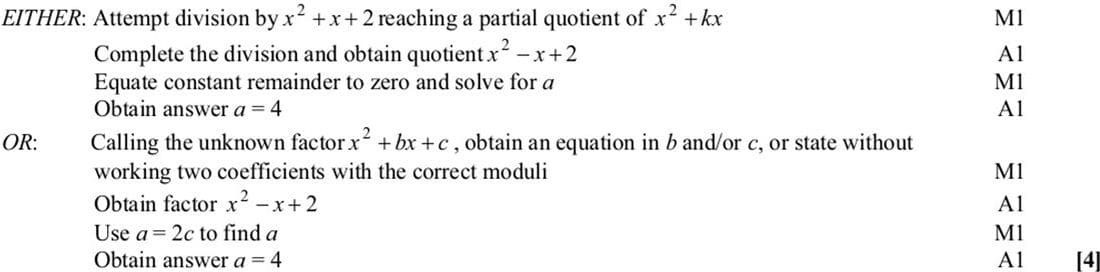
The polynomial \(x^4 + 3x^2 + a\), where \(a\) is a constant, is denoted by \(p(x)\). It is given that \(x^2 + x + 2\) is a factor of \(p(x)\). Find the value of \(a\) and the other quadratic factor of \(p(x)\).
June 2007 p3 q2
1440
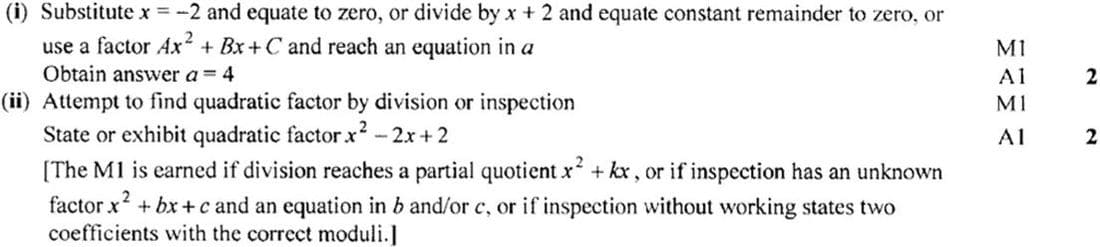
The polynomial \(x^3 - 2x + a\), where \(a\) is a constant, is denoted by \(p(x)\). It is given that \((x + 2)\) is a factor of \(p(x)\).
(i) Find the value of \(a\).
(ii) When \(a\) has this value, find the quadratic factor of \(p(x)\).
June 2005 p3 q5
1441
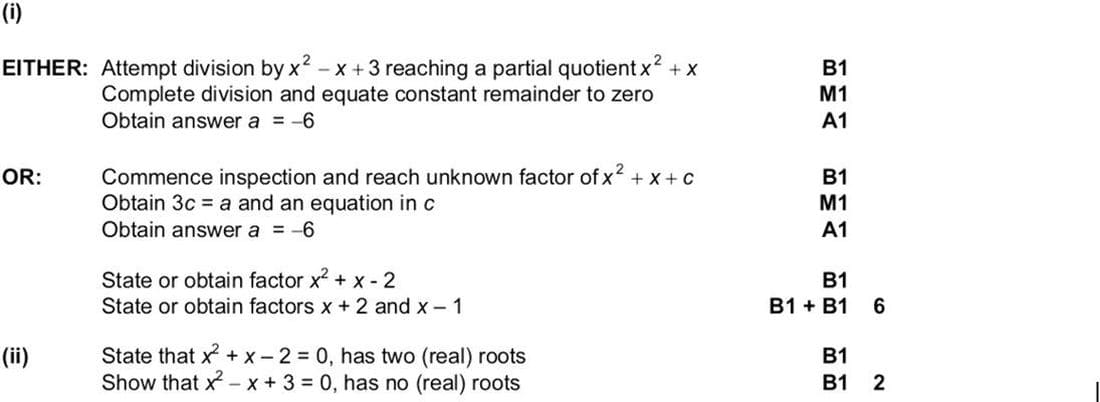
The polynomial \(x^4 + 5x + a\) is denoted by \(p(x)\). It is given that \(x^2 - x + 3\) is a factor of \(p(x)\).
(i) Find the value of \(a\) and factorise \(p(x)\) completely.
(ii) Hence state the number of real roots of the equation \(p(x) = 0\), justifying your answer.