Exam-Style Problems
⬅ Back to Subchapter
Browsing as Guest. Progress, bookmarks and attempts are disabled.
Log in to track your work.
Nov 2012 p31 q1
1475
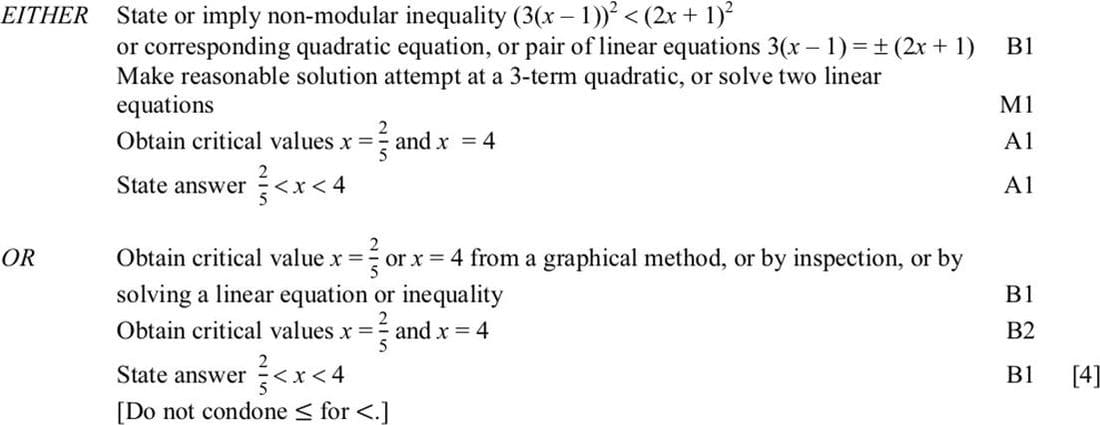
Find the set of values of x satisfying the inequality:
\(3|x - 1| < |2x + 1|\)
Log in to record attempts.
June 2011 p32 q1
1476
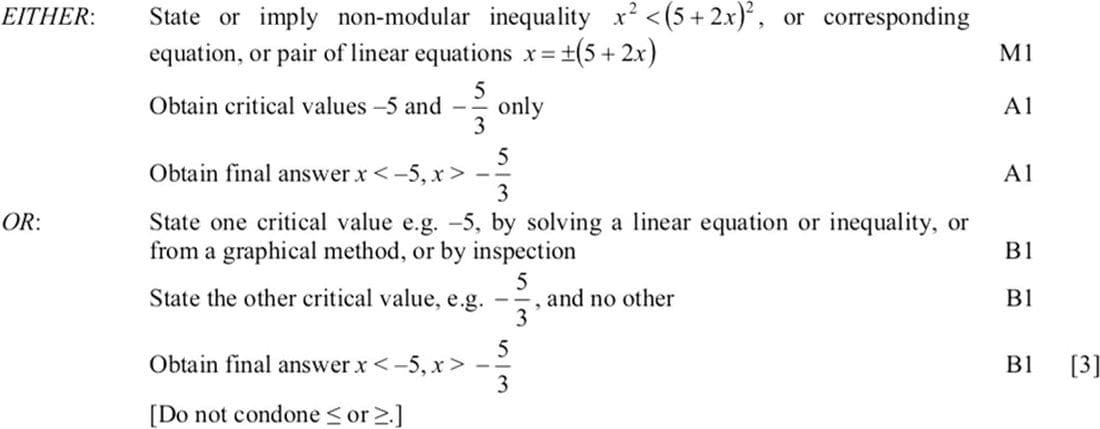
Solve the inequality: \(|x| < |5 + 2x|\)
Log in to record attempts.
Nov 2010 p31 q1
1477
Solve the inequality: \(2|x - 3| > |3x + 1|\)

Log in to record attempts.
June 2010 p33 q1
1478
Solve the inequality: \(|x - 3| > 2|x + 1|\)

Log in to record attempts.
June 2010 p31 q1
1479
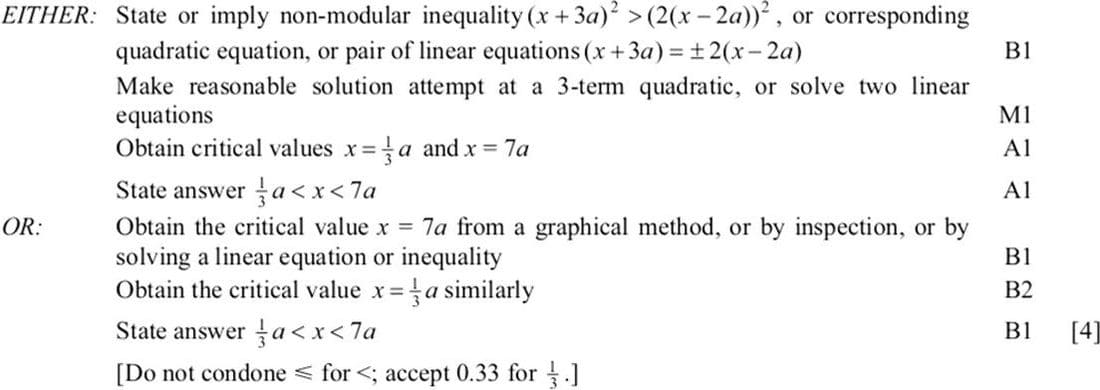
Solve the inequality: \(|x + 3a| > 2|x - 2a|\), where \(a\) is a positive constant.
Log in to record attempts.