Exam-Style Problems
⬅ Back to SubchapterNov 2011 p13 q10
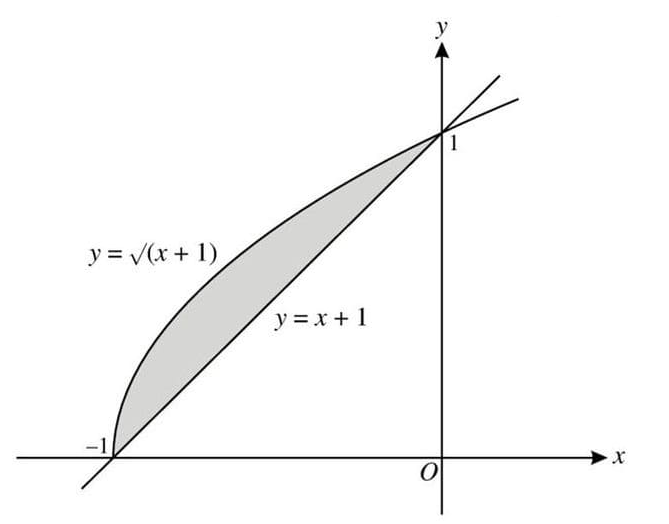
The diagram shows the line \(y = x + 1\) and the curve \(y = \sqrt{(x+1)}\), meeting at \((-1, 0)\) and \((0, 1)\).
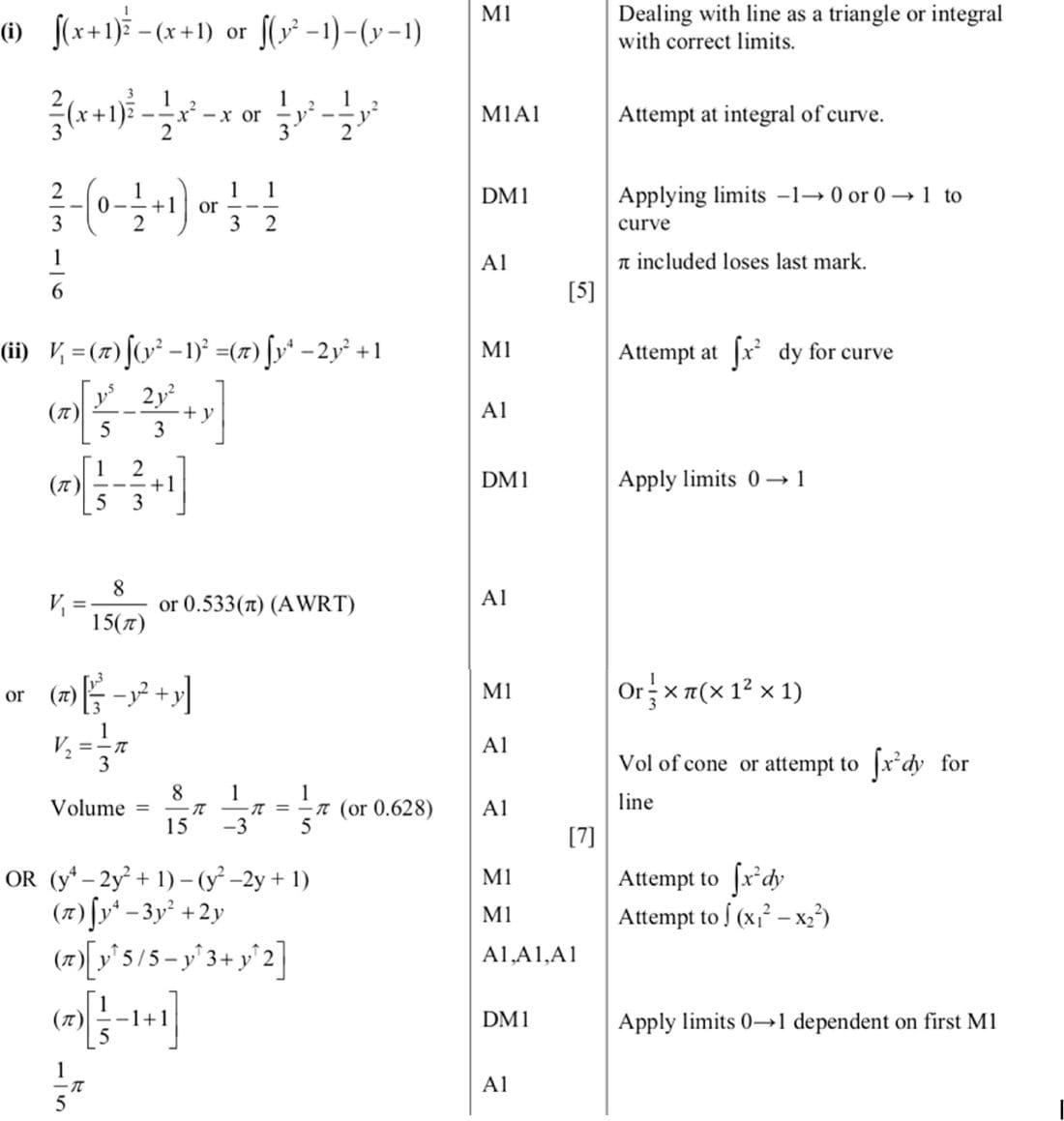
(i) Find the area of the shaded region.
(ii) Find the volume obtained when the shaded region is rotated through 360° about the y-axis.
Nov 2011 p12 q8
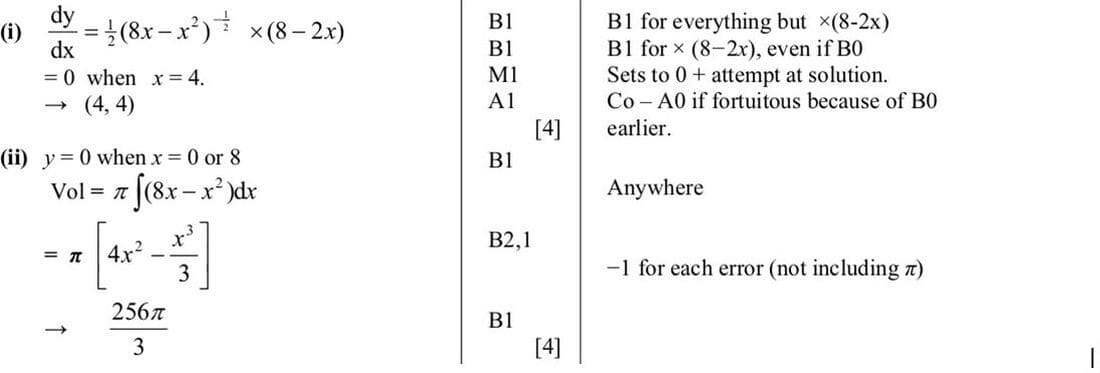
The equation of a curve is \(y = \sqrt{(8x - x^2)}\). Find
- an expression for \(\frac{dy}{dx}\), and the coordinates of the stationary point on the curve,
- the volume obtained when the region bounded by the curve and the x-axis is rotated through 360° about the x-axis.
Nov 2011 p11 q10
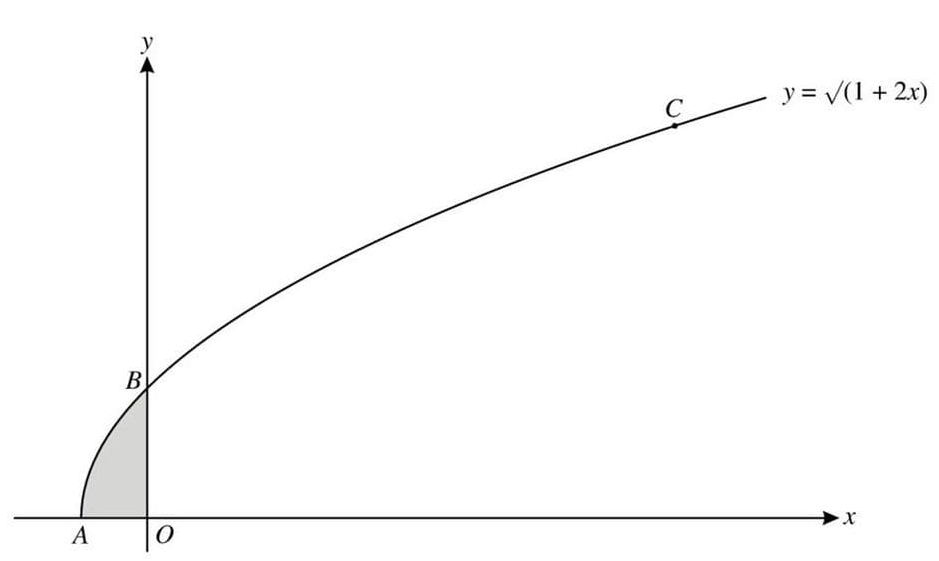
The diagram shows the curve \(y = \sqrt{1 + 2x}\) meeting the \(x\)-axis at \(A\) and the \(y\)-axis at \(B\). The \(y\)-coordinate of the point \(C\) on the curve is 3.
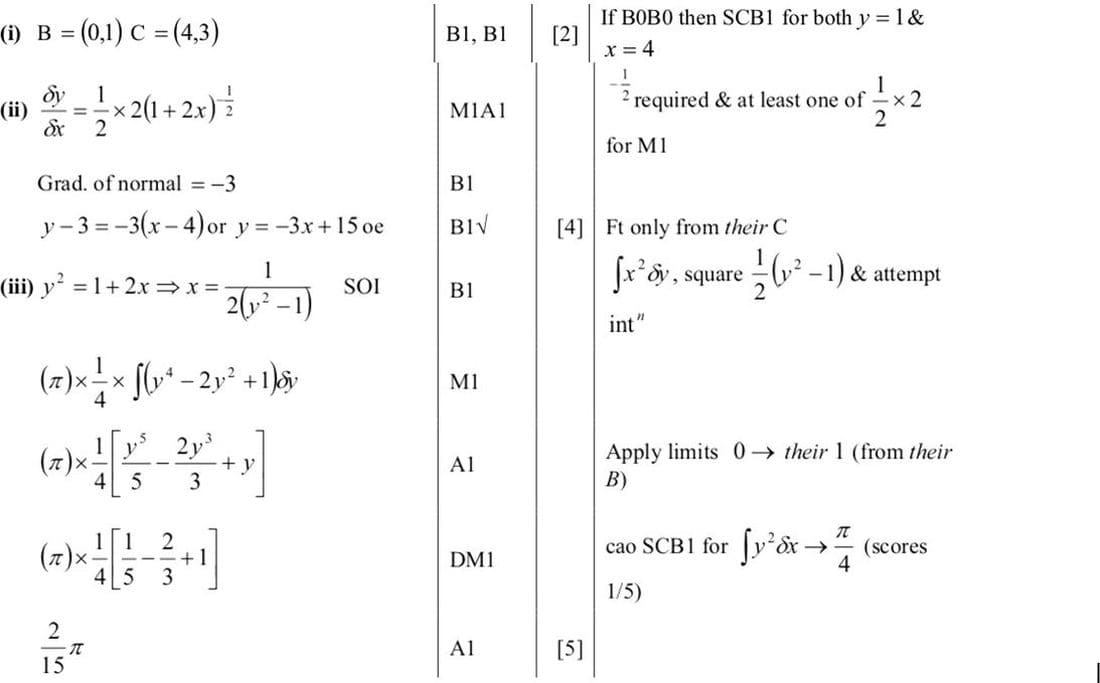
- Find the coordinates of \(B\) and \(C\).
- Find the equation of the normal to the curve at \(C\).
- Find the volume obtained when the shaded region is rotated through 360° about the \(y\)-axis.
June 2011 p12 q11
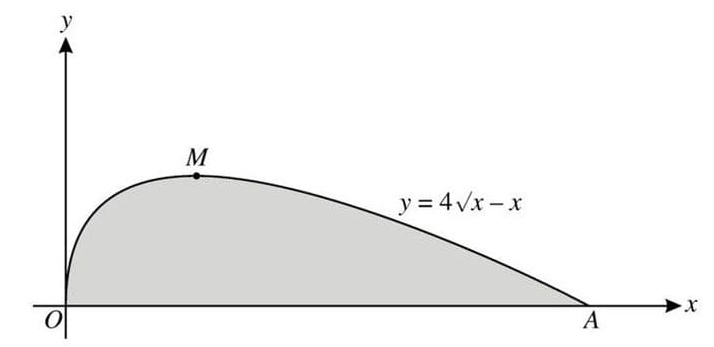
The diagram shows part of the curve \(y = 4\sqrt{x} - x\). The curve has a maximum point at \(M\) and meets the \(x\)-axis at \(O\) and \(A\).
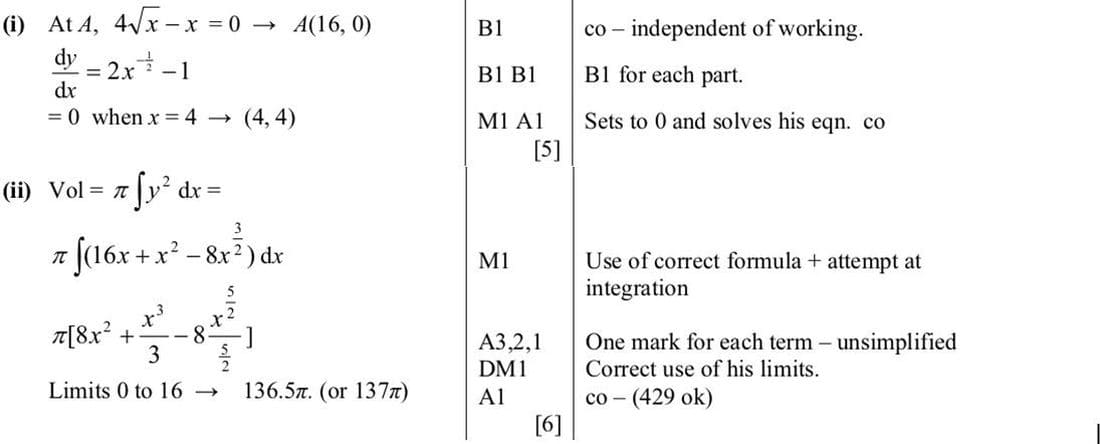
(i) Find the coordinates of \(A\) and \(M\).
(ii) Find the volume obtained when the shaded region is rotated through 360° about the \(x\)-axis, giving your answer in terms of \(\pi\).
June 2011 p11 q3
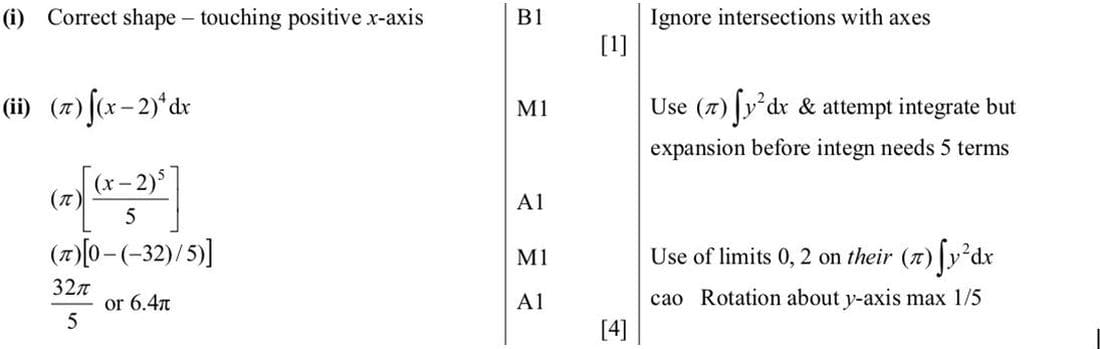
(i) Sketch the curve \(y = (x - 2)^2\).
(ii) The region enclosed by the curve, the \(x\)-axis and the \(y\)-axis is rotated through \(360^\circ\) about the \(x\)-axis. Find the volume obtained, giving your answer in terms of \(\pi\).