Exam-Style Problems
⬅ Back to SubchapterNov 2015 p13 q10
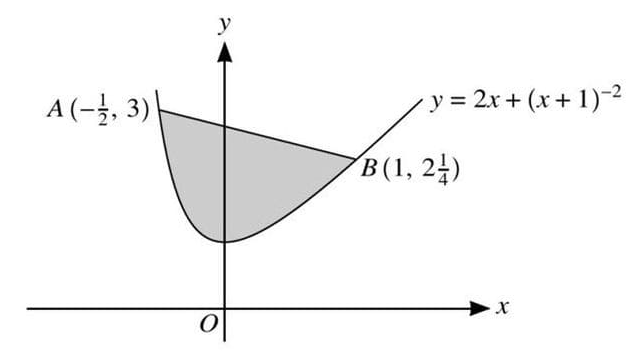
The points \(A\left(-\frac{1}{2}, 3\right)\) and \(B\left(1, 2\frac{1}{4}\right)\) lie on the curve \(y = 2x + (x+1)^{-2}\), as shown in the diagram.
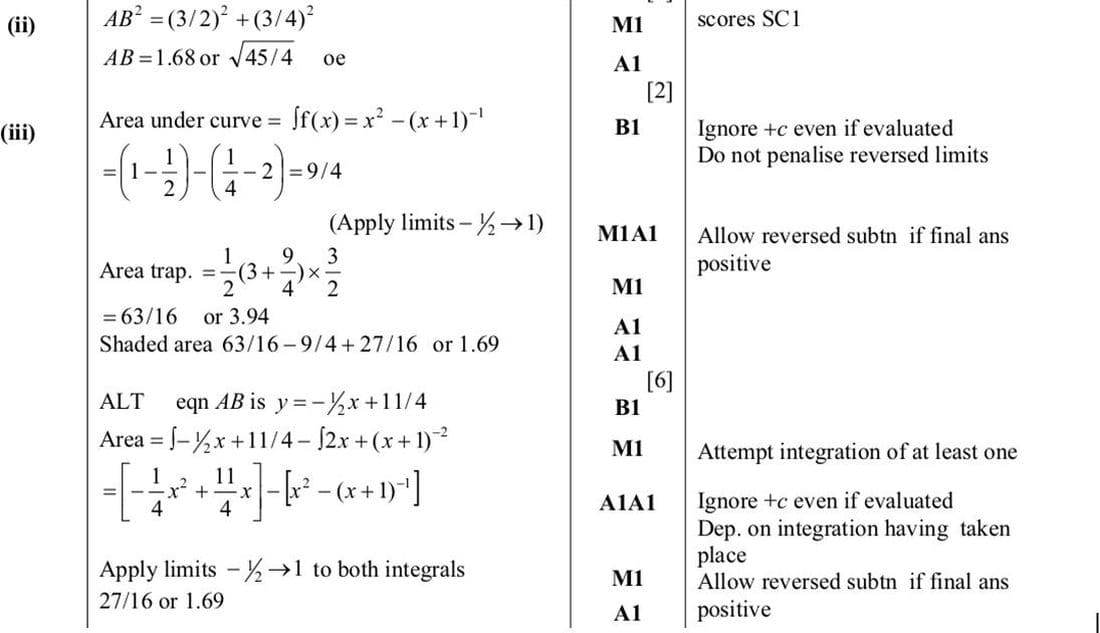
(ii) Find the distance \(AB\).
(iii) Find, showing all necessary working, the area of the shaded region.
June 2015 p13 q10
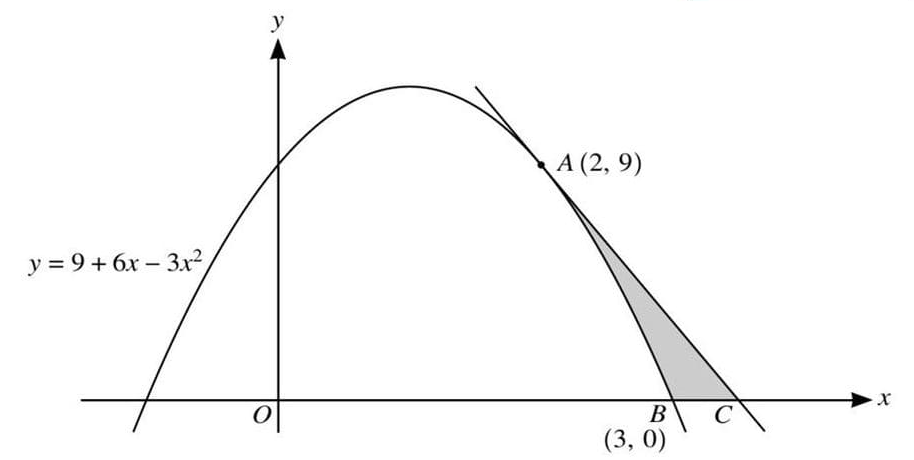
Points A (2, 9) and B (3, 0) lie on the curve \(y = 9 + 6x - 3x^2\), as shown in the diagram. The tangent at A intersects the x-axis at C. Showing all necessary working,
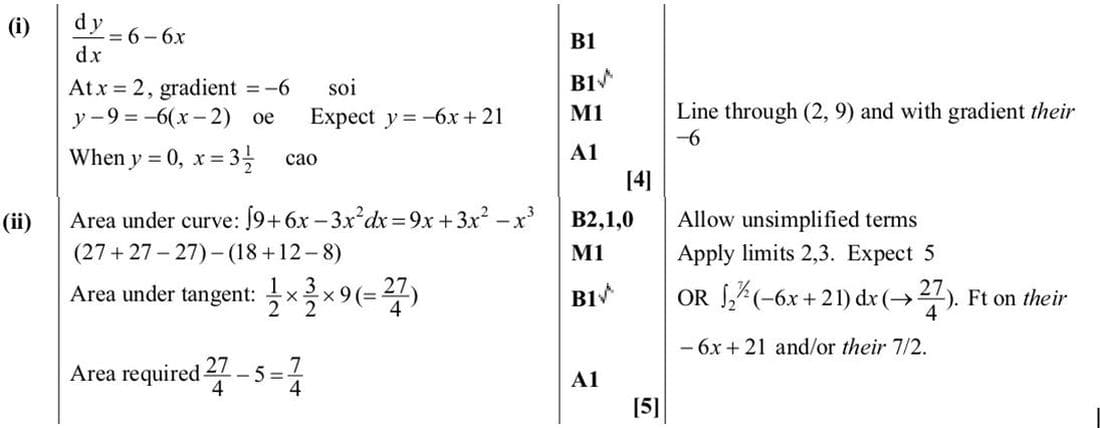
(i) find the equation of the tangent AC and hence find the x-coordinate of C,
(ii) find the area of the shaded region ABC.
June 2015 p11 q10
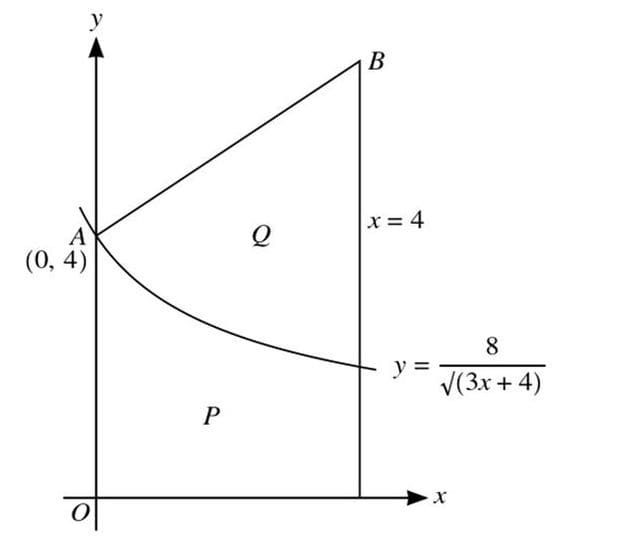
The diagram shows part of the curve \(y = \frac{8}{\sqrt{3x+4}}\). The curve intersects the y-axis at \(A (0, 4)\). The normal to the curve at \(A\) intersects the line \(x = 4\) at the point \(B\).
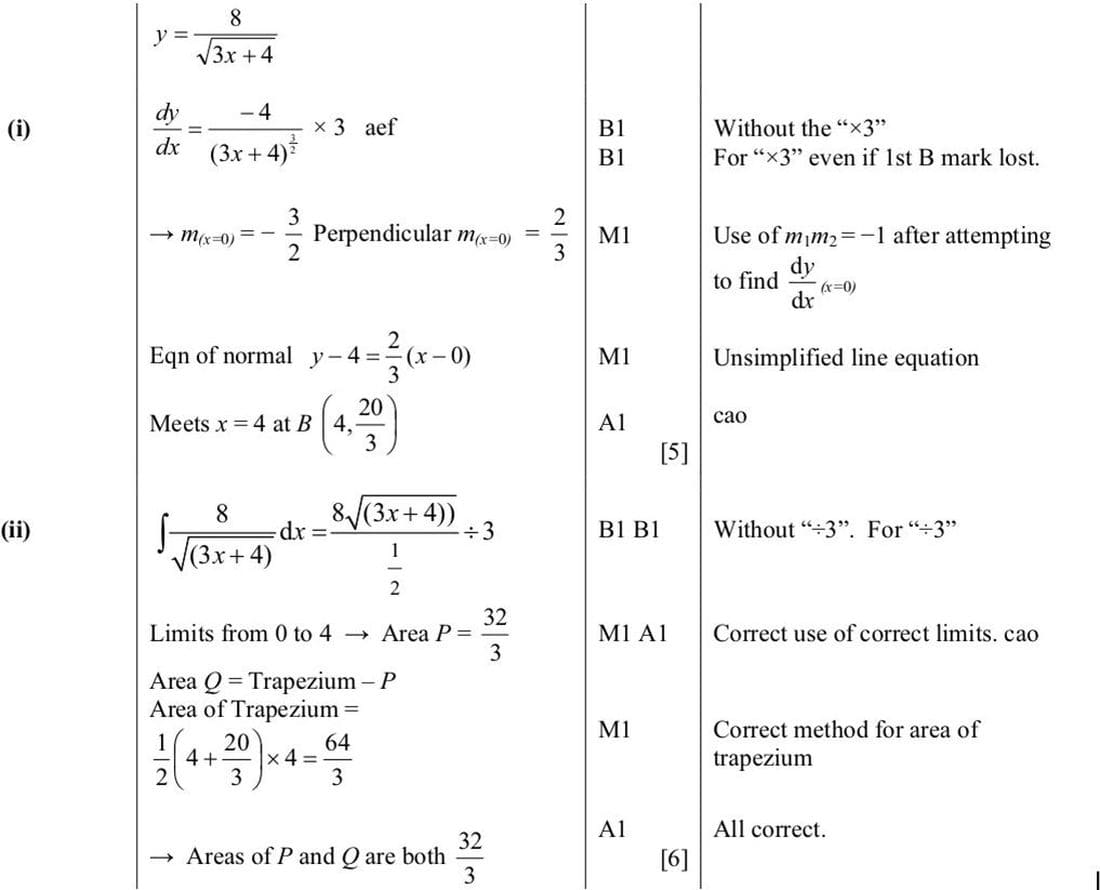
(i) Find the coordinates of \(B\).
(ii) Show, with all necessary working, that the areas of the regions marked \(P\) and \(Q\) are equal.
Nov 2014 p13 q9
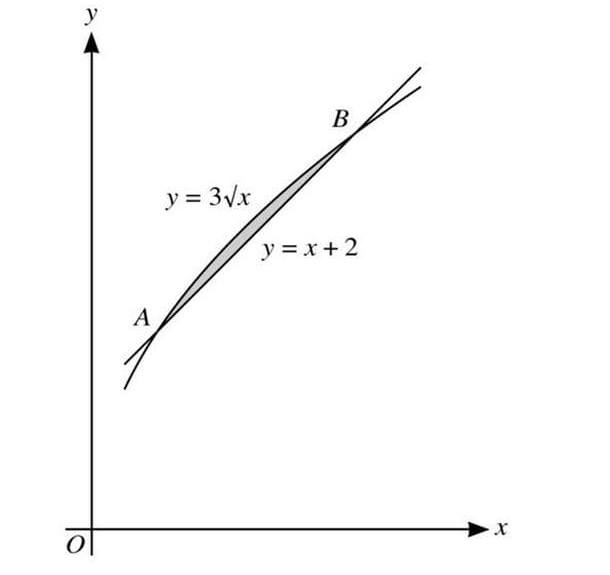
The diagram shows parts of the graphs of \(y = x + 2\) and \(y = 3\sqrt{x}\) intersecting at points \(A\) and \(B\).
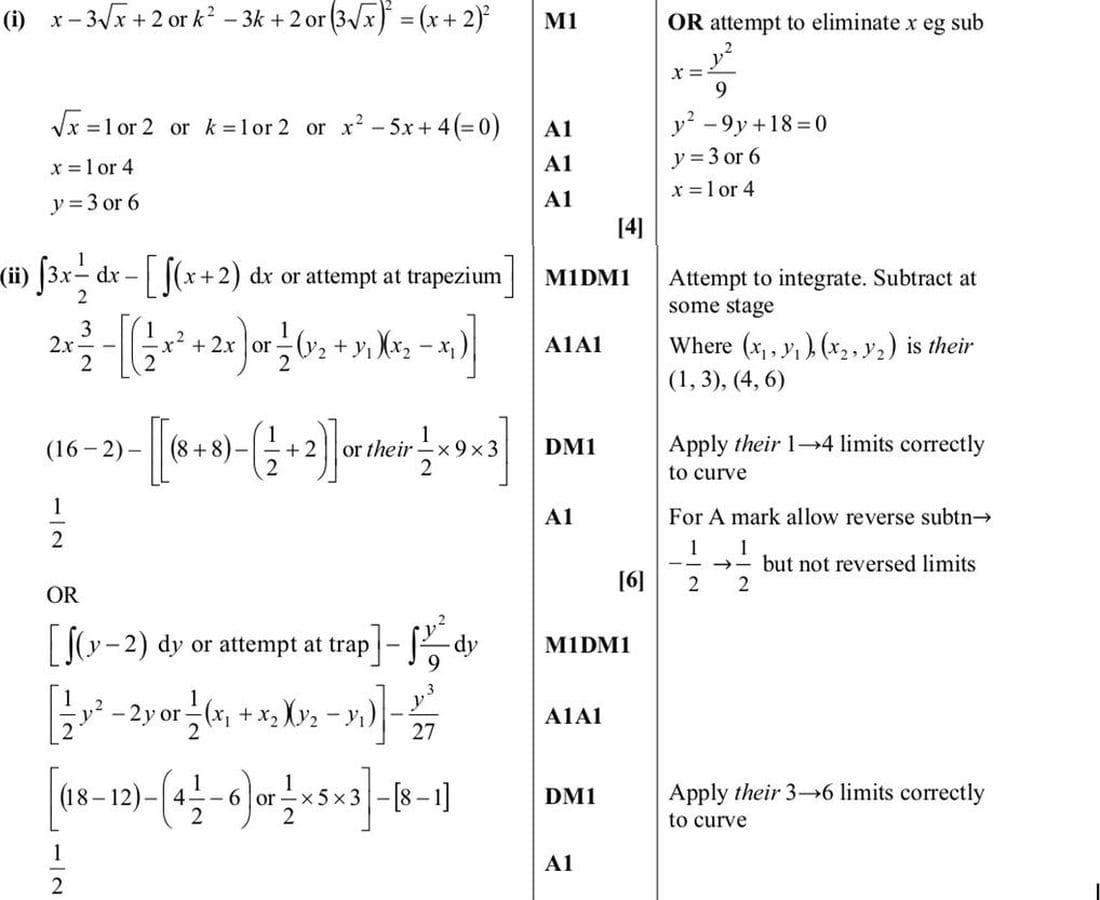
- Write down an equation satisfied by the x-coordinates of \(A\) and \(B\). Solve this equation and hence find the coordinates of \(A\) and \(B\). [4]
- Find by integration the area of the shaded region. [6]
Nov 2014 p11 q11
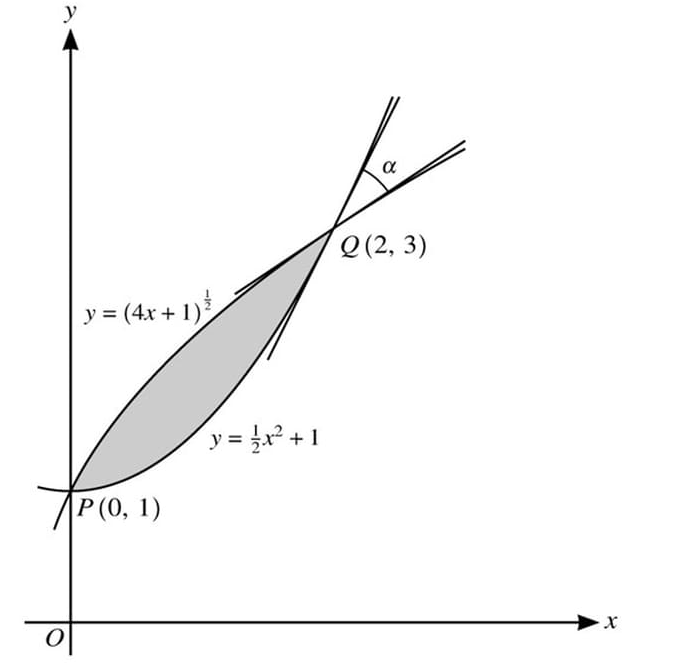
The diagram shows parts of the curves \(y = (4x + 1)^{\frac{1}{2}}\) and \(y = \frac{1}{2}x^2 + 1\) intersecting at points \(P(0, 1)\) and \(Q(2, 3)\). The angle between the tangents to the two curves at \(Q\) is \(\alpha\).
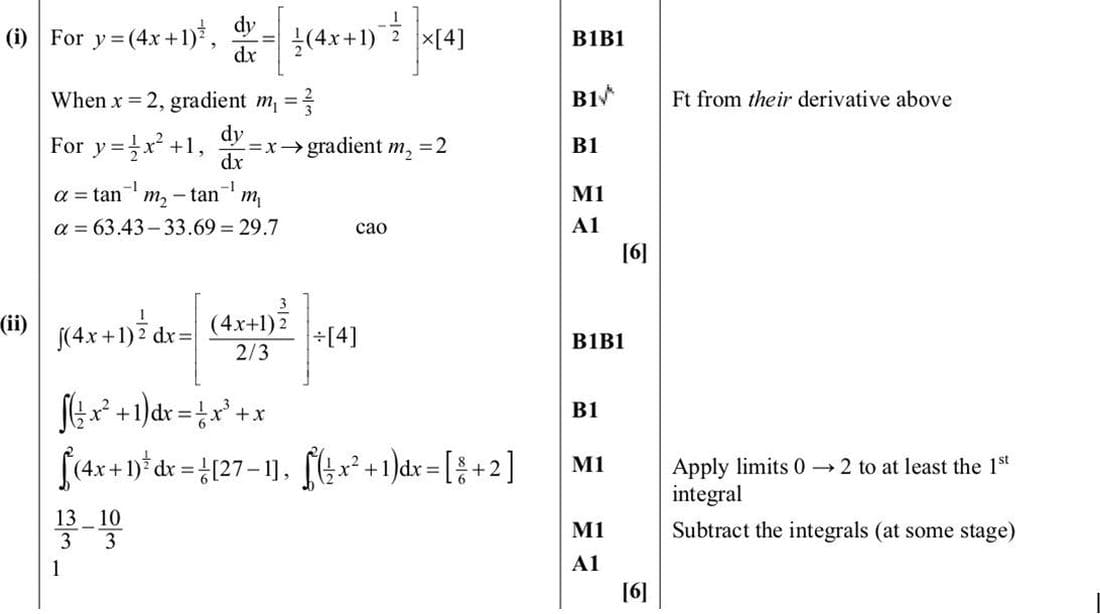
(i) Find \(\alpha\), giving your answer in degrees correct to 3 significant figures.
(ii) Find by integration the area of the shaded region.