Exam-Style Problems
⬅ Back to SubchapterJune 2012 p11 q4
1124
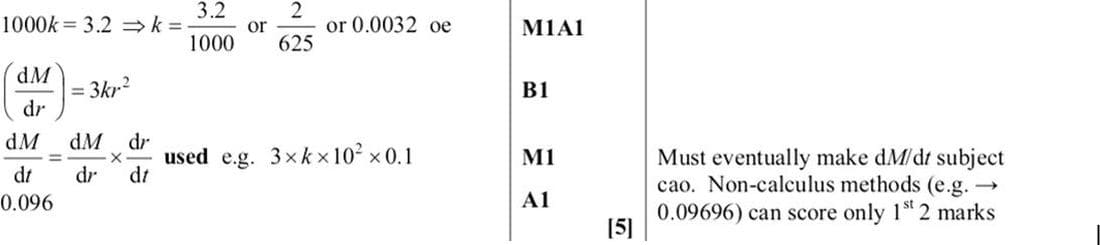
A watermelon is assumed to be spherical in shape while it is growing. Its mass, \(M\) kg, and radius, \(r\) cm, are related by the formula \(M = kr^3\), where \(k\) is a constant. It is also assumed that the radius is increasing at a constant rate of 0.1 centimetres per day. On a particular day the radius is 10 cm and the mass is 3.2 kg. Find the value of \(k\) and the rate at which the mass is increasing on this day.
June 2011 p11 q2
1125
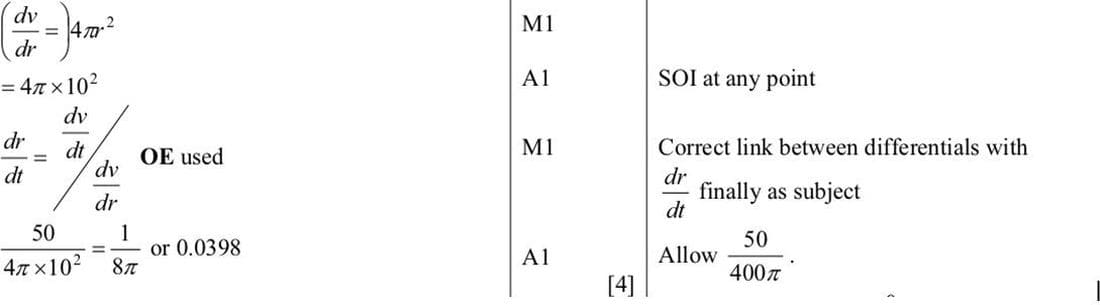
The volume of a spherical balloon is increasing at a constant rate of 50 cm3 per second. Find the rate of increase of the radius when the radius is 10 cm. [Volume of a sphere = \(\frac{4}{3}\pi r^3\).]
Nov 2010 p12 q3
1126
The length, x metres, of a Green Anaconda snake which is t years old is given approximately by the formula
\(x = 0.7 \sqrt{(2t - 1)}\),
where \(1 \leq t \leq 10\). Using this formula, find
(i) \(\frac{dx}{dt}\),
(ii) the rate of growth of a Green Anaconda snake which is 5 years old.

Nov 2009 p11 q7
1127
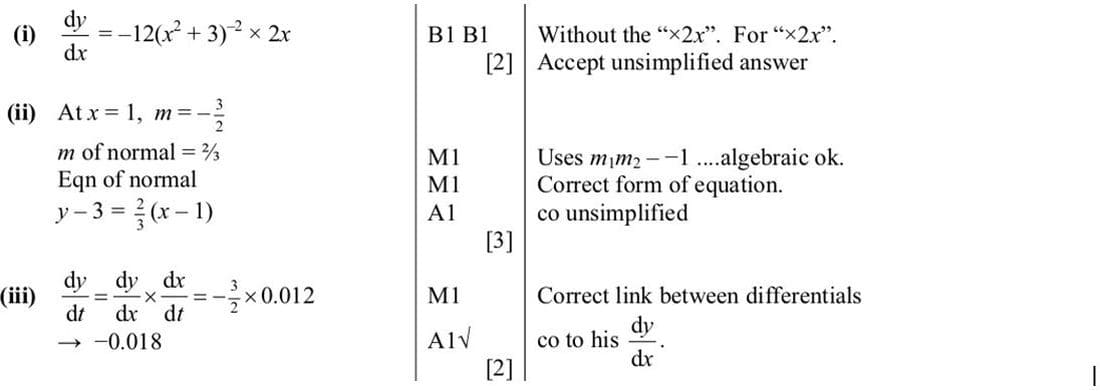
The equation of a curve is \(y = \frac{12}{x^2 + 3}\).
(i) Obtain an expression for \(\frac{dy}{dx}\).
(ii) Find the equation of the normal to the curve at the point \(P(1, 3)\).
(iii) A point is moving along the curve in such a way that the \(x\)-coordinate is increasing at a constant rate of 0.012 units per second. Find the rate of change of the \(y\)-coordinate as the point passes through \(P\).
Nov 2006 p1 q8
1128
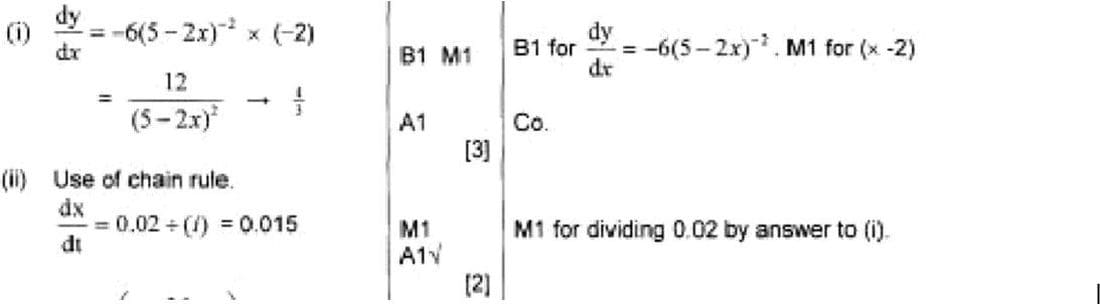
The equation of a curve is \(y = \frac{6}{5 - 2x}\).
(i) Calculate the gradient of the curve at the point where \(x = 1\).
(ii) A point with coordinates \((x, y)\) moves along the curve in such a way that the rate of increase of \(y\) has a constant value of 0.02 units per second. Find the rate of increase of \(x\) when \(x = 1\).