Exam-Style Problems
⬅ Back to SubchapterNov 2012 p13 q8
A curve is such that \(\frac{dy}{dx} = 2(3x + 4)^{\frac{3}{2}} - 6x - 8\).
(i) Find \(\frac{d^2y}{dx^2}\).
(ii) Verify that the curve has a stationary point when \(x = -1\) and determine its nature.

Nov 2012 p11 q5
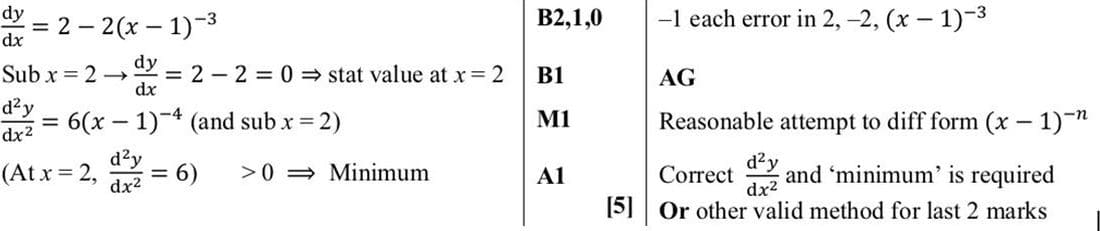
A curve has equation \(y = 2x + \frac{1}{(x-1)^2}\). Verify that the curve has a stationary point at \(x = 2\) and determine its nature.
June 2012 p11 q10
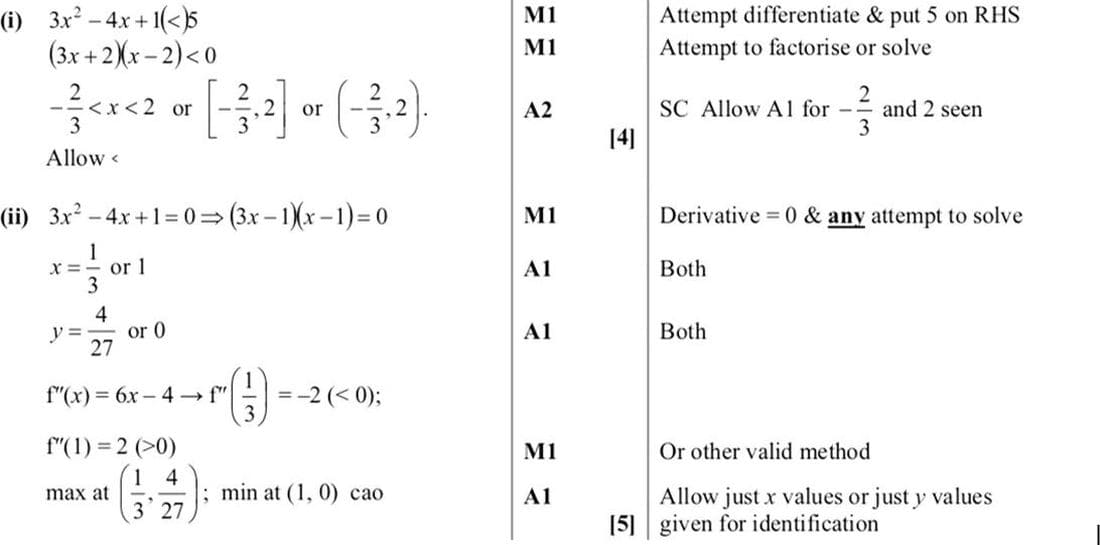
It is given that a curve has equation \(y = f(x)\), where \(f(x) = x^3 - 2x^2 + x\).
(i) Find the set of values of \(x\) for which the gradient of the curve is less than 5.
(ii) Find the values of \(f(x)\) at the two stationary points on the curve and determine the nature of each stationary point.
Nov 2011 p11 q2
A curve has equation \(y = 3x^3 - 6x^2 + 4x + 2\). Show that the gradient of the curve is never negative.

June 2011 p13 q10
Function g is defined by
\(g : x \mapsto 2(x-1)^3 + 8, \quad x > 1\).
Obtain an expression for \(g'(x)\) and use your answer to explain why \(g\) has an inverse.
